



How a personal fertility experience inspired Veena Reddy to launch Oval Fertility
Oval Fertility, founded by fertility expert Dr Brian Levine and entrepreneur Veena Reddy, is bringing advanced reproductive technologies and a patient-centred approach to fertility care in Hyderabad.



Veena Reddy’s personal experience with fertility treatment left her acutely aware that the journey is as emotional as it is medical.
“I came away with a much deeper appreciation for how emotional the process can be. Even when you are receiving excellent care, there are moments of anticipation, uncertainty, hope, and anxiety. You spend a lot of time thinking about possibilities and outcomes. My journey was ultimately a successful one, thanks to Brian (fertility expert Dr Brian Levine),” she tells HerStory.

Veena Reddy and Dr Brian Levine
Supported by Dr Levine, Reddy began thinking about how they could build a fertility clinic that combines world-class medical expertise with a patient experience that feels supportive, transparent, and human.
A double board-certified reproductive endocrinologist and obstetrician-gynaecologist, Dr Levine is internationally recognised for his work in IVF, fertility preservation, recurrent pregnancy loss, PCOS management, third-party reproduction, oncofertility, and LGBTQ+ family building.
Reddy holds bachelor's and master's degrees in chemical engineering from Heriot-Watt University, Edinburgh. She has also studied innovation and entrepreneurship at Harvard Extension School
With Dr Levine as Founding Medical Advisor, Reddy has established Oval Fertility as a next-generation fertility care clinic in Hyderabad, integrating advanced reproductive technologies, AI-enabled fertility solutions, world-class embryology capabilities, and internationally benchmarked clinical protocols.
In an already crowded fertility market like India, Dr Levine emphasises that this effort isn’t about adding another clinic but about raising expectations for what fertility care should feel like.
“India has incredible fertility specialists and some outstanding clinics. But what I saw was a lack of consistency in how care is delivered, and, frankly, how outcomes are discussed. Too often, patients are presented with numbers without enough context. One thing I’m passionate about is shifting the conversation from pregnancy rates to healthy live births,” he says.
“Patients aren’t coming to us hoping for a positive test result. They are hoping to build a family. That’s the gap I saw, and it’s what drew me to advise Oval,” he adds.
Reddy reveals that the hardest part in the fertility journey is uncertainty, the waiting for appointments, results, updates, and milestones. As she spoke to more women who had gone through the process, she recognised how deeply this uncertainty affected them. Reddy used these insights to shape Oval’s approach to patient care.
Better information leads to better decisions
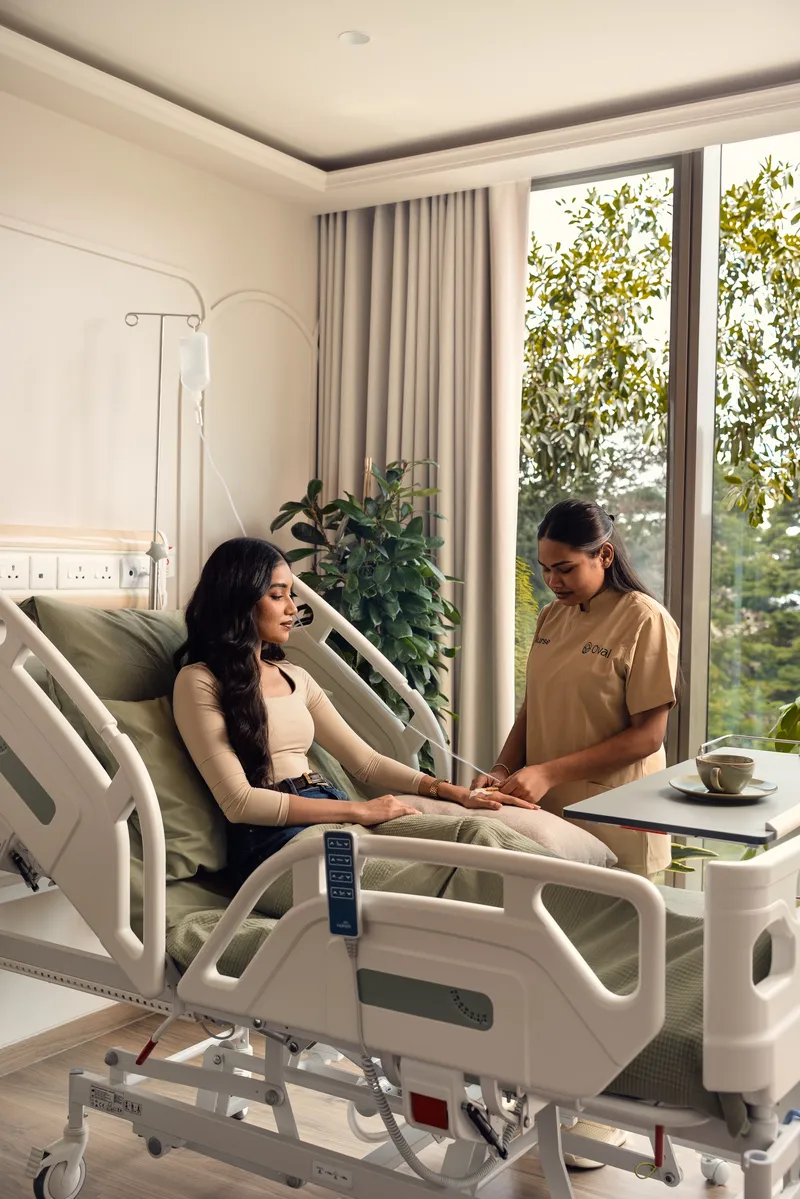
The Oval Fertility Clinic
Dr Levine believes patients are tired of buzzwords, and nobody walks into a fertility clinic asking for a “next-generation” platform. What they are looking for is answers, he emphasises.
“What Oval is building combines advanced technology with better decision-making and better communication,” he says.
Oval’s embryology lab, Dr Levine claims, is among the most advanced in India. It uses tools such as the Astec Chronos time-lapse incubator, which provides embryologists with deeper insights. And the lab's clinical protocols follow globally established standards, he says.
Elaborating on Astec Chronos, he says, “Traditionally, embryologists check embryos at specific points in time. With time-lapse technology, embryologists can continuously observe embryonic development while maintaining a stable environment for embryos. Think of it as watching a movie rather than looking at a few snapshots.
“It gives us a much richer understanding of how embryos develop over time and allows embryologists to make more informed assessments. It gives us better information, and in medicine, better information usually leads to better decisions.”
While technology and AI in fertility labs sound exciting, does advanced tech actually improve pregnancy outcomes?
Dr Levine says the easiest way to think about AI is as a very sophisticated assistant.
“AI is extremely good at analysing large amounts of data and identifying patterns. It can help embryologists review developmental information more efficiently and consistently. What AI is not doing is replacing doctors.
“Patients should be reassured that treatment decisions remain human decisions. Embryologists and physicians are responsible for every recommendation and every clinical choice. Technology should support expertise, not substitute for it.”
Dr Levine explains that advanced technology improves both pregnancy outcomes and operational efficiency. According to him, technology has transformed how clinics monitor embryos, manage laboratory conditions, and analyse data, enabling doctors to make more informed decisions and provide better care.
At the same time, he emphasises that fertility remains rooted in biology and carries inherent uncertainties. While technology can create better conditions and support clinical decision-making, it cannot eliminate the unpredictability of human reproduction. He views technology as a powerful tool but not a miracle solution.
Patient-centricity is crucial
What does patient-centricity look like in practice at Oval? Reddy believes that patient-centricity starts with respect.
“Patients deserve to understand what’s happening, why certain recommendations are being made, and what their options are. They deserve time to ask questions and feel comfortable doing so. When you’re going through fertility treatment, even small interactions can have a lasting impact. Being listened to, being informed, and being treated with empathy can make an enormous difference.”
At its core, Oval aims to make fertility care feel less isolating.
Reddy says, “More than anything, I hope every woman feels seen and supported. I hope she feels she was heard, that her questions were answered, and that she clearly understands her options. Most of all, I hope she feels confident that she has a team standing beside her, whatever stage of the journey she's in.
“Fertility treatment can sometimes feel overwhelming, but it shouldn't feel lonely. If patients leave Oval feeling informed, respected, and cared for, then we've achieved something meaningful.”
Edited by Swetha Kannan