



Sumi Vivek of Curriculum Associates on building a 28-year career in technology, leadership, and AI
As part of our Women in Tech series, we speak with Sumi Vivek, Senior Vice President–Information Technology at Curriculum Associates, about driving technology transformation, preparing organisations for AI, and creating workplaces where women can thrive.

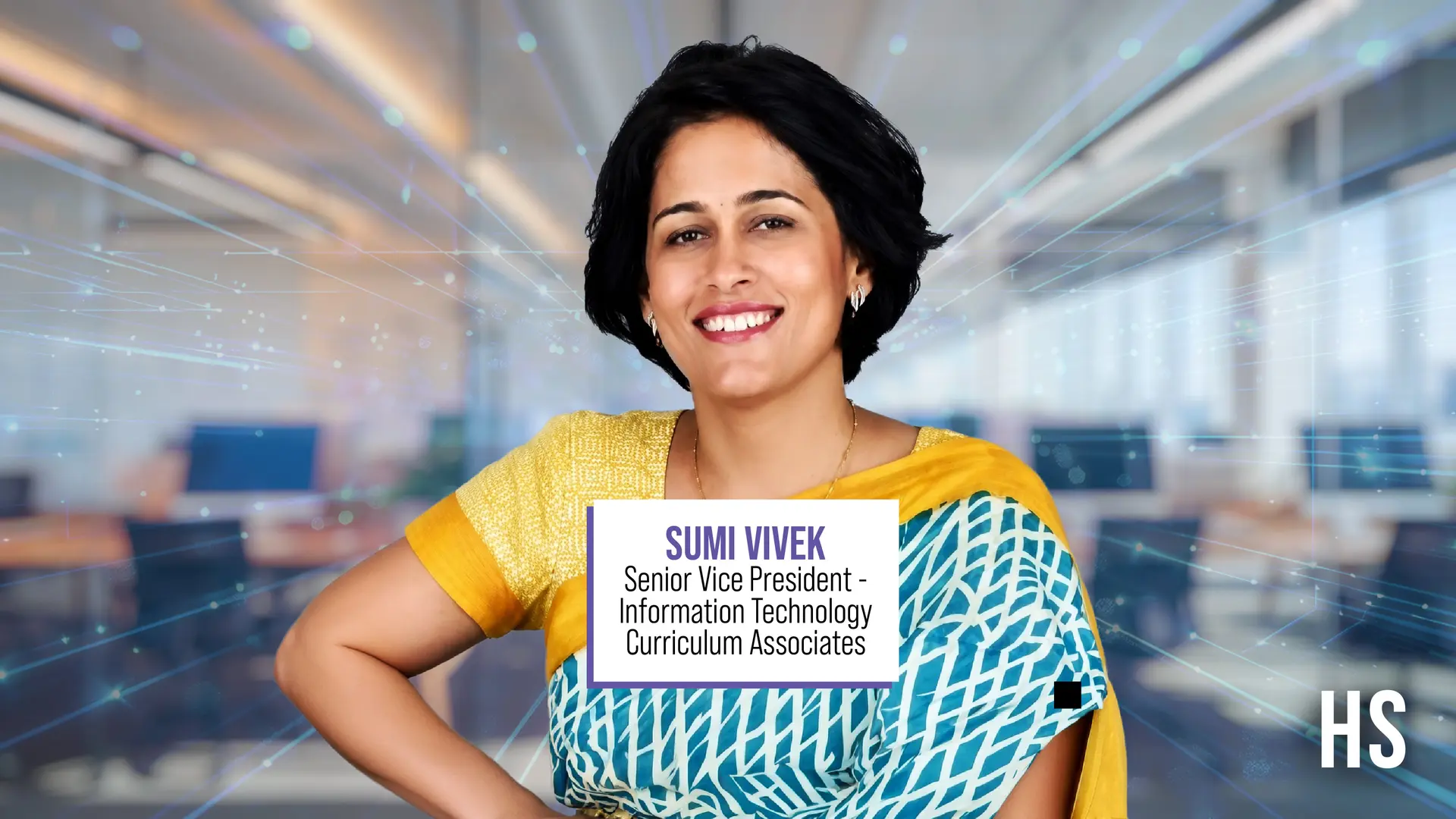

Growing up in the steel township of Bhilai, Chhattisgarh, Sumi Vivek was surrounded by a culture that valued creating a meaningful impact. From an early age, she understood that education was the primary pathway to achieving that goal and creating opportunities.
Sumi's interest in STEM originated from an interest in Mathematics. Among the first generation of students to be exposed to computer science in school, she first studied the subject as a hobby in Classes 9 and 10, then took it up as an additional subject in Classes 11 and 12.
What started as an introduction to computers in school eventually led her to study engineering at REC Calicut (now NIT Kozhikode) and grew into a lifelong association with technology. Over the next 28 years, she built a career across organisations such as PwC, IBM, Tata Electronics, and Diageo, before taking on her current role as Senior Vice President–Information Technology at Curriculum Associates.
Tackling diverse challenges
After completing her engineering degree, Sumi spent a year and a half in the software industry before pursuing an MBA at IIM Lucknow. Although she received an offer from Coca-Cola's technology division, she chose a career in consulting instead, drawn by the opportunity to work across industries and tackle a wider range of business challenges.
For Sumi, consulting offered more than a technology career. It provided a window into how organisations function, how complex problems are solved, and how technology could drive business outcomes. “Business impact, and how technology can enable that impact, was what I was looking for,” she says.
She joined PwC in technology consulting and spent the first four years working on projects across India and Europe, including assignments from Tata Steel in India and British Petroleum (BP) in Belgium. In 2002, when PwC's technology division was acquired by IBM, she moved to IBM as part of the deal.
“I started working with Unilever as my core client, at the junior-most level in the project—I was the one who would do anything that nobody else wanted to do. Starting from data management during migration, staying up for three nights altogether—I did all of that. I really enjoyed doing things that everybody else said were very difficult, hard, or impossible,” she says.
Sumi adopted a simple approach: take on every opportunity that came her way and trust that the experience would eventually come together. That mindset saw her move across diverse roles, from programme management to account management, steadily rising through the ranks.
Over time, she developed a reputation for handling some of the toughest assignments—whether they involved demanding clients, complex projects, or challenging deliveries—and became the lead partner.
In 2017, she moved into her first CIO role with Diageo.
“It was a large acquisition of United Spirits Limited (USL) and an overall transformation. Everything had to be changed—what hadn’t been done in 30 years had to be done in three years, and we delivered it in two. I came in, created a roadmap, built the team from scratch, and we delivered. By that time, I realised what I really enjoy doing is turning around, doing transformations,” she explains.
From Diageo, she went back to IBM for a short stint and thereafter joined Tata Electronics.
“Within two years, as part of the founding team, we built five plants. This was in the middle of the pandemic, when nobody was leaving their homes, and we were sitting in the plant, setting up IT. We operated in a bubble where we would stay in the plant for fifteen days and come back home for the next fifteen,” she says.
It was also a purpose-driven role, building for India, where she and her team would go to the villages, convince the elders and hire women.
“These were young girls, and we had hostels to support them. It was a 90% women-led organisation on the shop floor,” she adds.
When she joined Curriculum Associates about a year and a half ago, the company had 13 million students on its platform, was growing at 40% year-on-year, and was targeting 25 million students.
“If we were to continue towards that aspiration, we needed a much stronger foundation—of technology, of processes. That was the purpose for me to come in: to transform all of technology and AI-enable the business."
Her mother and grandmother were both teachers. “I had seen the life of teachers and how committed they are, but how limited they are in terms of resources and ability to make the impact they can.”
That, combined with the AI work she had begun at Tata Electronics, is what brought her to edtech.
Navigating gender dynamics in technology
Sumi believes that the overall acceptability of women in technology has increased over the years. But the speed at which technology works is also very high.
“Twenty-eight years ago, when I started working, you could think, plan, and take your time to come back with a solution. Today, you have to be on your toes. As women, we take a lot of time to think things through and perfect ourselves before we contribute. We have to be more comfortable with a very early idea, sharing it and working with teams to evolve it, rather than getting it perfect first. Building that confidence came from a lot of experience. Now we expect that from women very early on,” she notes.
On the other hand, one thing has remained the same. Women still don’t position themselves strongly or plan for the worst-case scenario. Instead, they pull out of the race much before it’s actually needed.
Retaining women in the workforce
On the issue of the missing middle, where women leave the workforce in their mid-careers for various reasons, such as caregiving or other family responsibilities, Sumi admits she would have been one of them.
“Honestly, I would have dropped out. In my particular case, it was specifically my manager who created those opportunities for me—in consulting, it was not possible to work in one location for more than six months, but he created roles for me. I turned out to be lucky,” she says.
According to Sumi, conversations about career pathways, flexibility and support systems should begin well before major life events such as parenthood.
When faced with competing responsibilities, many women naturally prioritise what feels safest for their children. Preparing them in advance, she believes, can help them make decisions without feeling that their careers must come to a halt.
She believes that flexible roles, research-focused positions, centres of excellence, business partnering functions, and other non-traditional career tracks can help women stay engaged in the workforce without sacrificing growth opportunities.
“In Curriculum Associates, we have very good maternity and paternity policies across all geographies, which allows people to take a balanced view,” she says.
The third pillar is building a culture of support through sponsors, mentors, and allies who view flexibility not as a concession but as a business imperative.
Sumi notes that women often step back when they feel their needs are creating additional burdens for colleagues or teams. Strong support structures can help counter this perception and ensure that women do not internalise guilt for seeking flexibility and can navigate career and caregiving responsibilities without compromising their confidence or well-being.
She also reiterates the importance of mentorship within the organisation and beyond, and mentors women at Curriculum Associates and across the network of organisations she works with.
Looking ahead, Sumi sees artificial intelligence as both the biggest opportunity and the biggest challenge facing technology leaders. She believes AI has the potential to fundamentally reshape the corporate world, transforming how organisations operate, innovate, and create value.
“I am looking forward to leading that path well within Curriculum Associates,” she says.
(The story has been updated to correct some typos.)
Edited by Megha Reddy