



The hidden cost of care: Why women are still missing from India's workforce
Data from the National Statistics Office highlights a stark gender divide in the reasons why people stay outside the labour force: men say they are pursuing studies, while women cite childcare and household responsibilities.

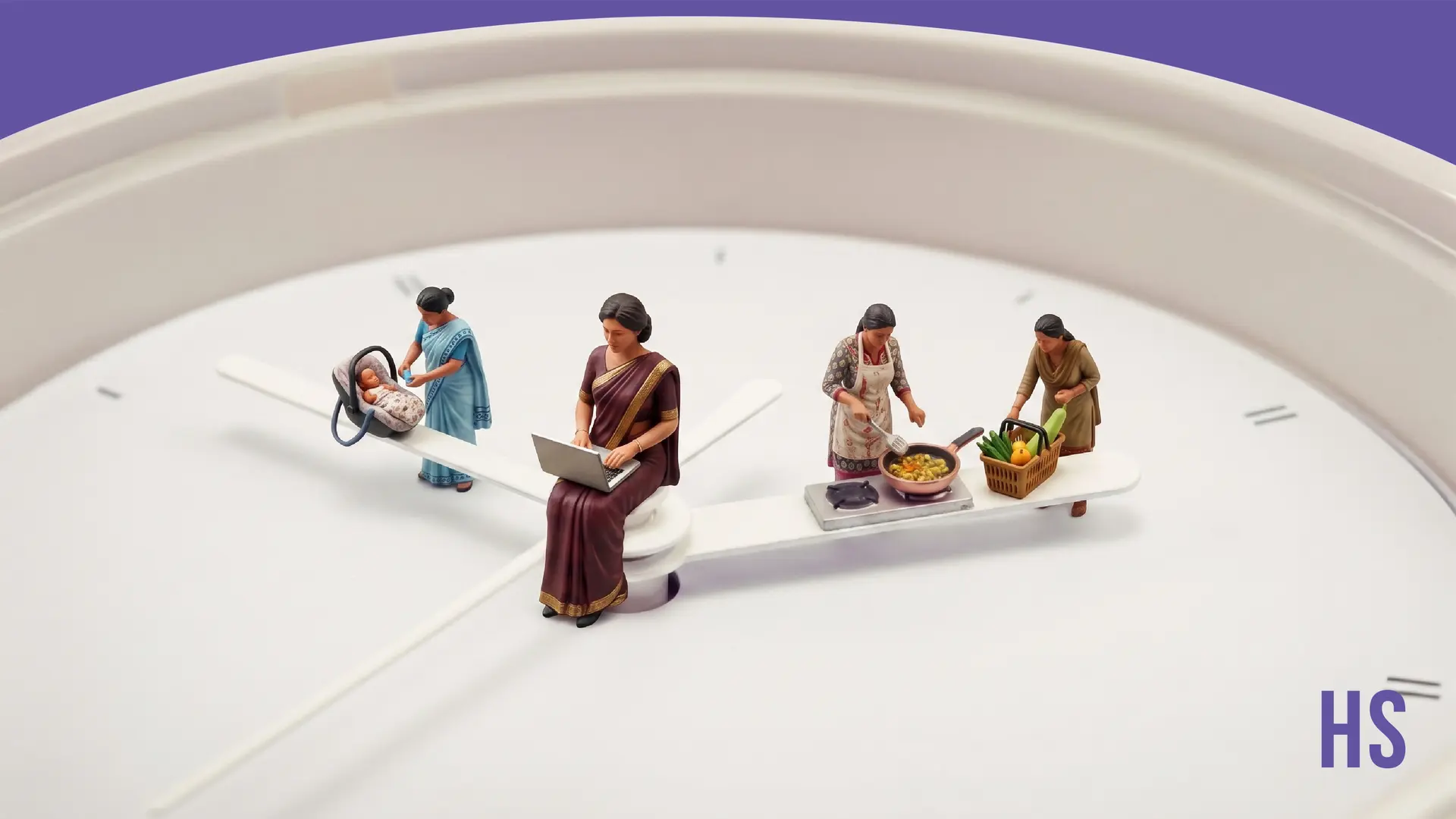

When Indian men stay out of the workforce, it is often because they are preparing for their future. Conversely, when Indian women stay out of the workforce, it is because they are looking after everyone else.
New data from the National Statistics Office (NSO) highlights a stark gender divide in the reasons why people remain outside the labour force. Among men, 53.5% said they were not working because they wanted to continue their studies, while 68.7% of women cited childcare and household responsibilities as the primary reason for staying out of the workforce.
These numbers, released by NSO, Ministry of Statistics and Programme Implementation for 46-million-plus cities (cities with a million-plus population as per Census 2011), are based on the Periodic Labour Force Survey 2025 and the Annual Survey of Unincorporated Sector Enterprises 2025.
The results of the Time Use Survey, released earlier this year as part of the Economic Survey, also mirror this unequal distribution of unpaid care work in Indian households. Women spend an average of 363 minutes a day on unpaid domestic and caregiving activities, compared with 123 minutes for men.
The NSO data also point to gradual progress in women’s economic participation. Female labour force participation in million-plus cities, measured by usual status, rose from 19.8% in 2017-18 to 27.2% in 2025, while the Worker Population Ratio increased from 17.9% to 25.5% during the same period.
These gains have not erased the structural barriers that keep many women out of the workforce, namely childcare and other responsibilities.
The NSO findings are particularly significant because they come from India’s 46 million-plus cities, where employment opportunities, educational institutions, and infrastructure are expected to be better than in smaller towns.

Comic strip: Nihar Apte
Improving women’s participation in the workforce
The data point to a gap in structural support for women. Along with the need to create new jobs for women, the challenge is also how to enable them to keep them.
India already has the building blocks of a care economy through its network of Anganwadi centres under the Integrated Child Development Services, workplace crèches mandated under the Maternity Benefit Act for larger establishments, and the Palna Scheme under Mission Shakti (formerly known as the National Creche Scheme).
However, these policies suffer from uneven implementation, limited urban coverage, and inadequate investment. Affordable childcare facilities and access to quality daycare, especially employee-supported daycare, will help women remain in the workforce.
These should be complemented by flexible work options that do not hinder women’s career progression. Employers should also offer returnship programmes for women who want to take a career break. Fathers should be encouraged to play an equal role in caregiving and other family responsibilities.
Improving women’s participation in the workforce does not just mean creating more jobs. The burden of unpaid care work, which disproportionately affects women, can be minimised through a combination of stronger policy interventions and a shift in societal attitudes towards caregiving.
Until then, many women will continue to face what economists describe as the ‘motherhood penalty’, the persistent disadvantage in employment, pay and career progression that often accompanies motherhood.
The latest NSO data suggest that while India’s cities are creating more opportunities for women, the unequal distribution of care work continues to determine whether they can take advantage of them.
Edited by Swetha Kannan