



Why this humanitarian believes inner healing is key to building peace in conflict zones
Working across Lebanon, Syria, Israel/Palestine, Mozambique, Sudan, South Sudan, Chad, and Congo convinced humanitarian Lena Lieberknecht that peacebuilding needs an inner dimension. Through the Art of Living, she is bringing stress-relief programmes to people living and working in conflict zones.


Lena Lieberknecht’s adult life has always been defined by movement.
Lieberknecht is from a small town in Germany. But her humanitarian work has taken her around the world: from Palestinian refugee camps in Lebanon to conflict zones in Syria, Sudan, Mozambique, Chad and the Democratic Republic of Congo—some of the world’s most fragile frontiers.
Somewhere along that journey, in a modest ashram tucked away in Black Forest, a mountain range in Germany, Lieberknecht encountered something that would fundamentally reshape the way she approached her life’s work: the Art of Living.
The beginning of a life in humanitarian work
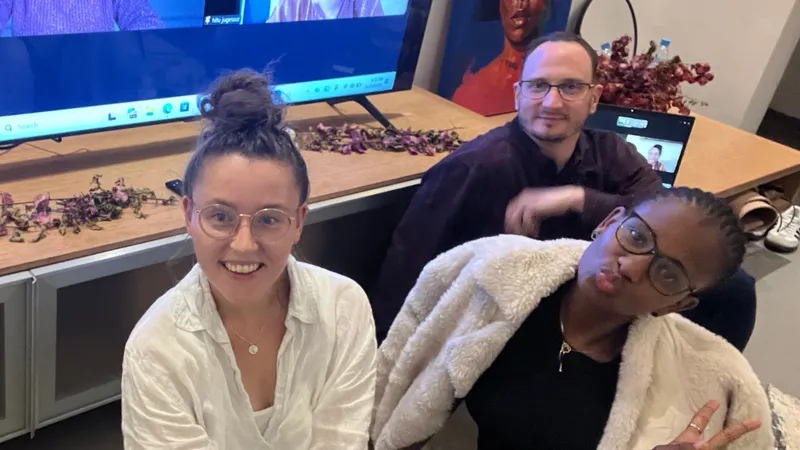
Lena Lieberknecht (left) with partcipants
For the first 18 years of her life, Lieberknecht remained in Germany. In the last year of school, she became interested in Weltwärts, a government-funded programme that sends school graduates abroad to work on a project as volunteers.
She ended up spending a year in Cameroon, working in the kindergarten run by sisters of the Catholic church.
“I didn’t feel the work was right for me, and after six months, I found another project in the north in a rehabilitation centre in Adamawa. We also had a project to build a new school—I was in touch with the Catholic Church and the local authorities to get the approvals signed. Eventually, we got the approval to build the new school there,” she recalls.
After her year was over, Lieberknecht enrolled in a bachelor’s in international social work in Germany that also had a mandatory period abroad for internship and study. As part of the programme, she went to Lebanon, worked in Palestinian refugee camps, and with Syrian refugees.
“I was working with humanitarian organisations doing social work. Later I went to Bolivia, which was very interesting because I felt that social work there was much more activist and more present in society,” she says.
In her final year, Lieberknecht spent a year in Romania, where she finished her bachelor’s degree and also studied international relations, conflict resolution, and mediation.
Thereafter, Lieberknecht enrolled at the University for Peace in Costa Rica in 2018 to study international law. Following this, she completed a year’s internship at the UN International Criminal Court in The Hague.
When the pandemic hit, she ended up switching three jobs in the first six months since travel was uncertain. Eventually, she joined GIZ [a German development agency] in security risk management and went back to Lebanon.
A few months later, she joined the Nonviolent Peaceforce in South Sudan, an organisation built around unarmed civilian protection.
“It kept me close to communities, and I liked the holistic approach: not just reacting to violence once it happens and trying to reduce its impact, but being proactive and trying to prevent it from happening at all. It’s a strong combination of approaches that makes the work more effective and lets you stay flexible depending on the situation,” says Lieberknecht.
After her stint in South Sudan, she went to work with the International Committee of the Red Cross in Israel and Palestine, and later in Syria.
When she started feeling she had “no impact”, she moved to Doctors Without Borders (Médecins Sans Frontières). Here, she worked in Mozambique’s Cabo Delgado province confronting an Islamic State-affiliated insurgency, and later in eastern Chad, where she worked in one of the biggest refugee camps along the border with Darfur.
Being in the moment
After she’d completed her mission in Chad in 2024 and before taking on a new role in Sudan with Geneva Call, Lieberknecht felt very stressed and was looking for a few techniques to cope with it.
“I searched online for something near my town in Germany, and what came up was an Art of Living course at the ashram in the Black Forest, two hours by train from where I lived. I signed up and felt so present, so completely in the moment. It was the first time I had such a profound feeling of really being in the present, without thoughts pulling me toward the past or the future,” she recollects.
Travelling via Kenya to Sudan, she attended a follow-up session in Nairobi, where she connected with two Art of Living teachers and shared that she felt an inner dimension was missing in humanitarian work.
“Violence cannot be stopped by the external interventions we design; nothing really changes unless there’s internal transformation as well. I felt strongly that we needed to connect the Art of Living with humanitarian organisations,” she notes.
Art of Living organised a couple of introductory talks with humanitarian organisations, including her new employer in Sudan. Unfortunately, they saw it as “mental health work” and didn’t really understand why internal transformation mattered.
In Sudan, training armed groups on international humanitarian law (IHL), she began to feel the limits of purely cognitive interventions.
“I can train people in IHL, and they can get the information, but it’s on the cognitive level. Nothing is going to change within their hearts.”
Her conviction grew that any lasting transformation—in a fighter, a perpetrator, a stressed-out aid worker—had to start from the inside, from a genuine experience of inner peace, before any conversation about law or ethics or restraint could really land.
“It will flow automatically,” she says, “because they have connected to themselves… we tend to forget who we really are. I think the Art of Living’s beauty is reminding us of who we are,” she says.
When her organisation didn’t see it that way, she went back to the Nonviolent Peaceforce, this time in the Democratic Republic of Congo in February 2025 and then switched to UNHCR in September that year. In eastern Congo.
Before UNHCR, she went back to the German Ashram and completed the Art of Living volunteer training programme.
“I was in touch with Dr Katrien Hertog, the global director of peacebuilding at the International Association for Human Values (IAHV), part of the Art of Living. I told her how frustrated I felt that a lot of people there are doing it for the money or for their careers, and that it doesn’t really feel like it’s coming from the heart for many of them. She and I started talking about how we might connect and work together,” she says.
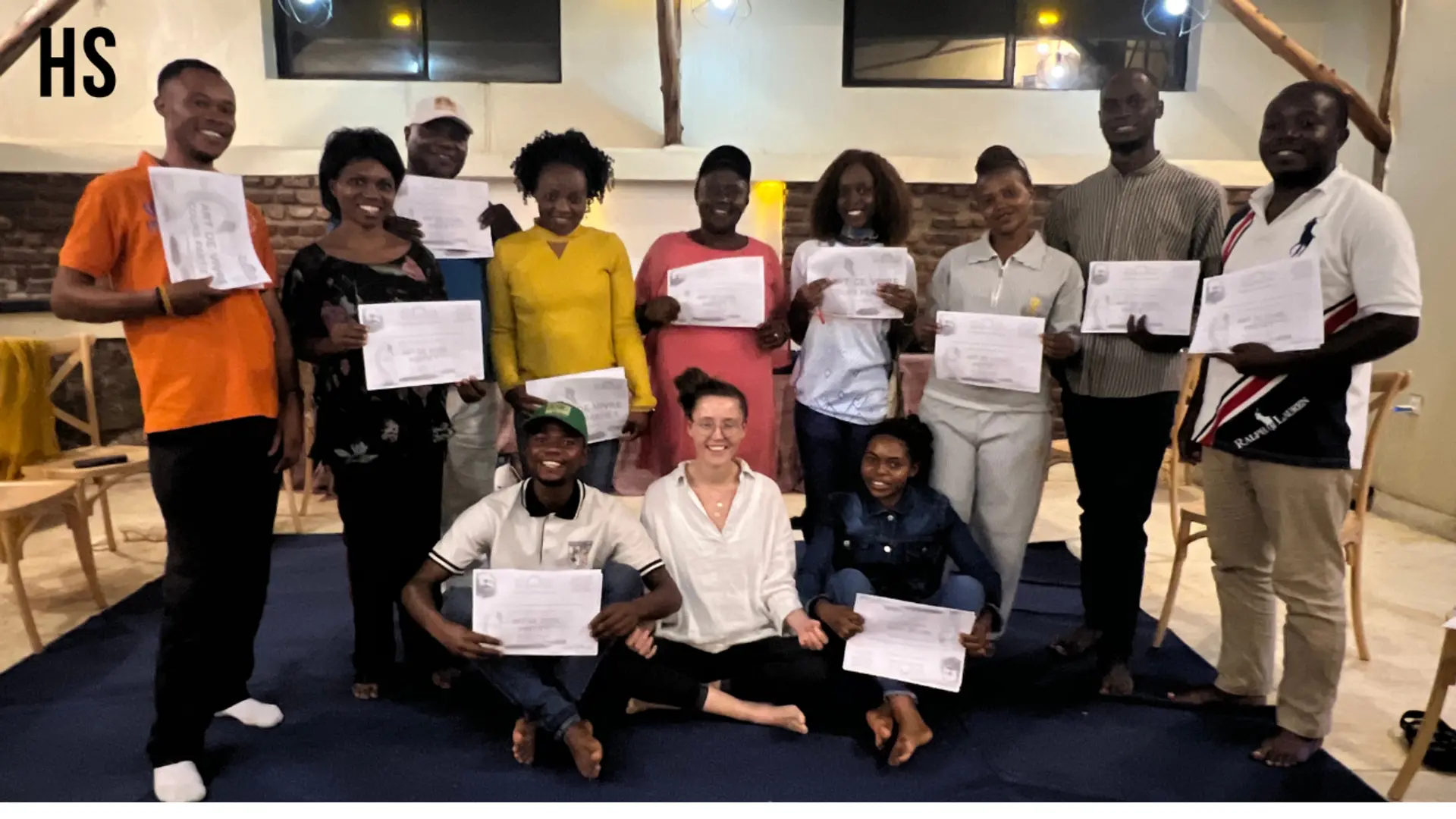
Once she was back in Congo, she started organising courses. The teachers would join online while Lieberkecht gathered the participants in the hall in person — since it’s difficult for a teacher to physically travel into a conflict zone.
Eventually she decided to become a teacher herself. In March this year she went to Poland for teacher training.
“After that, I went back and ran a lot of courses in a short time, in different locations in eastern Congo, before coming to India for Gurudev’s (Sri Sri Ravi Shankar) birthday,” she says.
The participants came from across the humanitarian ecosystem—aid workers, psychologists, psychotherapists, lawyers, peacebuilders, interpreters, translators, activists, and even business professionals. While the course she taught was the Art of Living’s flagship Happiness Program, Lieberknecht quickly realised that the name didn't resonate in a conflict zone.
“In a place like eastern Congo, it can be difficult to talk about happiness. So I introduced it as a stress-release or stress-management course. That immediately made sense to people because they are living with enormous amounts of stress,” she says.
The framing worked. Colleagues who had worked with her on community protection projects at the university began attending weekend sessions after she explained the link between psychosocial wellbeing, stress management and their effectiveness as humanitarian workers.
“I didn’t expect so many participants to have such a transformative experience in just three days,” she says.
So far, Lieberknecht has conducted seven courses across several cities and provinces in eastern Congo, reaching around 70 participants.
Soon she will be travelling to a different country with a different organisation, and another conflict zone.
“If I get the opportunity, I want to continue teaching and help participants who are interested in becoming volunteers and teachers themselves,” says Lieberknecht. “When the teachers come from the communities affected by conflict, the work is far more effective and sustainable than relying on people travelling in from other countries—which is often difficult, if not impossible, in conflict zones.”
Edited by Swetha Kannan