



How Karunya Gunavathy is helping women in Tamil Nadu transition from bidi rolling to sustainable livelihoods
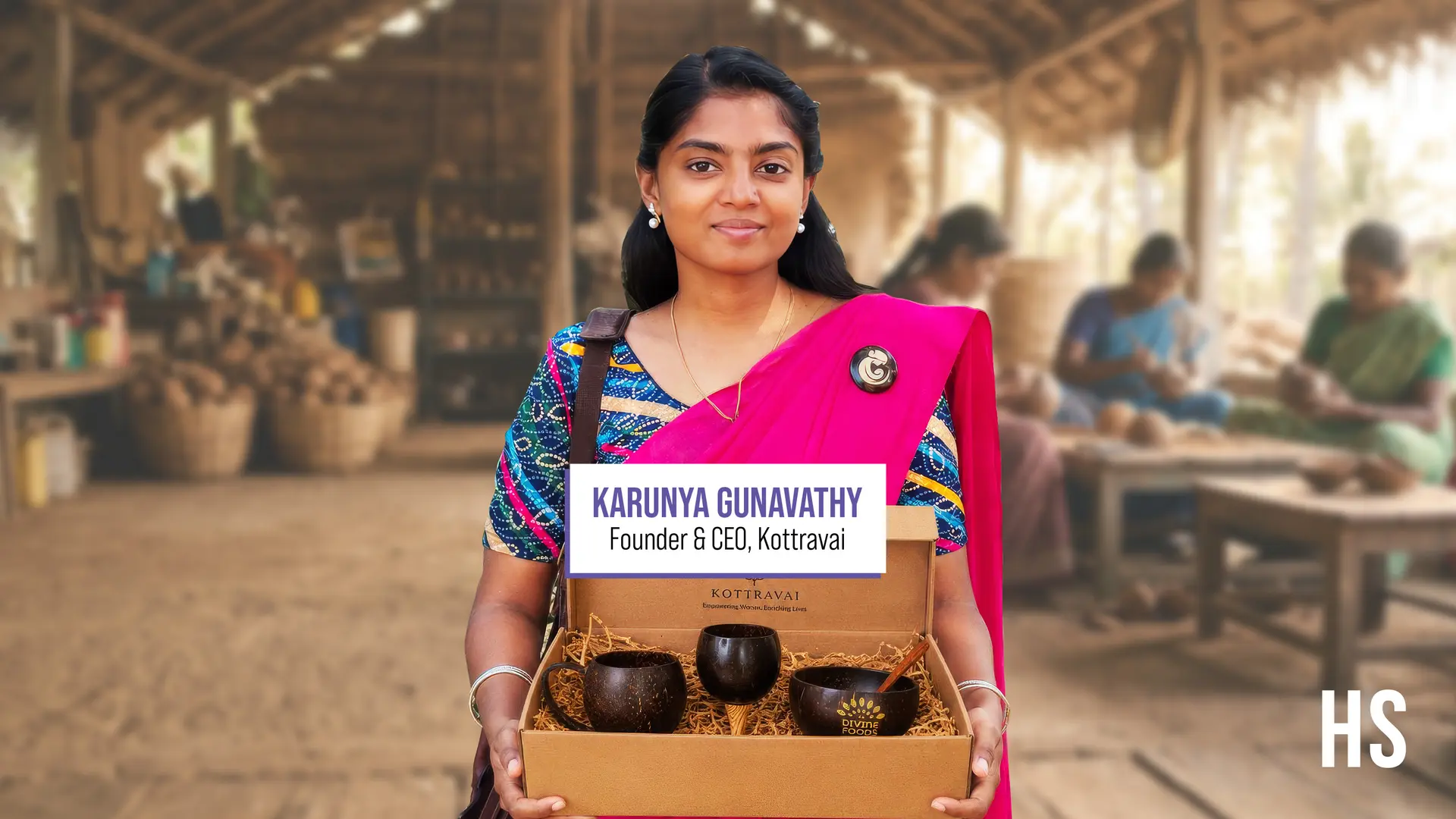
Growing up in Tamil Nadu's bidi belt, Karunya Gunavathy watched women sacrifice their health to earn a living. Today, through the Kottravai platform, she is helping them transition from bidi rolling to sustainable livelihoods, with a mission to create jobs for 10,000 women.


The Tenkasi-Tirunelveli belt of Tamil Nadu is one of India’s major traditional bidi (hand-rolled cigarette) manufacturing hubs, employing thousands of women.
Here, every woman who hand-rolls bidis knows the toll her work takes on her body. Bent at the waist, fingers moving quickly, she rolls tobacco leaves into bidis for up to 12 hours a day, sometimes without a break. If her fingers are quick enough, she can roll a thousand bidis and earn Rs 230, enough to feed her children.
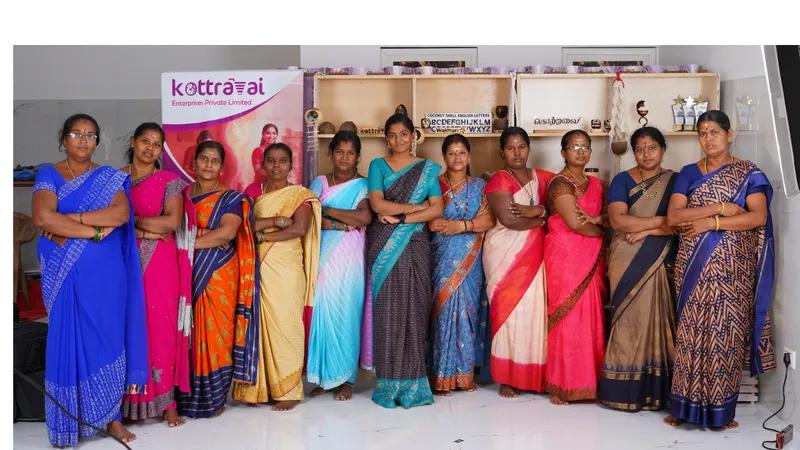
The women of Kottravai
Karuna Gunavathy grew up watching this in her own family. “My aunt contracted TB because of this work. I was in school, and since my own family was in survival mode, we couldn’t do anything much,” she tells HerStory.
This observation would eventually lead to the founding of Kottravai, a platform that trains and employs women across Tenkasi to make coconut-shell, banana-fibre, terracotta, and food products.
The initiative and direction reflect the purpose behind the name.
For Karunya, Kottravai symbolises the fierce, feminine force of motherhood, the one who creates, protects, and also survives.
Providing women with healthy livelihoods

Coconut shell cups
Born and raised in Perumalpatti, a village in Tenkasi, Karunya completed her undergraduate degree in electrical engineering and later worked as a graphic designer. She eventually switched to freelancing, which gave her the time and freedom to pursue social work as the co-founder of the Voice of Tenkasi Foundation.
Karunya is also the first graduate in her family. Her father is a welder, and her mother runs a small mess.
Her parents could barely cover her school and college fees, and most of the time, Karunya paid for college using her prize money won at symposiums and paper-presentation competitions.
She went on to complete an MBA through a correspondence course. She is now pursuing a PhD in social entrepreneurship.
“I observed that girls often stopped studying after 12th standard and got married. So we (Tenkasi Foundation) thought of raising awareness and giving them training in AI and ML.
“We also introduced children to financial literacy. Since I had a digital and branding agency, I did this on the side, where we would visit a village, teach something, clean ponds, and so on,” she explains.
Karunya conducted a survey in 2024 that revealed that roughly 5 lakh women across the Tenkasi and Tirunelveli region rolled bidis for a living. She asked them 10 questions, including whether they were in this profession by choice.
About 83% of these women reported chronic respiratory conditions, and, in some cases, lung cancer had forced women to quit.
An eye doctor in the area told her that, on any given day, 20% of her patients are bidi rollers and the minute work often damages their eyesight.
Karunya was determined to ensure that no other woman endured the same fate as her aunt, trapped in the endless cycle of livelihood and survival.
The survey also revealed that 93% of women were willing to switch jobs if an alternative option was available. This strengthened her resolve.
She decided to start Kottravai with a single vision: to provide these women a healthy livelihood.
Her initial idea—creating a sales platform for products—hit hard against ground reality. A woman needed 6-7 months of training to make a saleable product, and during that period, they needed support.
She decided to provide a stipend during the training phase. Fortunately, the central government provided training on making products with banana fibre. Fifty women were trained, of whom 30 were retained by Kottravai.
Kottravai also partnered with Crazy Coconut, a sustainable, eco-friendly brand, to train the women for three months. A handicraft expert also pitched in.
However, the real challenge came from misinformation.
“The bidi factory owners had convinced the women they had to work as a bidi worker for 10 years to avail themselves of PF and ESI benefits. Most of these women, many of whom hold degrees, believed it. We had to educate and demonstrate to them how to use the government portal to withdraw the money using their PF number,” Karunya explains.
The team at Kottravai also faced resistance from the factory owners where these women were traditionally employed. In Mathalamparai, which has five large bidi factories employing over 3,000 women, the challenge was finding a place to conduct the training.
“Once, we had booked a mandapam (wedding hall) for training. A factory owner then booked it, saying it was for a wedding. We had to back out, and we chose to train the women under a banyan tree in a temple compound.
“Since then, we have used different venues, and as we have grown, it isn’t much of a problem now,” says Karunya.
She foresees more obstacles in the future, but she is all set to face them.
Kotravai now runs four production clusters with 55 women: a coconut shell hub in Mathalamparai, a banana fibre hub in Surundai, a terracotta jewellery hub in Sankarankoil, and a food products hub in Chinthamani. A unit for aromatic candles and wellness products is opening soon.
Stories of transformation
In June 2025, Kottravai began accepting orders through its websites, but the volume wasn’t much. Over time, the B2B segment began to pick up, and the platform started receiving orders from companies for handicrafts and food products.
“We are still struggling; our burn rate is still high. Corporate gifting is an area we are pursuing now. I have confirmed orders from two top companies for Rs 50 lakh each. I am optimistic we will have significant sales this year,” says Karunya.
Kottravai has also partnered with ethnic wear brand Shobitam to sell its products to the US and the UK. Once sales stabilise, Karunya plans to launch more clusters.
The impact of Kottravai is perhaps best understood through the stories of the women behind the products.
One of them is Anjali, a mother of three whose life took a turn after her husband lost his hearing and speech in an accident. As the family's sole breadwinner and caregiver, Anjali struggled to survive on Rs 3,000-4,000 she earned each month from rolling bidis.
After she joined Kottravai, her income has more than doubled to Rs 8,000–Rs 9,000 a month.
But for Karunya, the transformation goes beyond finances.
“For the first time in four or five years, people saw Anjali smile again. We took her to Vijay TV, she was recognised by her village, and today, wherever she goes, she walks with pride,” says Karunya.
Before joining Kottravai, Jeeva earned a living by rolling bidis, a job she says she took up because it was the only source of work available in her village.
“When I was rolling bidis, I knew the products we made could cause health problems. I saw the impact on people around me, but at that time, I never really thought much about it because it was the only work available to us,” says Jeeva.
Today, she works as a coconut shell artisan with Kottravai, handcrafting products for use in homes, offices and workplaces. She feels life has given her a new sense of purpose.
Currently, Kottravai operates as a private limited company and is entirely bootstrapped, with Karunya and her co-founder investing in the venture. Alongside the for-profit entity, Karunya plans to establish Kottravai Foundation as a Section 8 company, enabling it to tap into government schemes, CSR funding, and grant opportunities while continuing to scale its social impact.
By December, Karunya wants to earn at least Rs 3 crore-Rs 4 crore through corporate gifting, and use the profits to train more rural women. The profits, she says, will be reinvested into training and upskilling.
Over the next five years, Kottravai aims to create livelihoods for 10,000 women. The venture also plans to expand beyond handcrafted products into cosmetics, apparel and bags next year. Its goal is to become a full-fledged sustainable lifestyle brand by the end of its third year.
“I want Tenkasi district to become the Estonia of Asia. In Estonia, men and women contribute equally to the country’s GDP. I want Tenkasi to become a model district where women participate equally in the economy,” says Karunya.
Edited by Swetha Kannan