



This woman entrepreneur is helping small farmers earn more through community-supported agriculture
Spudnik Farms, founded by Sumeet Kaur, connects urban consumers with local farmers through a subscription model. The company works with 250 farmers across Karnataka, helping them earn higher incomes while promoting seasonal, indigenous and sustainably grown produce.

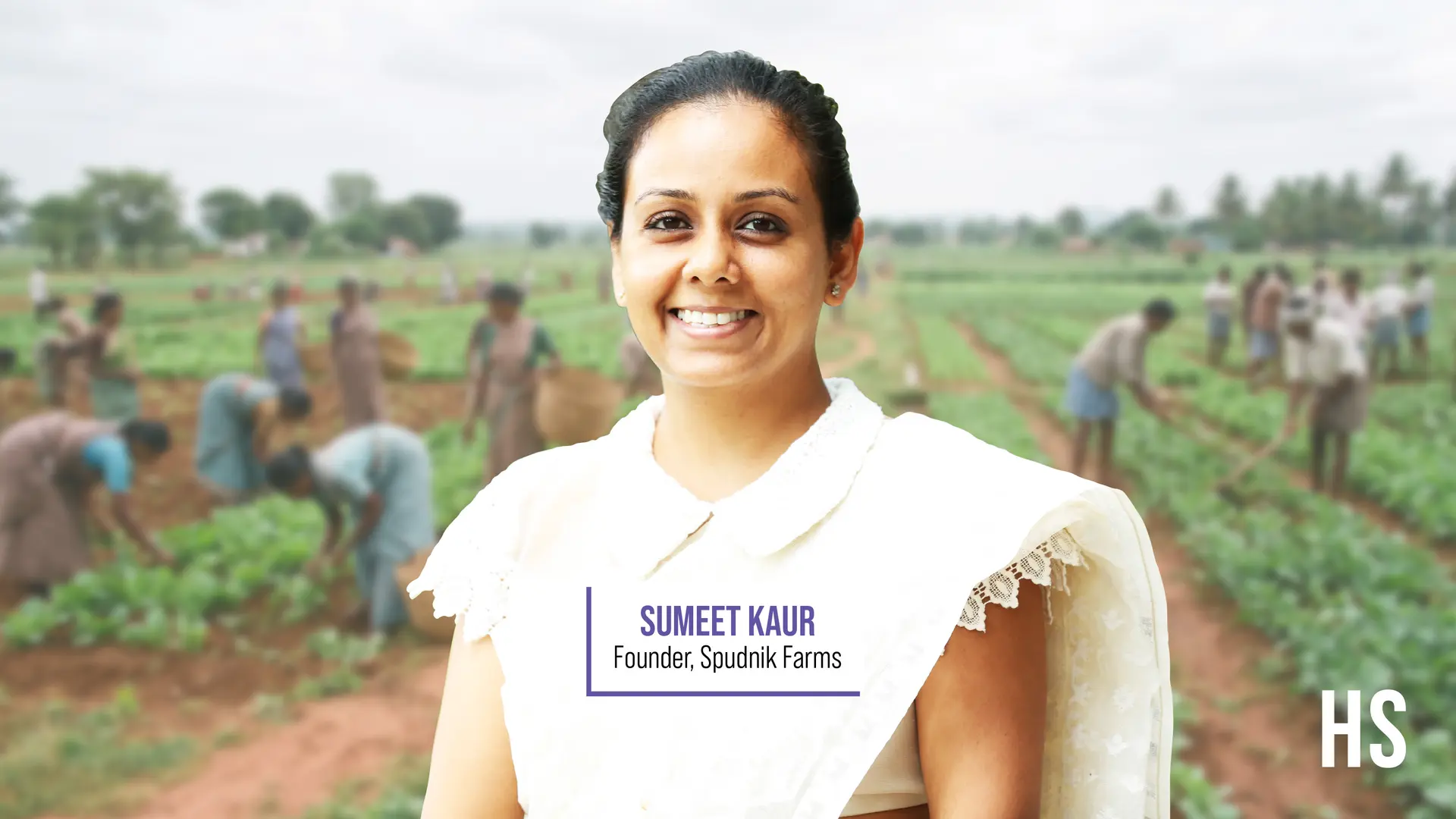

Three years into her career as a tax advisor, Sumeet Kaur was struck by an existential question she couldn’t ignore—what was the real purpose of her life?
In 2012, she walked away from the certainty of corporate life in search of something she believed mattered more.
“Even though I grew up in Delhi, my family has close ties to Punjab. I was always close to rural life without having lived in that setting. At some point I thought of trying to grow my own food as the subject interested me a lot,” she recalls.
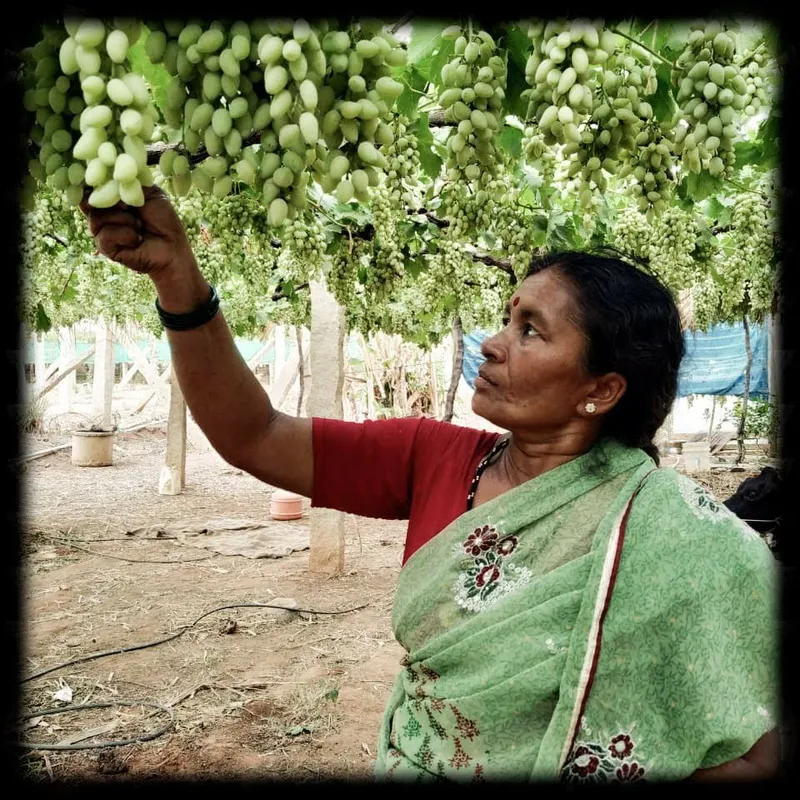
Gowramma with grapes
Luckily, a friend’s father offered her his vacant plot of land in Hoskote, on the outskirts of Bengaluru. What began as an experiment would eventually grow into a journey that would redefine her relationship with food, farming, and the possibilities of agriculture.
The first year, 2013, was spent physically clearing the land of boulders and rocks and rendering it usable. She spent the next year digging the soil, sowing seeds and watering, following the principles of natural farming, learning from workshops and YouTube videos. The experiment quickly produced more vegetables than one could eat, and Sumeet started selling the surplus to friends and acquaintances.
“The taste of what I grew was noticeably different, nicer than what you'd find commercially. That's why people started asking me for more, and that's when I ran into a problem: what had started as a hobby was now being demanded as a regular supply,” she says.
For the next three to four years, she grew the produce, marketed it, sold it, raised invoices, and coordinated deliveries, with just one farmhand helping her in the fields.
Once the cost of transporting fresh produce to customers' doorsteps was factored in, the model became financially unsustainable.
A sustainable farming model
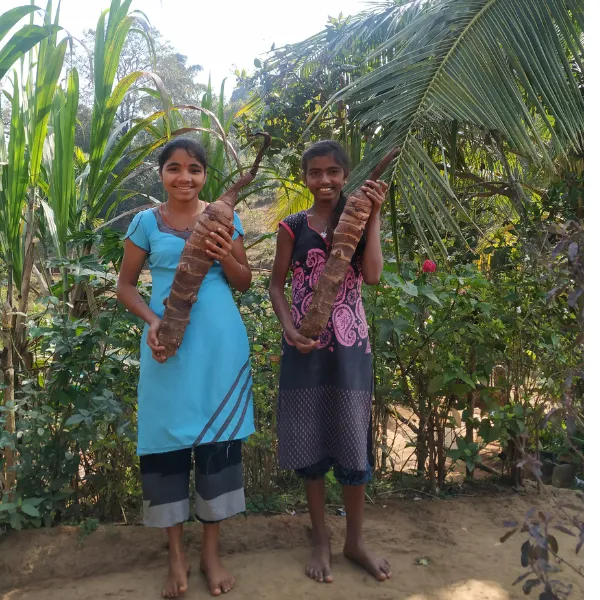
Girls holding Mudali Mudli, a highly nutritious indigenous tuber belonging to the taro family, grown primarily in the Joida region in Karnataka,
Sumeet began studying farming models from around the world in search of an alternative. That's when she discovered Community Supported Agriculture (CSA), a model widely practised in countries such as the US and across Europe, as well as in Japan, where consumers commit upfront to supporting farms in return for regular deliveries of fresh produce.
However, the CSA models she had read about were largely Western, with land running into hundreds of acres, with five to ten set aside just for CSA produce. In India, most of the fresh produce comes from small and marginal farmers who often work on land under five acres or less.
The question was how to adapt a model built for large farms to the Indian farming system, given the other challenges Indian farmers face.
“Climate change is already affecting yields. Input costs keep rising: farmers buy inputs at retail rates but sell their produce at wholesale prices, which creates a constant disconnect. With every generation, landholding size shrinks further. Water is another big challenge. And on top of all this, there's no guarantee your produce will even sell,” she explains. In short, it’s a system skewed against farmers, who take on the most risk in the entire supply chain, while profit is concentrated with middlemen and final sellers.
While CSA works well in many countries, she realised Indian households weren't looking for niche or speciality produce alone; they wanted a trusted source for the vegetables they used every day like onions, potatoes and tomatoes.
That insight led to Spudnik Farms' curated weekly baskets tailored to household size. Instead of asking customers to pick individual vegetables, the farm offered baskets designed for two-person families, four-person families, and larger households, making fresh, seasonal produce both convenient and predictable.
After months of recalibrating the model, Spudnik Farms officially launched in its current form in November 2019. But soon, the Covid-19 pandemic hit, and people started to value knowing where their food comes from and having a local supply chain. Sumeet was clear about not building complicated supply chains and sourcing from hundreds of kilometres away. Her idea was simple—eat what’s grown locally, and in season. When larger supply chains collapsed, Spudnik was one of the few in Bengaluru able to keep delivering fresh produce without real downtime.
Working with farmers across two clusters
Today, Spudnik Farms works with around 250 farmers across two clusters in Karnataka, one near Nelamangala on the outskirts of Bengaluru, and another in Uttara Kannada.
The first farmers came through horticulture university networks. The Uttara Kannada partnership came about through an unexpected opportunity. A cold-storage facility built under a CSR initiative for a group of tribal farmers was lying underutilised because there wasn't enough produce to justify operating it.
“The team behind the project asked if we could step in and help those farmers grow produce for us,” she says. Spudnik Farms has expanded market access and helped increase incomes by roughly Rs 30,000 a month.
"We are able to buy multiple crops from the same farmer—cucumbers one week, bhindi the next, and then whatever else is ready. It's almost four or five different crops from the same piece of land,” she adds. The company encourages companion planting and crop rotation, practices that improve soil health while ensuring farmers have a more diversified source of income.
Spudnik Farms is now looking beyond fresh produce. In Uttara Kannada, where farmers grow indigenous root and tuber vegetables such as sweet potato, yam and colocasia (taro), it is building a value-addition business producing sweet potato poppers, taro chips and sweet potato chips, generating more value for farmers.
It has two verticals today: the CSA subscription business for fresh produce and a value-addition business that we're building alongside it,” Sumeet elaborates. Consumers can choose from weekly subscription boxes available in Standard, Small, Mini, and Raw sizes, as well as a Seasonal Fruit Box featuring fresh, seasonal produce.
While the company currently works largely with farmers who already practise organic farming, its long-term goal is to help more growers transition to organic methods. In the meantime, it has focused on reviving indigenous varieties, encouraging farmers to grow naati produce instead of hybrids.
For Sumeet, however, building a sustainable food system is about reconnecting consumers with the people who grow their food. Over the past three years, Spudnik Farms has organised festivals, workshops and community events in Bengaluru around local, seasonal and indigenous produce.
Farmers from Uttara Kannada now take part in chef residencies and food festivals, preparing meals using ingredients from their own region.
Gowramma, the first farmer to join Spudnik Farms in 2019, began by cultivating organic vegetables on just 0.25 acres. Within three months, she earned nearly Rs 50,000, prompting her to expand cultivation across her entire 1.5-acre farm. Today, she grows over 10 varieties of vegetables and earns about Rs 25,000 a month. The increased income has enabled her family to move from a modest kutcha house to a three-bedroom pucca home.
Challenges and way forward
Changing consumer habits have been one of Spudnik Farms' biggest challenges. "People expect the same vegetables to be available all year round. That was one of the reasons I started growing my own food in the first place."
She believes many consumers have become disconnected from seasonality, often expecting crops like broccoli, cauliflower or green peas even when local conditions are unsuitable.
"Eating sustainably starts with eating what's local and seasonal. Instead of peas, for instance, Bengaluru's climate is better suited to avarakai (broad beans), an equally nutritious and flavourful alternative,” she says.
Spudnik Farms has more than 1,200 subscribers who place orders via Google Forms. It’s also building its ecommerce website so that even non-subscribers can order. Pricing is decided on three factors—how much it costs them to get the product to the consumer, a reasonable price to pay farmers and what the consumer is realistically willing to pay.
On average, they try to pay farmers around 20–30% more than what they'd get selling their produce elsewhere.
“One key benefit a subscription offers consumers is that their monthly spend on produce stays fixed regardless of market fluctuations — we only revise prices occasionally, maybe once a year,” she notes.
Spudnik Farms is bootstrapped and is close to breaking even. Sumeet credits Technoserve’s Greenr Accelerator Program, which has helped it strengthen its business model beyond subscription. That’s how its B2B supply to Blinkit came about. Greenr also pushed the team to become more efficient, more cost-effective, and to approach the business with a stronger commercial lens.
“We definitely want to reach more consumers. One thing we have started in a small way is supplying select products through e-commerce platforms, which helps us reach consumers we otherwise wouldn't and grows our visibility. As customers push us to evolve, we evolve the business with them,” she concludes.
Edited by Affirunisa Kankudti