



How an Army veteran-led organisation is working to build a society free from sexual violence
Founded by Army veterans and civil society members, Swakshatra works to protect children from sexual violence and exploitation. Major Bhavana Chiranjay, founder and executive secretary, talks about why healing is at the heart of Swakshatra’s work.


In the late 1990s, while living in Hyderabad, Major Bhavana Chiranjay was pacing her room at midnight, preparing for the civil services examination, when something outside her window caught her eye.
There was a flicker of movement in the narrow shadow between a builder’s heap of sand and its sandbags. She was certain it was not a dog. Bhavana and her sister stepped outside to look.
Children at the centre
“It was a child, around eight or nine years old. All my sister and I did was wrap a blanket around him. He woke up startled. That moment, a thought lodged in my head: no child should be discarded like this,” she recalls.
She admits that’s all they did at the time, but it always troubled her: if someone educated and privileged could look at a child like that and not act, what hope is there that everyone else would respond?
Twenty-nine years later, Bhavana still returns to that moment as the one that quietly rewired her future.
Child protection, she decided, would be her retirement plan. But retirement was still a full career away.
Bhavana joined the Indian Army in 2009, the culmination of a childhood dream. She served for nine years and retired in 2017.
She went looking for work in child rights organisations around Bengaluru, only to be offered Rs 4,000 to Rs 6,000 a month. So, she took a corporate detour, spending four years at Wipro.
A former army course-mate sent her a link about Prajwala, a Hyderabad-based organisation that has, over 28 years, rescued nearly 30,000 women and children from sex trafficking and featured a phenomenal body of work that spans the full spectrum of intervention: prevention, rescue, rehabilitation, and policy advocacy.
She wrote to the founder Dr Sunitha Krishnan, asking to volunteer and was met with silence for a year. When she persisted, Dr Krishnan met her and showed her around the second-generation prostitution-prevention schools they ran.
“I got to know that these were children who, without that intervention, could have ended up in prostitution themselves. That thought still scares me. It reinforced something for me — that if you are not part of the solution, in some strange way you're part of the problem. This was one problem I couldn't be part of,” she says
She volunteered with Prajwala for about three years. In 2016, Bhavna and eight others — six of them fellow army veterans, three from civilian backgrounds — founded Swakshatra. The name combines swa (self) with kshatra (power): self-empowerment, built for women and children. Its mission is to protect children from all forms of oppression, through end-to-end strategies to fight sex crimes and trafficking.
“Prevention is the cutting edge. Rescue and rehabilitation are reactive strategies — but very important ones; for a trafficked person or a child in exploitation, that's often the only hope. So the full life cycle of intervention includes: prevention, rescue, rehabilitation, reintegration, and policy advocacy. We have done bits of all five, but our major focus has been rehabilitation,” she explains.
Important interventions
Within rehab, Swakshtra focuses on two things. The first is vulnerable witness protection: keeping a child safe enough, for long enough, to depose without fear. The stakes are high: conviction rates in cases like these are low, reporting rates are lower still, and a single acquittal can undo everything a survivor has already endured to get that far.
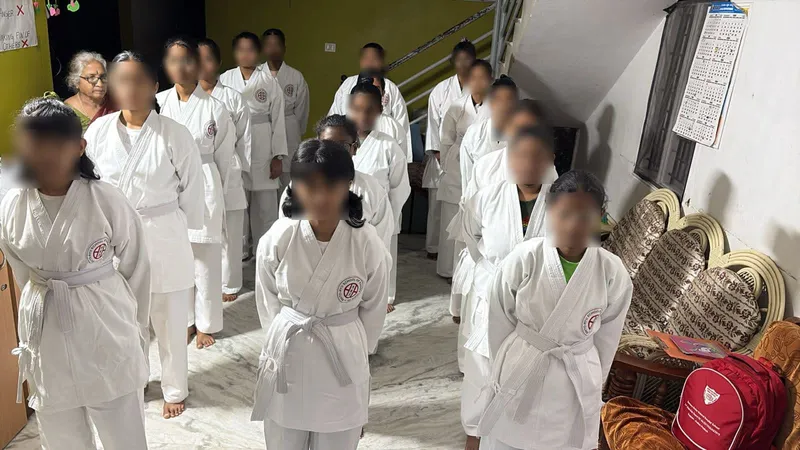
The second, post-trauma care, treats healing as a discipline in itself. Counselling and psychotherapy come first; psychiatry is treated as a last resort, not a first response. Counselling includes art therapy and structured extracurricular activities.
Education is another important intervention. Since many of the children who arrive at Swakshatra aren’t ready for mainstream schooling, the organisation runs its own bridge-education and vocational programme called Setu, which also includes migrant children and adolescents from nearby communities. The Setu learning centre serves 55 people, aged 8 to 35 — a range that includes women from underprivileged communities enrolled in tailoring, nutrition, and computer courses alongside the children.
Swakshatra also has a residential children's home with room for 25 and currently housing 20, ranging in age from 12 to 22 years.
Only a small percentage of the children at the residential home are survivors of commercial sexual exploitation (CSE).
“The majority are survivors of other sex crimes — incestuous abuse within households, sexual assault by various perpetrators, that kind of thing,” Bhavana says.
For many of these children, returning to a conventional classroom is not immediately possible. Around 50–60% of the children from the residential home come to Setu for bridge education because “they aren’t ready for mainstream schooling”.
In 10 years, the total impact has been 75 children, not a large number, but the impact has been substantial. “It was an arduous journey. Even one life matters, given the kind of horror stories we see,” she notes.
Bhavana is clear that they do not yet run an outreach rescue vertical.
“Every child comes to us through a quasi-judicial body called the Child Welfare Committee. We registered under the Juvenile Justice (Care and Protection of Children) Act — the J.J. Act — and the Child Welfare Committee is also a body under that Act. All our children fall under a legal category called CNCP — Children in Need of Care and Protection,” she explains.
Currently, it operates on a “pull” model, responding to information from the community. This will change in 2027, when the organisation plans to launch a dedicated outreach-and-rescue vertical, Gaurav Niwas, under construction in the suburbs of Bengaluru, with room for roughly 50 more children.
“An organisation doing rescue and rehab work specifically around commercial sexual exploitation carries a different, and higher risk profile than general rehab work, so a dedicated, secure facility is needed,” she says.
The children are doing well. Six children recently cleared their 10th standard exams through the National Institute of Open Schooling; two have pursued journalism, one has graduated in law, and another is currently studying it, and others have gone on to become yoga instructors, dental assistants, and computer professionals.
"For us, healing is the real success story — and by that measure, I'd count all 75 children who've come through us as success stories. They dare to heal,” she says.
Bhavana has always known that Swakshatra would be a lifelong endeavour.
She credits the volunteers and the team that makes this work happen every day. Along with organisations such as the Hank Nunn Institute, iProBono and the Alternative Law Forum, which offer consistent support.
“What keeps us going is our children, the extraordinary courage they show. I consider myself a fairly courageous person, but these kids have been through unimaginable horror and still find it in themselves to pick up the pieces, hope for a beautiful life, and keep going — it's humbling. Their courage, the sheer will to survive, fight, and hope — that's beautiful to witness. They are warriors in their own right,” she says.
Edited by Affirunisa Kankudti