



Meet Agimol Pradeep, the Aster Guardians Global Nursing Award winner championing organ and stem cell donation
Indian-origin nurse Agimol Pradeep from the UK has won the $250,000 Aster Guardians Global Nursing Award 2026. She speaks to HerStory about her journey in nursing, transplant care, organ donation, and community impact.


From a very young age, Agimol Pradeep knew she wanted to be a nurse. Growing up in Kottayam, Keralam, the second of four daughters, she recognised the professional and personal opportunities nursing offered her.
After completing her nursing diploma at CSI Hospital, Bengaluru, followed by a course in dialysis and a short stint at Manipal Hospital, Agimol migrated to the UK, where she began her career as a transplant nurse at a Manchester Hospital in 2001.
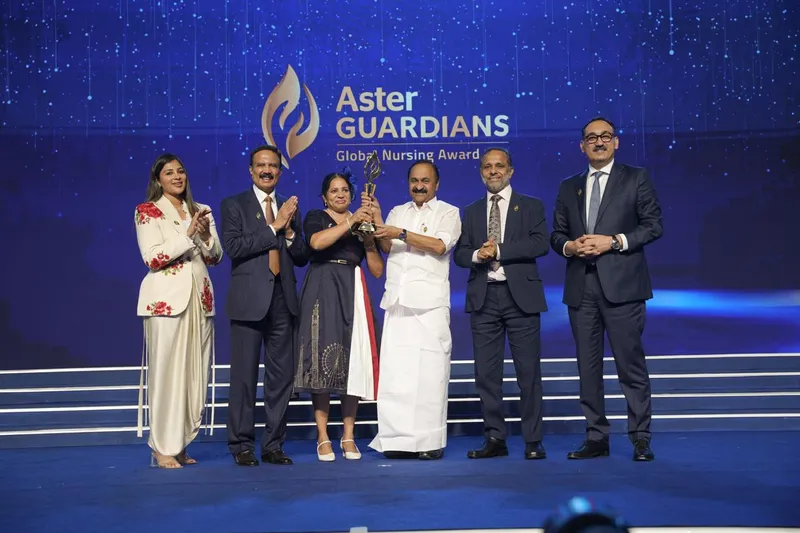
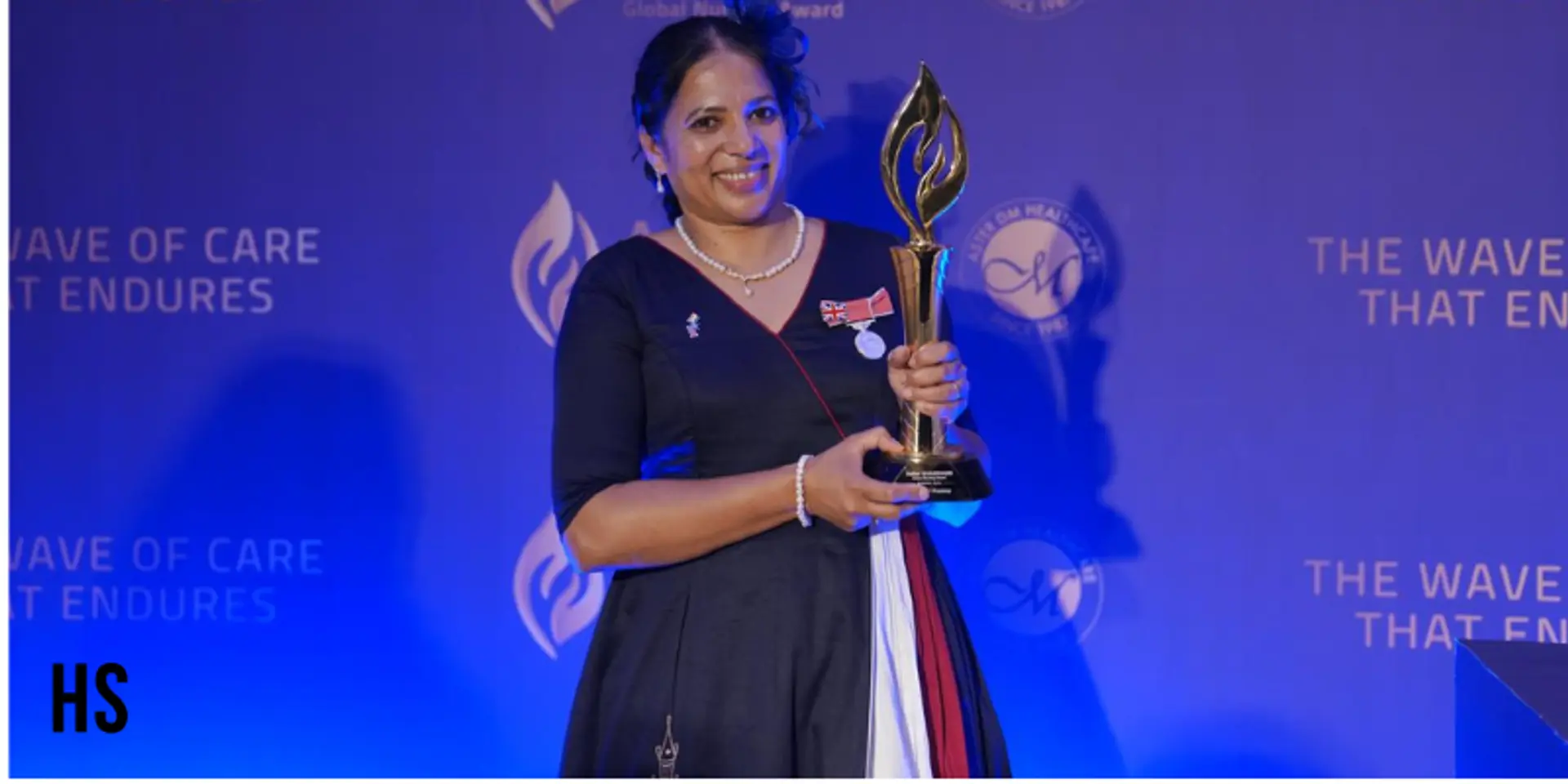
Agimol Pradeep - Aster Guardians Global Nursing Award 2026 winner
Twenty-five years later, the Indian-origin nurse from the UK has won the Aster Guardians Global Nursing Award 2026 for her pioneering work in organ transplantation and stem-cell donation. The award includes a $250,000 prize.
Agimol is a Senior Transplant Coordinator at King’s College Hospital and Honorary Senior Lecturer at the University of Salford.
“I felt truly blessed and humbled. It feels surreal to win the award. I didn’t even have the slightest intuition of winning,” Agimol tells HerStory.
In her first role as an adaptation nurse, she worked under a mentor to build a portfolio of skills until the Nursing and Midwifery Council granted her full registration. She cleared it in six months.
Over the next decade, Agimol pursued one qualification after another. In 2005, she began her degree pathway at the University of Manchester, with support from her employer. She married in 2003, welcomed her first child in 2005, and continued studying through her maternity leave. A fully-funded Master’s degree followed.
She progressed into specialist nursing in transplant care, becoming one of the first Asian nurses to specialise in the field. It also became a turning point that would trigger her entire subsequent journey.
“An Asian patient asked me why he was waiting longer for a transplant compared to other white patients. I went on to work on a dissertation on this topic and got the highest mark in the University. My professor guided me to apply for a grant scholarship to start my PhD,” she says.
The answer, it turned out, had nothing to do with discrimination by the healthcare system. It came down to tissue-type matching. Ethnicity affects compatibility, and a patient’s best chance of a match often comes from a donor of the same background.
In the UK, Agimol found that there were disproportionately more transplant patients from Asian backgrounds than there were organ and stem cell donors from those same communities.
"It is our own community failing our own community; it was because we were not donating,” she says.
Driven by her passion for the subject, she completed her part-time PhD in just three years, well ahead of the allotted six.
“What became evident through that research was that when a nurse-researcher roots her research in the community, working with its members, religious leaders, healthcare professionals, patients and families, she is able to save more lives. I continued along those lines,” Agimol adds.
In 2012, Keralam-based priest Father Davis Chiramel heard about Agimol's research and voluntary work and visited the UK to observe the organ donation and transplant programme firsthand. He stayed with her family for nearly a month while she organised his visit with NHS Blood and Transplant.
During that same visit, a paediatric haematology consultant who had heard about her work told her that Asian children were dying for lack of matched donors. He suggested they act together.
“He knew about my work and told me there were many Asian babies and paediatric patients dying because there weren’t enough donors matching with recipients. He suggested we come together to promote both organ and stem cell donation,” she explains.
By 2014, that conversation had become Upahaar, an organisation dedicated to promoting both deceased organ donation and, crucially, stem cell donation, which, unlike organ donation, can be done during a donor's lifetime.
Agimol carefully explains why that distinction matters to the communities she works with.
Stem cells, she points out, regenerate naturally, roughly every 90 days. Fears, shaped by stories of organ trafficking and medical malpractice, had kept Asian families from even considering donation.
Building trust through community and faith
Upahaar and Agimol’s mission was to create a safe space where patients and families could ask questions about donation openly.
They built trust slowly, through community and faith.
“At religious gatherings, whether Christian, Hindu or Muslim, I made a point of bringing a scholar from that faith along with me, so that any question rooted in religious belief could be answered by someone with the authority to answer it,” she says.
It worked. Upahaar has now grown into a UK-wide network supported by roughly 100 volunteers. According to Agimol, it has registered around 10,000 potential donors. Volunteers identify community events, request a 10- or 15-minute slot on the agenda, and use it to explain, in plain terms, how and where people can register.
Even now, Agimol says the biggest obstacle isn't fear. It can be logistical ignorance—people simply don't know how or where to sign up. The second biggest is outdated information, as many still associate stem cell donation with the old bone-marrow extraction method, unaware that with advanced technology, it’s similar to a blood donation.
Their rallying efforts have seen results. Agimol speaks of a three-year-old Sri Lankan girl diagnosed with cancer and at a critical stage, waiting to find a potential donor match.
“As soon as we heard, we rolled out campaigns, and I remember everyone was so touched by her story that a lot of potential donors came forward,” she recalls.
The girl is now nine years old, living a normal life. Her father recently sent Agimol a picture of her enjoying the summer holidays. She was touched.
“There are many stories like that, especially involving small children—you touch not just that child, but their whole family and extended family, and the parents going through that pain. To me, that's the positive human impact of this work,” she notes.
Reflections on nursing
Eleven years into Upahaar, and twenty-five years into her nursing career, Agimol sees her own profession evolving in real time.
“Historically, nurses were called bedside nurses. Now we have nurses as advocates, educators—nurse researchers, nurse leaders, nurse practitioners. That’s a positive aspect youngsters can look forward to,” she says.
Some challenges, however, still remain. These include infrastructure and pay, particularly the gap between nursing salaries in Asian countries and those in Europe.
Agimol points out that the World Health Organisation (WHO) has projected a shortfall of around 40 million nurses by 2030.
She believes we need to keep talking about it and keep promoting the profession to attract more nurses.
For Agimol, nursing has been a journey of resilience, hope, and human connection. “Nurses are change agents, and nursing is the most trusted profession in the world,” she says, adding that every challenge is an opportunity to learn, improve patient care, and save lives. On difficult days, the thought that someone is smiling or living a better life because of her keeps her going.
Edited by Megha Reddy