



How Enlightened India Foundation is empowering girls in rural Himachal become leaders in their communities
Working across rural Kangra in Himachal Pradesh, Enlightened India Foundation uses education, digital safety, research, and civic engagement to help girls and young women build agency and lead change.

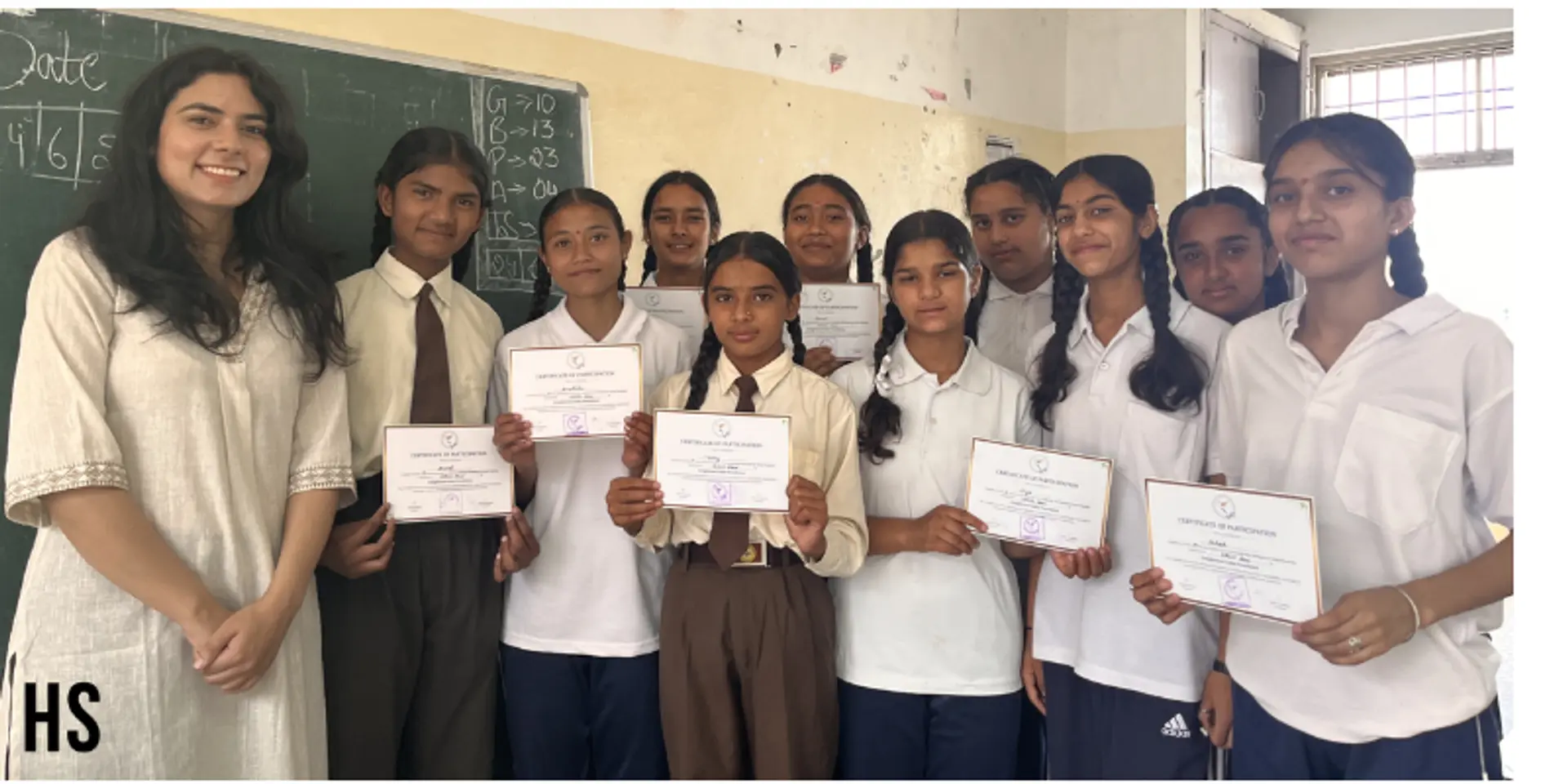

Growing up in Lank, a small village near Shamli in Uttar Pradesh, Smita Choudhary witnessed how differently boys and girls were raised. Girls were expected to leave school early and take on household responsibilities, while boys were encouraged to attend college and build careers.
“My older sisters would get comments like, ab bas, itni padhai kaafi hai, kya karoge padhkar aage (that’s enough studying for now; what will you do by studying further?) I heard all of this as a child,” she recalls.
However, Smita’s parents took a leap of faith and moved the family to Shamli, a small town, so that she could get a better education. This decision led her to higher education at Miranda House, Delhi and a career in corporate communications.
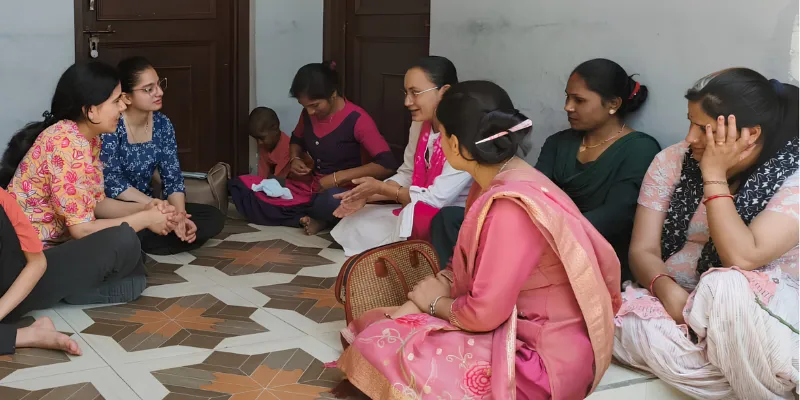
Women taking part in a survey
But a version of her childhood kept following her—the belief that her cousins were living a different life than she was. In 2020, a visit to Kangra in Himachal Pradesh to meet her friend Shivati Jastoria, a teacher, became a turning point.
It also gave her and Shivati the impetus to start the Enlightened India Foundation, a self-funded grassroots non-profit run entirely by young rural women.
When the Covid-19 pandemic hit, Smita had to stay back. With schools shut and a remote job, she used the opportunity to join Shivati and spend time with children.
She saw a familiar inequity. Most homes had just one basic smartphone, and if a family had a son and a daughter, the boy would get the phone for online classes. The girl was pulled into domestic or farm work, cooking, cleaning, and taking care of younger siblings. Despite the responsibility, they had no decision-making power.
“We realised that simply giving them textbooks wouldn’t be enough. We had to build their confidence and leadership skills,” Smita says.
Initially, their aim was small. Confidence first, followed by awareness of legal rights.
“I wanted them to participate in their communities, raise problems in the village panchayat on day-to-day problems, like transport, broken roads, common in the hilly areas of Kangra,” she explains.
EIF conducted learning sessions in Mathematics, English, Science, and coding, along with sports training programmes and life-skills activities.
“As we trained these girls and young women, they themselves showed leadership qualities, which convinced us that we could learn from them and expand our learning hubs because these women leaders would go on to teach more children in their own villages and communities,” says Smita.
They established learning hubs in Sidhpur, Rakkar, and Mohali, reaching out to households and building relationships with families, especially girls and adult women. This was important because girls were being pulled out of school once the lockdown ended, and some who were 17 or 18 years old were told to get married.
EIF understood that once the girls were trained and given agency, they could run centres independently. They were also given a stipend.
The impact
So far, EIF has engaged over 800 households, impacted 3,500 children, of whom 70% are girls, in over 46 villages in the region. The foundation currently has five village-level community leaders and one field associate, all trained through its programmes.
What sets EIF apart is how it responds to everyday grievances that surface during these after-school sessions. When children mention a broken road, a dry tap or patchy internet, it documents them. This documentation feeds directly into EIF’s civic and governance work.
“Recently, we organised a civic and governance workshop in local schools to teach students and girls about their rights, duties, and how local government works. It gives them a safe space to share and submit the problems they see in their villages and communities,” Smita says.
EIF also digitises, categorises, and converts all complaints into a formal report that it sends to the relevant government department. It also visits the departments to explain the issues. The team also follows up to check if the problem was fixed.
EIF is now preparing a fresh report on infrastructure gaps for submission at both district and state levels, aimed at pushing administrative reform across more than 40 remote villages it has already surveyed.
It also recently completed two surveys, led entirely by its women leaders, covering 21 villages in Kangra and presented both reports at the district and state level.
“Our core method is that we find evidence through our surveys first. Based on that evidence, we build our programmes and curriculum, share them with government officials, and then roll them out through schools and our learning centres,” Smita says.
EIF’s work extends beyond school campuses to anganwadis. In remote villages, girls lead digital-safety sessions for mothers and caregivers, following a survey that found many were unfamiliar with online fraud or OTP scams.
EIF’s interventions are seeing more girls participating in learning hubs, largely through word of mouth.
According to Smita, the programme has helped adolescent girls become more conscious of their screen time and better understand online safety.
She recalls a student at a government school who was being harassed online by a boy in her class. Frightened and unsure of how to respond, the girl was reluctant to approach her teachers or the school principal.
She eventually confided in one of the programme’s women leaders, who guided her on what to do next. The woman leader advised her to take screenshots of the messages as evidence, block the boy, and report the harassment to the principal. The woman leader also offered to accompany her and support her if needed.
Priyanka was 17 years old when she joined Enlightened India Foundation (EIF) in 2021. The daughter of a construction labourer from the Gaddi community, she scored 93% in Class X but hesitated to speak up or put herself forward. EIF supported her academically and financially, while giving her opportunities to lead programmes in villages alongside her studies.
She went on to study Mathematics, Physics, and Computer Science, while taking on responsibilities ranging from organising educational programmes to conducting field research and working with Panchayat representatives. Today, she is EIF’s Project Coordinator for Kangra district, coordinating research and governance initiatives across around 50 villages.
Priyanka’s goal is to become a fighter pilot in the Indian Air Force.
Challenges and way forward
EIF has faced resistance in taking its digital-safety sessions to schools. Some schools were initially reluctant to organise them. To address this, the organisation approached the District Magistrate, the ADC and the District Education Officer in Kangra, shared its findings and sought official permission to conduct the sessions. With government approval, schools that had initially declined eventually agreed to host them.
The foundation also wants to expand its operations to other villages and also in Uttar Pradesh and Uttarakhand.
EIF runs on Shivati’s and Smita’s savings and salaries. Most of its learning hubs operate from community centres and its biggest backers are panchayat leaders.
“Our survey reports were well received, and we have told the government we would welcome any scheme they would like us to work on, or any assistance they need in reaching remote villages where their own departments haven’t been able to make an impact. We are collaborating with government schools and the government more broadly now—that’s the direction we’re taking,” she says.
Edited by Megha Reddy