



[Teacher’s Day] How Preetimayee Sahu is taking STEM beyond textbooks at a Kalahandi govt school
Preetimayee Sahu, a science teacher in a government school in Kalahandi, Odisha, is helping students from tribal communities explore STEM through experiential learning.

![[Teacher’s Day] How Preetimayee Sahu is taking STEM beyond textbooks at a Kalahandi govt school](https://images.yourstory.com/cs/4/8e7cc4102d6c11e9aa979329348d4c3e/TeachersDayHSOption11600x900-1788573332583.jpg?mode=fit&crop=faces&ar=16%3A9&format=auto&w=1920&q=75)

In a classroom in Kesinga Block of Odisha’s Kalahandi district, science lessons are increasingly moving beyond textbooks.
Children are building models of plant and animal cells and the solar system. They are experimenting with magnetic fields, using a home battery to light a bulb, making bioplastic from banana plants, and exploring how waste could be converted into green energy. They have also worked on wastewater management and learned how houses could be designed to better protect people during floods.
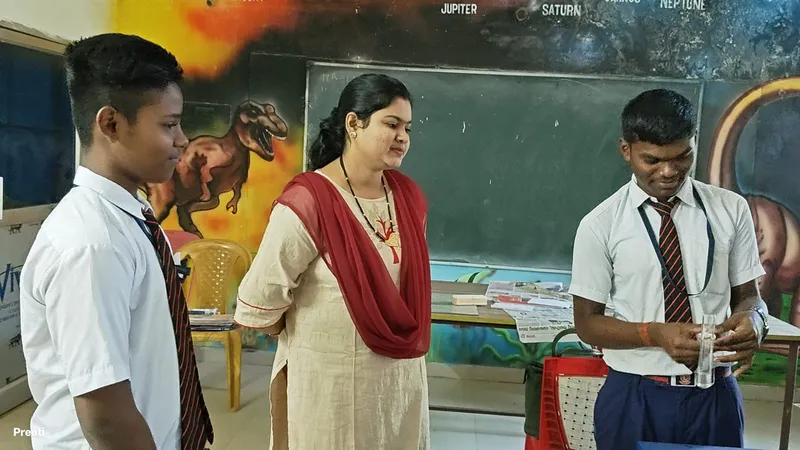
Preetimayee with students
But this kind of hands-on learning was not always part of the classroom experience.
In Kesinga, where a significant proportion of the population belongs to tribal communities, schools faced the challenge of making classroom learning more engaging and meaningful.
Teaching remained largely traditional. Students had limited opportunities to experiment, explore scientific concepts, or connect what they learnt to problems in their everyday lives.
At PM SHRI Government High School, Kesinga, science teacher Preetimayee Sahu is driving change through the school’s STEM Club.
She has been introducing students from Classes VI to VIII to experiential learning, encouraging them to think beyond the curriculum. As part of the intervention at her school, ORF (Odisha Rising Foundation), a momentum partner in the Shikshagraha STEM Collective, works on the ground to train teachers and strengthen STEM learning in Kalahandi district
Teaching runs in Preetimayee’s family. Her grandfather and several of her uncles were teachers. Inspired by them, she also wanted to make a difference in the lives of children in her village, particularly girls and those from families with limited resources.
“I wanted these children to get a good education and be able to do something in life. I want their family conditions to improve in the future, and I want them to become independent and be able to stand on their own feet,” she says.
Preetimayee completed her BSc (Honours) in Botany in 2019 and was in the seventh month of her pregnancy when she appeared for the teacher’s qualifying exam. She joined the school after her child was born and has been teaching since December 2023.
Kalahandi, once synonymous with poverty and hunger in the 1980s, has changed considerably over the years. Preetimayee says more people are educated today, but many families continue to face difficult economic circumstances.
“Many of the children in our school come from families where parents work as daily-wage labourers or take up other forms of manual work. Some run small shops. The support and guidance the children need at home is not always available,” she explains.
When STEM learning becomes engaging and fun
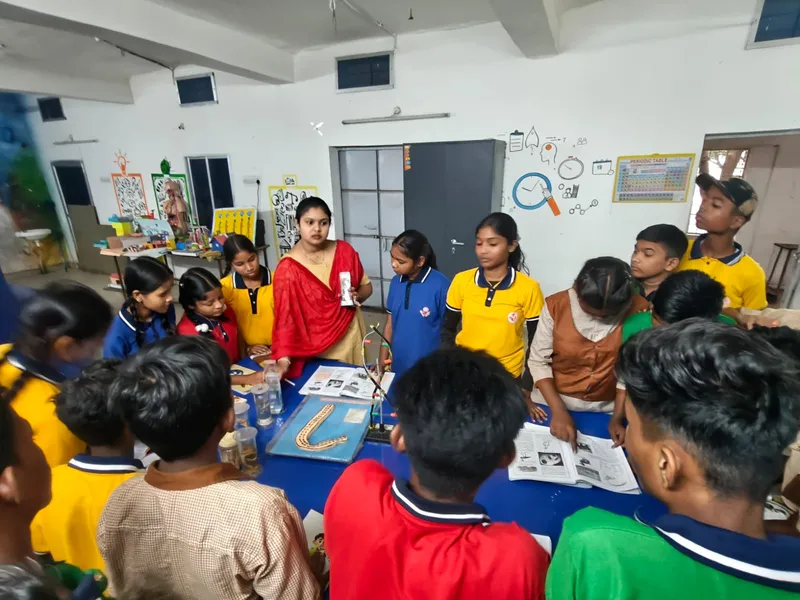
A session in progress
When Preetimayee became a Guide Teacher, she began looking for ways to bring more activity-based learning into her classroom through the STEM Club.
With support from Headmaster Sameer Kumar Behera, she introduced students to a range of STEM activities, from experiments using Teaching-Learning Materials (TLMs) and practical demonstrations to group projects that encouraged teamwork.
“The children are encouraged to make and experiment rather than simply learn concepts theoretically. They build models of plant and animal cells and the solar system, explore magnetic fields, use a home battery to light a bulb, and work on projects around waste, recycling, wastewater management and green energy,” she elaborates.
Students also learn about internet-based research, basic coding and artificial intelligence. The school also houses an Atal Tinkering Lab (ATL), which gives students access to project equipment.
The school has 373 students across Classes VI to VIII, including 120 students in Class VI, 113 in Class VII and 140 in Class VIII. With large classes, it is not always possible for a teacher to interact with every student individually.
Preetimayee noticed that when science was taught theoretically, some children struggled to remain attentive.
“When we conduct practical activities, we see much more interest among the children. They participate, ask questions, and want to know how things work, how they can make things themselves,” she says.
After establishing the STEM Club, the school also set up STEM Mini Science Labs where students and teachers worked together on projects. With guidance from their teachers, students also began developing their own Teaching-Learning Materials (TLMs). In the process, along with scientific concepts, they are also developing practical skills, creativity, and problem-solving abilities.
Preetimayee says the STEM Club has led to a two-way learning experience.
“We learn together. Sometimes there are things I am not aware of. I am learning new things while working with the children,” she says.
The students’ active participation in the STEM Club has seen positive results. In addition to a noticeable improvement in their understanding and problem-solving skills, they are now participating in competitions at the block, district, state, and national levels.
"The STEM Club shows what becomes possible when children are given the space to ask questions, test ideas and learn by building, experimenting and finding solutions themselves. But this kind of change is not about one teacher or one classroom. It needs teachers to have the trust, support and space to try new ways of teaching,” says Santosh More, Co-Founder & Director, Mantra4Change and Weaver, Shikshagraha.
“Preetimayee looked at what was available around her students and used it to create learning opportunities. When teachers are supported to do this, classrooms can become spaces where children take greater ownership of their learning. That is the kind of change Shikshagraha aims to build across the education system,” he adds.
Meanwhile, Preetimayee is excited to introduce students to more STEM Projects.
“There are many problems that we face in our daily lives. STEM training should be connected to these real-life problems. Children should be encouraged to think about solutions and make projects using things that are easily available around them and do not cost a lot,” she says.
Edited by Megha Reddy