



A retired engineer’s mobile school is transforming lives of Bhatinda’s underprivileged children
After retiring from Indian Railways, electrical engineer KK Garg repurposed a tractor trolley into a fully functional mobile classroom, educating underprivileged children.


In many parts of Bathinda, Punjab, not every child has the option to go to school. Data from the Sarva Shiksha Abhiyan Punjab indicates that Bathinda's overall literacy rate was 69.6%, with male literacy at 75.3% and female literacy at 62.9%.
KK Garg first-hand saw the deplorable condition of education in the region when he traveled the length and breadth of Punjab as an Indian Railways electrical engineer. He saw hundreds of children in slums by the railway tracks, spending their formative years in poverty and abandonment.
“I knew that I would come back to this cause one day,” he tells SocialStory.
After retiring in 2006, he decided to do something about the complex and deep-rooted crisis and built a mobile school.
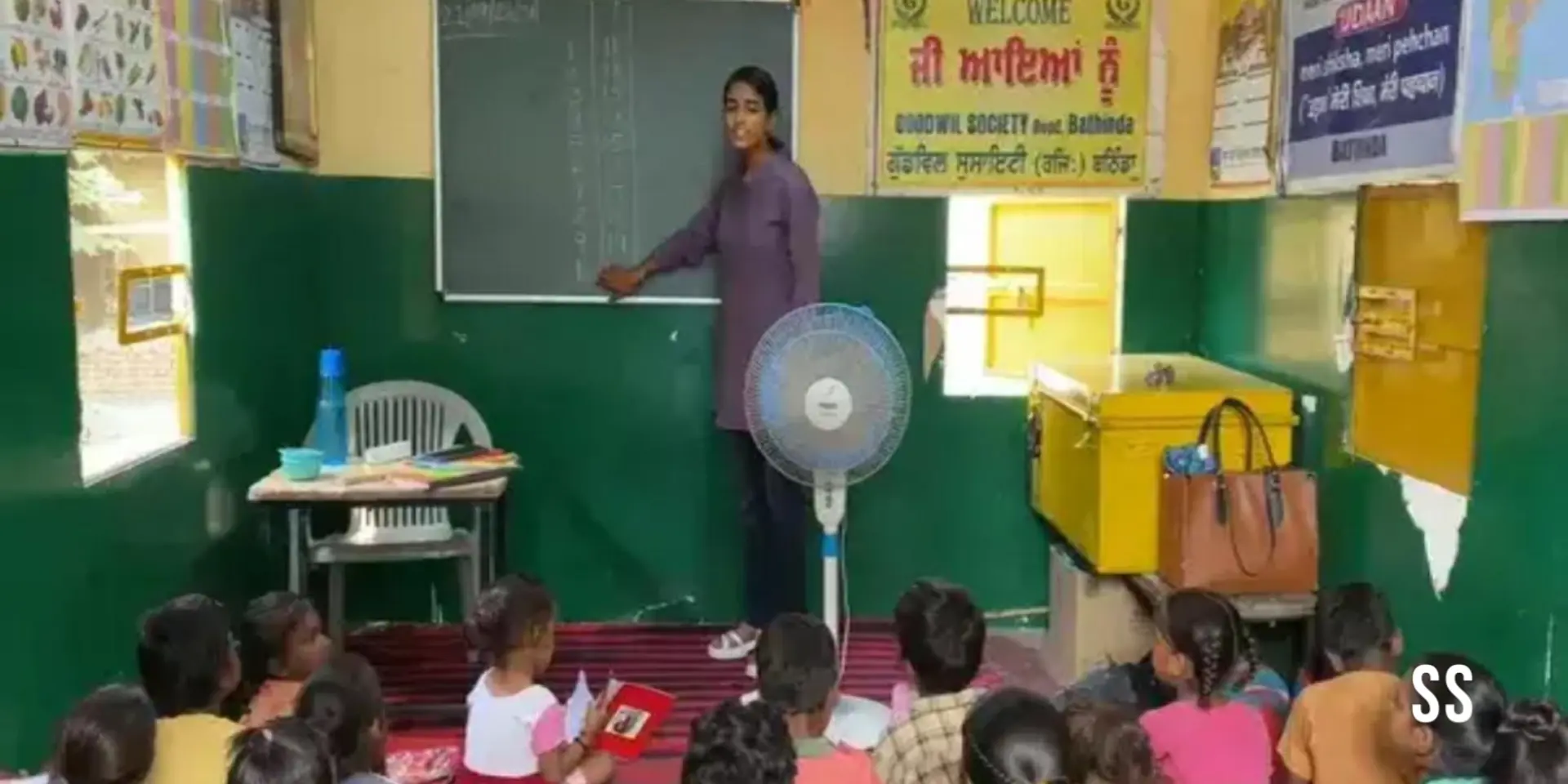
With Punjab being a farming state, tractors are widely available. Garg decided to put his skills to use; he took a tractor trolley, built piping and created waterproof panels, gave it a gypsum board lining to keep the heat out, and added lights, fans, and a blackboard.
The Goodwill Mobile School was started as an operation under the NGO Goodwill Society in Bhatinda (which Garg joined after his service). It runs skill centres and educational programmes for disadvantaged children.
The Goodwill Mobile School trolleys have been travelling through various neighborhoods in Bathinda, focusing on slums and remote areas where traditional schools are inaccessible. Each mobile classroom is equipped with basic learning materials, and classes are conducted in two shifts, from 2 pm to 4 pm.
The initiative also addresses a critical infrastructural gap. With thousands of migrant families moving through the city each year, many children lack the documentation required for enrollment in formal schools. The mobile school bypasses this hurdle, offering flexible and inclusive access to education without the red tape. This kind of schooling is designed to accommodate the varying needs of children, allowing them to attend classes without conflicting with their responsibilities at home, says Jaswinder Singh, Founder of the Goodwill Society.
“We saw that many children living in slums and temporary settlements were unable to access formal schooling,” he adds. “We had to find a way to bridge that gap.”
According to his team at Goodwill Society, the mobile school’s route has been planned such that it stops in areas where school dropout rates are the highest. Teachers are roped in on a voluntary basis and are trained to cover basic literacy, numeracy, and general knowledge in Hindi and Punjabi.
For many students, this is their first encounter with formal learning. Teachers use storytelling, interactive games, and visual aids to engage learners, who may have had little or no exposure to conventional classrooms. They give basic education—reading, writing, and maths, while also giving lessons on social values and practical life skills.
“The response has been encouraging, and the local communities have lent their support consistently,” says Garg.
In 2024, the 14th Goodwill Mobile School was rolled out, covering almost 1,000 children under the programme. The team has also been instrumental in enrolling children into government schools after one year of training through the mobile school.
The initiative has largely been funded through community donations and local partnerships. The bus itself was refurbished and customised for its educational purpose using support from individual donors and private sponsors. Volunteers, including retired teachers and college students, regularly assist with lessons and logistics.
“The Goodwill Society envisions scaling the initiative further, with hopes of deploying more buses across Punjab, ensuring that every child has access to learning, no matter where they live,” says a member of the Goodwill Society. “For now, we have halted this service until the next academic term begins this year. We plan to come back with a more detailed roadmap that addresses different factors leading to illiteracy and child labour.”
Edited by Kanishk Singh