



Where care meets justice: Kerala’s groundbreaking project for queer-inclusive public healthcare
Through a first-of-its-kind collaboration, the State Health Systems Resource Centre – Kerala and Mariwala Health Initiative are working to embed queer-inclusive practices in the public health system.

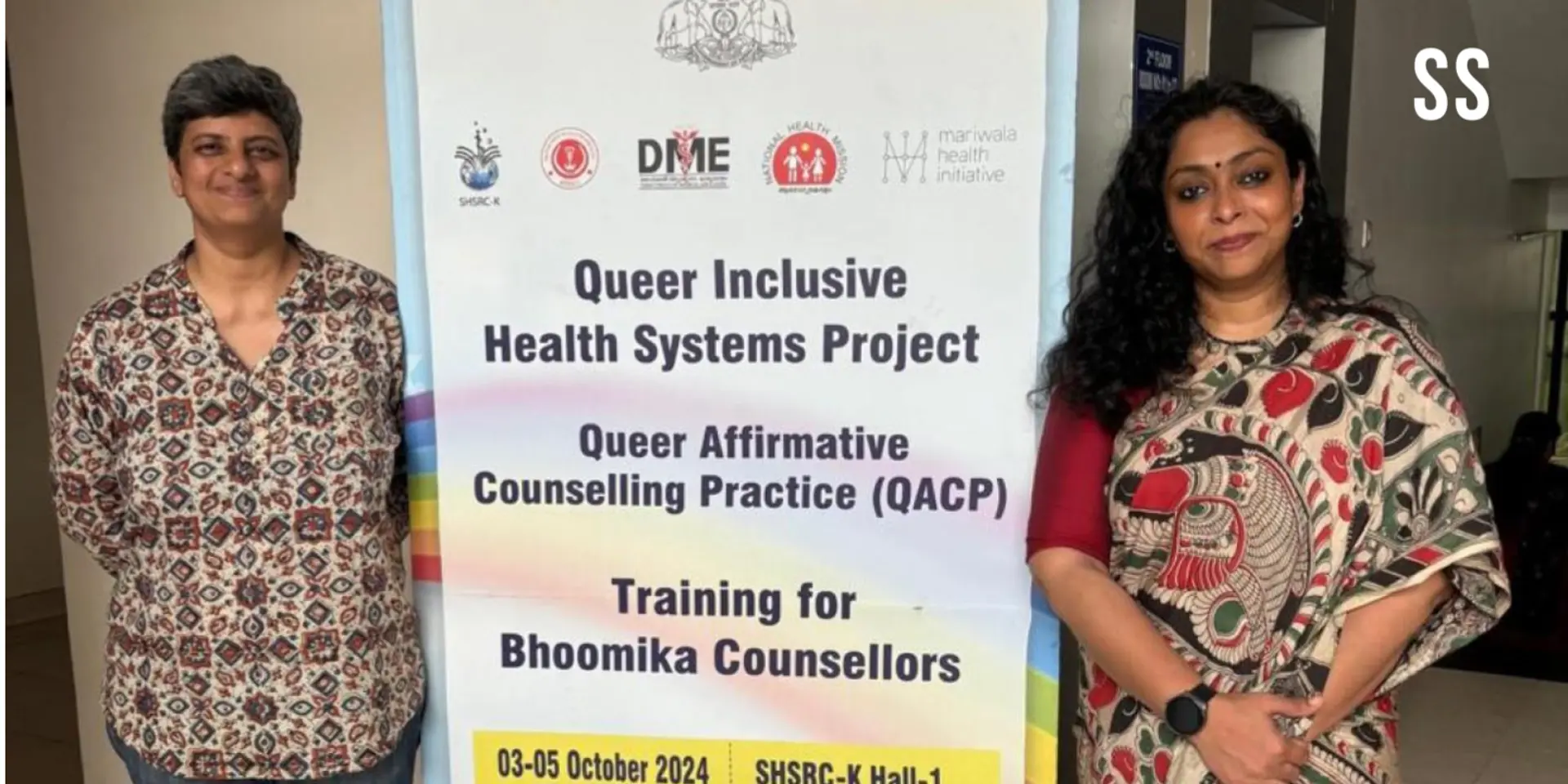

Can public hospitals in India champion dignified healthcare for queer and trans persons? Kerala is stepping up to realise that vision.
The State Health Systems Resource Centre – Kerala (SHSRC-K), a technical support institution under the Department of Health and Family Welfare, Government of Kerala, and Mariwala Health Initiative (MHI), Mumbai-based mental healthcare non-profit, have joined hands to create a queer-inclusive public healthcare model in government hospitals across the state.
The Queer Inclusive Healthcare System programme is led by Dr V Jithesh, Executive Director of SHSRC-K, and Pooja Nair, Mental Health Consultant and Queer Affirmative Healthcare Practice (QACP) faculty at MHI.
In a country where marginalised communities at the brunt of discrimination often struggle to access quality healthcare, this collaboration aims to reimagine the hospital not just as a site of treatment, but as a space of change, inclusion and belonging.
"Trans persons have a right to affordable healthcare. Public health systems must be proactive in ensuring that care is not just accessible, but also affirming," Nair says.
Working from the ground up
At its core, the three-year-old project recognises that discrimination against trans and queer persons happens at every level of the healthcare system, from the security guard to the specialist doctor.
The programme addresses this through four core interventions.
- Sensitisation training to all hospital staff—from administrative personnel to frontline workers.
- Queer Affirmative Counselling Practice trainings for mental health professionals working within government hospitals.
- Peer counselling training for trans community members identified as Community Link Workers (CLWs), to act as bridges between the medical system and the communities they serve.
- Training of Trainers sessions with healthcare professionals, to build internal capacity and ensure long-term sustainability of the initiative.
The initiative's success hinges partly on Kerala's already robust public healthcare system. With a widespread network of primary health centres and a history of investment in universal care, Kerala is uniquely placed to take this leap.
In 2015, Kerala became the first Indian state to introduce a comprehensive policy aimed at safeguarding the rights and dignity of trans individuals. The policy affirmed their right to self-identify (irrespective of surgical status), included them under healthcare and insurance schemes, and proposed shelter homes, day-care centres, and HIV surveillance efforts.
While MHI has attempted similar collaborations in other states, the resistance has often been stark, says Nair.
“In most places, we are the ones knocking on doors, trying to convince systems to let us in. We are starting from a better ground. We’re working with people who want to learn. Doctors are saying, ‘We should be doing better, but we don’t know how.’ That’s a very different problem than apathy,” she adds.
Through the Bhoomika programme—a pre-existing state initiative which places trained counsellors in government hospitals—MHI is also training professionals in queer-affirmative mental health. These mental health professionals not only offer direct care but also help patients navigate the healthcare system, making them key allies in the push for inclusion.
“Most other states don’t even have counsellors in their hospitals,” Nair points out. “Kerala does. That allows us to build on something real, not start from scratch.”
Gaps and ways to fill them
Despite the state’s progress, the State Policy for Transgenders in Kerala, 2015 has not permeated to state government departments, says Devutty Shaji, a transwoman and CLW, has been at the forefront of the trans rights movement in Kerala. Among other things, she has been pushing for strict action against doctors who sexually harass trans patients.
“Our community members have to beg even for basic needs,” she says.
Shaji has been appealing for pensions for transpersons above the age of 45, as she says by then, many struggle with illnesses due to years of poor nutrition, lack of shelter and proper healthcare, unlike many cis-persons.
“No government hospital in the state does Sex Reassignment Surgery (SRS). For some time now, the state has been telling us that government hospital doctors will be sent abroad to be trained in SRS before doing it here, but that too has not happened. This means that an entire population of trans persons who are already marginalised and do not have economic freedom are denied the scope for the surgery, which is a crucial stepping stone to their right to dignity and self-identification,” says Shaji.
However, SRS or Gender Reaffirming Surgery, which requires highly detailed microsurgical work, can only be performed by expert doctors, says Shakhiya S, a transman consulting with MHI on the initiative.
Kerala has seen tragic instances of transgender individuals resorting to suicide following complications of SRS. Anannyah Kumari Alex, Kerala's first transgender radio jockey, died by suicide in July 2021 after she experienced severe physical discomfort and alleged medical negligence after undergoing SRS at Renai Medicity in Kochi in 2020. The Kerala government ordered an inquiry into the incident, but the case remains unresolved.
“We understand the risks and complications involved in this and are now working with the government to train doctors to become experts in the procedure. We are also cognisant that doctors who are trans affirmative and believe in the dignity of the community must be the ones getting training,” says Shakhiya.
Community at the centre
He also points to negligence, misgendering and sexual harassment that the trans community has faced in hospitals in the state—an issue he hopes the CLWs will be able to iron out. These trans persons trained in peer counselling and healthcare navigation help trans patients access services, interpret processes, and advocate for themselves within the medical system.
It’s a model borrowed from Kerala’s own pandemic response, where Migrant Link Workers helped non-Malayali workers access healthcare during crises. It hinges on the idea that inclusion is most meaningful when it is guided from within the community.
Nair believes trans people are more likely to seek help when they see someone who understands their reality. “Even the best queer-affirming private hospitals cannot solve these issues, because they are not accessible. If we are serious about equity, then we need to invest in the public. The public health system is not just where care is offered. It is where rights are realised,” says Nair.
This trust, believes Shakhiya, is beginning to show results.
“So far, the trans community in Kerala has felt underconfident to ask for what it needs. Even when the state launches initiatives for us, we would accept what we get and move on. For the first time, we have a queer-affirmative organisation like MHI representing our needs and struggles at the government level. We feel we are in good hands,” says Shakhiya.
(The copy was updated to reflect a correct designation.)
Edited by Kanishk Singh