



Weaving hope from waste: How EcoKaari is transforming lives through plastic
EcoKaari, founded by Nandan Bhat, upcycles plastic waste and makes handwoven products using the charkha and handloom. It also empowers underprivileged women by skilling them and giving them a steady income.

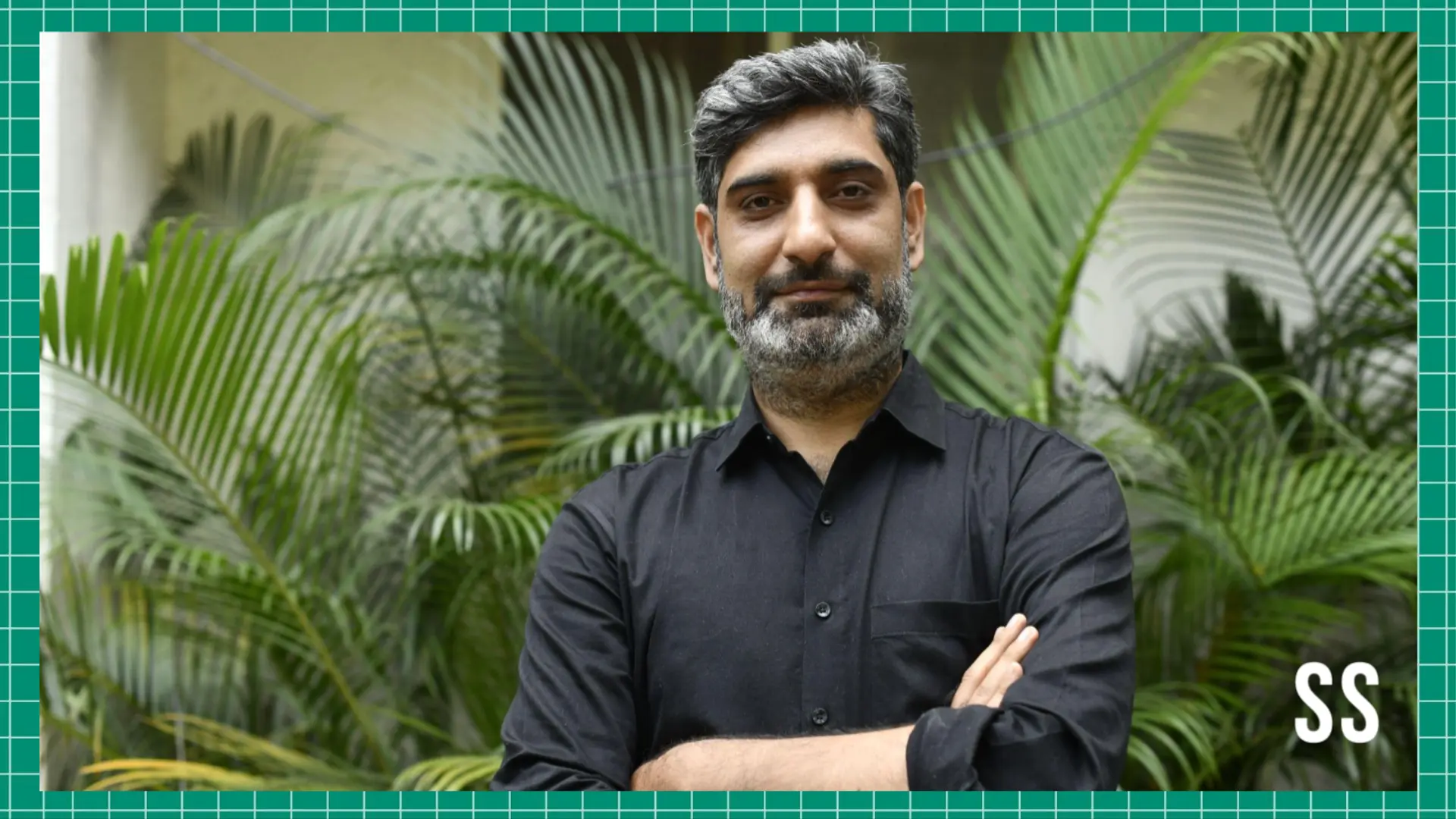

The 90s were unsettling times for Nandan Bhat and his family. After getting displaced during the Kashmir exodus—leaving behind their apple business and moving to a migrant camp in Jammu—they settled in a one-room apartment provided by the government in 1999.
Meanwhile, Bhat moved to Mumbai to pursue engineering and then to Pune for his MBA. In the early 2000s, he bought a flat and finally moved his family to the city, giving them a permanent home.
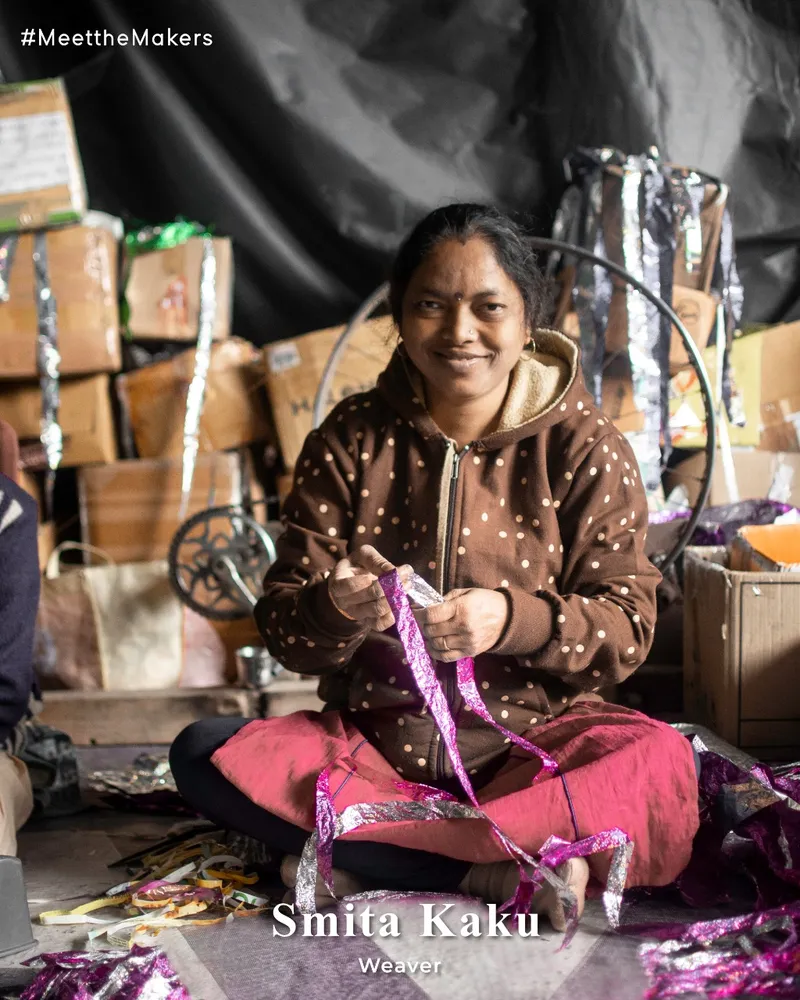
Smita Kaku - a weaver at EcoKaari
This early experience of losing everything and rebuilding from nothing shaped Bhat, the founder of EcoKaari's approach to creating opportunity where others see only waste.
EcoKaari is an organisation that upcycles waste plastic into beautiful handcrafted fabrics using the charkha and handloom.
The idea for the startup was ignited during Bhat’s many treks through the Sahaydri mountains, where he was deeply disturbed by the growing piles of discarded plastic marring the landscape's natural beauty.
"Trekkers will take care of the mountain because that's what they love. But the tourists will go for weekend getaways... and then dump a lot of garbage—whiskey packets, bottles, plastic containers,” he recalls.
While hard plastic items like bottles get collected because they fetch decent money for waste pickers, soft plastics—wrappers, bags, packaging—remain scattered across the landscape, choking waterways and scarring the earth. "Nobody picks the soft plastic because there's no commercial market attached to it," Bhat observes.
This realisation led him to make a dramatic shift and pursue something with purpose. For 16 years, Bhat climbed the corporate ladder across companies like Satyam Infoway, Tata Telecom, and Big Bazaar, before starting up Aarohona Eco Social in 2015. He moved from the firm to start EcoKaari in 2020.
Learning the loom
While the purpose and intent were clear—to convert plastic waste into something useful—Bhat realised he couldn’t transform an industry he didn’t understand without learning the craft himself.
In a blind school in Pune that taught weaving, Bhat learned the technicalities to transform plastic waste into functional fabric. “I had to learn where the thread comes from, why it’s crisscrossing, what the moving parts are, how it is maintained, and if there are gaps in fabric, how does one tackle that?” he explains.
He visited the handloom unit every day from 10 am to 6 pm for three months to take it to the next logical step—to train others.
Bhat collaborated with SWaCH, a non-profit that works with waste pickers in Pune, to collect plastic waste. Initially, he employed 2-3 people to pick up waste, two for weaving, two for tailoring, and one person to manage the operations.
The metamorphosis of discarded plastic into beautiful, usable fabric requires patience and precision. "You get the plastic, wash them, sanitise them, dry them, and then sort them colour-wise. Once the sorting is done, you cut them using a pair of scissors into long strips, then that's done on the charkha and then to the handloom,” he says.
The process is labour-intensive, taking close to 1 to 1.25 days for one person to make one fabric, but the transformation is almost magical. What was once destined for landfills or oceans becomes colourful, durable material for bags, accessories, and more.
However, the challenges are many. It begins with the collection itself. "Plastic is one of the dirtiest things if it goes out of your home. It's either mixed with food waste or with health waste or even sanitary waste,” notes Bhat.
This contamination creates not just practical problems but also human dignity and health issues, for a waste picker has to use their hands to pick up all kinds of waste, including sanitary waste.
Despite this, EcoKaari has persevered and developed multiple sources for plastic waste. Most heartening is how communities have embraced its mission: "We get 40% of our raw material from donations from households. People store plastic at home, and once it's a sizable amount—10 to 30 kilos—they ship it at their own expense to our recovery unit,” he shares.
Empowering women with jobs and financial independence
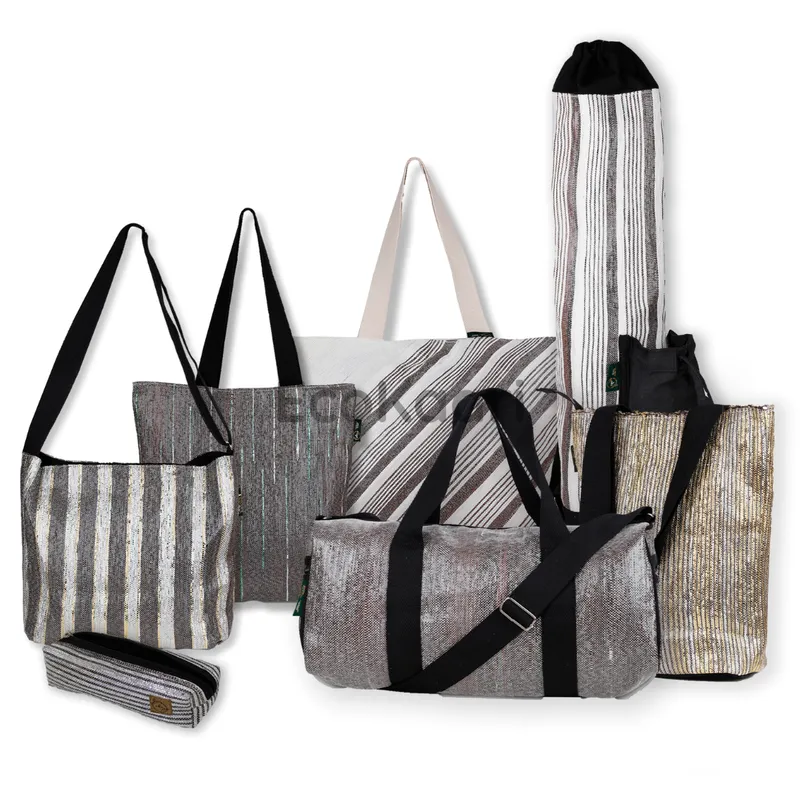
Some of the products of EcoKaari
Women are at the heart of what EcoKaari does. It has trained close to 125 weavers in three locations—Kolkata, Ballari, and Pune. Bengaluru is its strongest B2C market, followed by Pune and Mumbai.
In Ballari, EcoKaari works with women over 35 from highly marginalised backgrounds—women who have been pushed into exploitative situations and then discarded as they age.
Working with JSW Foundation, it has created four Self-Help Groups (SHGs) where these women earn Rs 8,000-15,000 monthly, depending on how much they work. The transformation extends beyond income.
"Now, banks are giving them soft loans under the SHG scheme. Children are going to school; health checkups happen every month," Bhat says.
It has also expanded to Kolkata in partnership with Jindal Poly Films. Recently, Bhat returned from Kargil, where EcoKaari will train war widows from the 1999 conflict.
Corporates, too, have chipped in. Among EcoKaari's most successful initiatives is its three-year partnership with ITC, where pre-consumer plastic waste from factories gets a new lease of life in the hands of EcoKaari’s artisans.
"It's an end-to-end project for us. The plastic comes from their factory—it's pre-consumer waste—and we convert it into fabric. Then they ask us to make totes, lunch bags, and pouches, which they give away to students in the schools they work with."
This circular economy offers multiple benefits. ITC reduces waste and strengthens its sustainability commitments; students receive useful, eco-friendly products; and most importantly, artisans gain stable income through consistent orders.
A similar partnership with Nestle has transformed discarded Maggi packet rolls—those with barcode errors or expiry date misprints—into new products.
For EcoKaari, sustainability begins at home with its production waste finding purposes. "The waste we generate is given to an organisation called Rudra, which makes biofuel out of it through pyrolysis. They heat the plastic in closed chambers. It breaks down to its original form, crude oil, which is then given to factories for heating purposes,” he elaborates.
Finding fame and changing lives
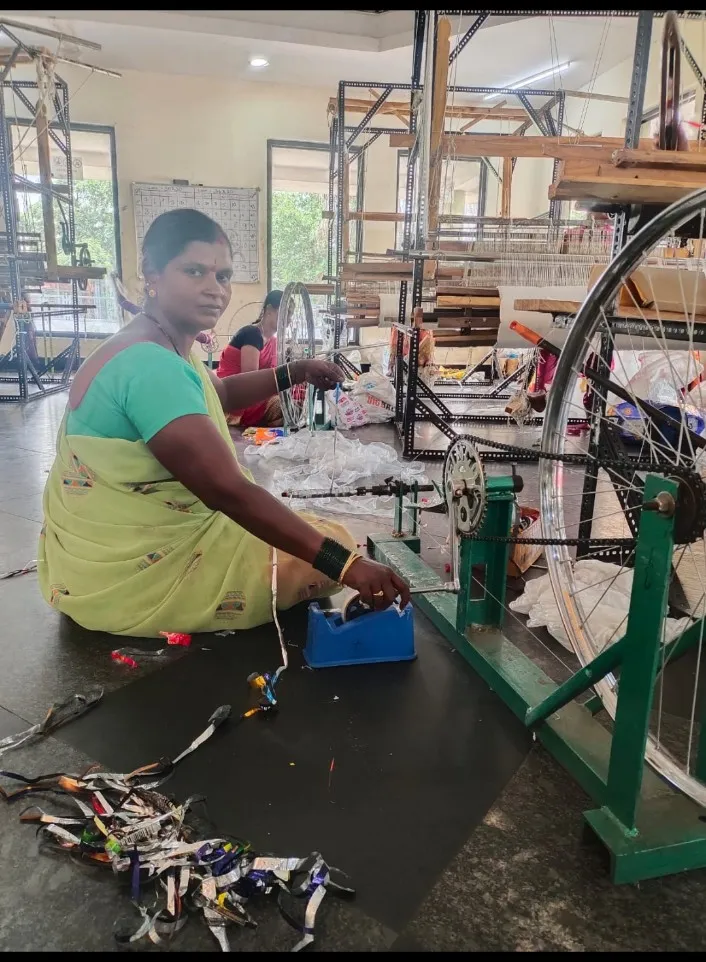
An artisan at work
EcoKaari’s collaboration with fashion designer Gaurav Gupta took the brand on the ramp of Lakme Fashion Week in 2021.
“He also made a bomber jacket from our fabric that was worn by Ayushmann Khurana for his movie 'Chandigarh Kare Aashiqui.’ Kareena [Kapoor Khan] was also a showstopper for an event, wearing something partly made by EcoKaari,” he says.
Despite the acceptance by the fashion industry, Bhat is sceptical. "The problem with big designers is that they act like sharks. They'll take the fabric and say, 'I will not pay you for it. I'll give you one little social media post.” I have to feed artisans. His social media post doesn't work for me,” he admits.
For individual customers, products, including handbags, wallets, purses, backpacks, and other accessories, are available on its website and through exhibitions across India.
EcoKaari’s customers include urban, environmentally conscious customers living in metros and sub-metros, earning between Rs 25,000 and Rs 30,000. However, a lack of awareness and the willingness to pay remain challenging.
Bhat points out EcoKaari’s bags start at Rs 1,200, and the sweet spot for bags in India remains less than Rs 1,000.
EcoKaari was recently awarded the Climate Innovation Award by SELCO Foundation through Kula Innovate—India’s first sector-wide Innovation Challenge designed to bridge the massive R&D gap across craft-based value chains.
“Our research during Business of Handmade revealed that over 80% of craft-led enterprises in India lack access to the patient capital needed to take risks, test ideas, and build future-ready solutions. For enterprises like EcoKaari, this support has been catalytic, unlocking capital, networks, and visibility,” says Priya Krishnamoorthy, Founder of 200 Million Artisans, which Kula Innovate is a part of.
Unlike many social enterprises dependent on donations, Bhat reveals that EcoKaari has achieved profitability with an 8% bottom line last year. "I don't like to burn money because we haven't raised any," he states.
"By this year's end, we will have close to 350-400 artisans working with us. In the next five years, we would like to have 100-plus units, each with 50 artisans—that's 5,000 artisans in total. Each unit can produce close to Rs 2 crore in revenue and upcycle 2 lakh plastic bags every month,” he says.
Edited by Suman Singh