


How Kshetra is using the power of dialogue to drive lasting change
Bengaluru-based Kshetra Foundation for Dialogue uses the Dialogic Method, a framework to help users harness dialogue for different purposes, to create multiple, sustainable outcomes.

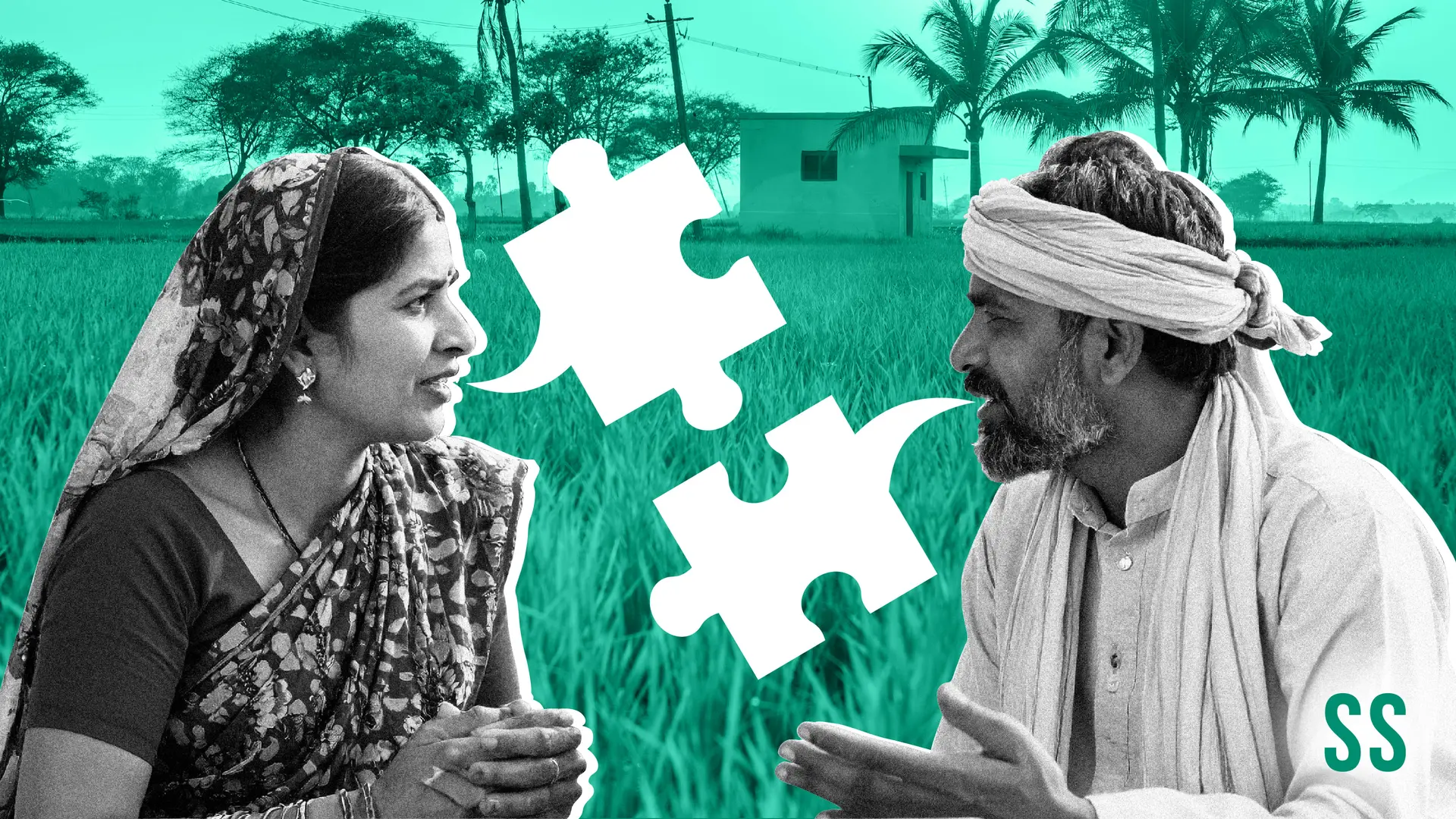

Women gathering at communal water taps was a familiar scene for Krishna Udayasankar, who would often watch them fight for water from her apartment balcony in Bengaluru.
These daily heated engagements weren’t just about water scarcity; they were about something deeper: the lack of dialogue.
"This is not about us going in and solving people's problems. It has to be about people figuring out how to solve their own problems and having conversations,” she tells SocialStory.
This realisation would lead to the formation of the Kshetra Foundation for Dialogue in 2022 and the Dialogic Method—a tool that helps people change the way they participate in any situation by creating value, discovering new approaches to a situation, and co-creating solutions that last, at individual, community, and societal levels.
The breakthrough
With a law degree from National Law School of India University, a master’s from Sydney, and later, a PhD in business-government-society interactions from Singapore, Udayasankar spent nearly two decades in academia, grappling with a fundamental question: how can strategic philanthropy coexist with business interests and mutually benefit from each other?
After she returned to India “for good” a month before the pandemic lockdown, a casual Facebook update unexpectedly forged her path. “The next day, somebody I know calls me saying, 'Hey, there's this idea, and we want somebody to sort of run with it. We don't even know what it looks like,'" she recalls.
The idea came from Rohini Nilekani, the philanthropist and author of Samaaj, Sarkar, Bazaar. Udayasankar had spoken with Nilekani after her book was released, and her vision of strategic philanthropy—where these forces could "coexist and mutually benefit each other"—aligned perfectly with her years of academic research.
While she left that first meeting not understanding how it would pan out, the sight of daily water conflicts in the slum settlement behind her apartment brought clarity.
She went back to Rohini Nilekani Philanthropies (RNP), who agreed to incubate the organisation for three years, providing the foundation for what would become a systematic approach to dialogue-based change.
Udayasankar illustrates the simplicity of the concept through an interesting take that she calls the “orange metaphor.”
“It’s lunchtime. You and I are both hungry. But there’s only one orange. The typical response? Cut it in half, with both parties getting less than they wanted. Or one person graciously sacrifices their share. Or they both walk away frustrated,” she says.
Neither party got what they really wanted. Why? Because they failed to ask a simple question—"What are you going to do with this orange?”
"Maybe I want the peel for garnishing my salad, and you want the pulp for juice. But because we didn't ask, we never discovered the complete value inherent in this orange,” she poses.
The Dialogic Method is based on the idea that the value inherent in any situation is never completely exploited because we do not have an approach to have an exchange to extract the full value.
The method behind the magic
Udayasankar spent a year researching the Dialogic Method framework, drawing from law and negotiation, mediation, peace-building, psychology, and principles of business strategy, among other disciplines.
This structured, replicable framework is a three-step process with three components each, creating a "three by three" approach:
Define: The first step involves asking three crucial questions—what, why, and who. Instead of dealing with problems at the surface level (the what), the method pushes participants to uncover underlying motivations (the why) and identify all stakeholders, including the invisible ones (the who).
Understand: This addresses information asymmetry, the reality that most conflicts arise from incomplete or emotionally filtered information. "Anything I tell you is my interpretative view. My perspective is layered on top, and sitting on top of that perspective is my emotional response to that situation," Udayasankar says.
Solve: The final step focuses on co-creating multiple solutions rather than finding the "right" answer. There can be a hybrid solution. Because everyone involved contributes to the solution, implementation becomes more sustainable and actionable.
Real-world transformations
Over three years, Kshetra has worked with 25 organisations, reaching about 28,000 people across diverse contexts, from panchayat members in Karnataka to anganwadi teachers in Telangana, to changemakers in the Northeast.
One powerful example involves a changemaker in rural Assam who works towards skilling physically challenged women to become economically independent. She had spent six years trying to convince a mother to let her daughter with a locomotor disability receive beautician training. It became a community issue, and she was asked why she was bothering them again and again. The mother also prioritised her disabled son's education over her daughter's skill development, even carrying him on her back to college every day.
After a workshop where she learned the Dialogic Method, the changemaker shifted from confrontation to conversation.
She was able to negotiate and schedule the training for her daughter during the summer holidays when her son was home. "Let's fix the fixables rather than say it can't be done," became the new approach. The community's perception shifted from "this can't be done" to "this looks doable."
Another striking example comes from a panchayat in Davangere district, where women were initially silenced by male members. Three months after training, the same women had found their voice, not through aggression, but through gentle assertion: "They said, ‘Please, I am speaking. I will finish. You please wait your turn, sir!’ has worked wonders,” notes Udayasankar.
Unlocking potential
Kshetra recognises that dialogue isn't just about resolving conflicts, it's about unlocking potential before conflicts arise.
"We always thought dialogue was something that comes in handy when there is a perceived conflict. But what we discovered was that it was never about conflict. It was about bringing people together. It was about creating those collaborations,” she says.
Policymakers now use it to drive policy narratives, conflict resolution, peace-building and community mobilisation.
It has expanded to Dialogic Leadership, which Kshetra took to business schools. Conservation groups, too, apply it to environmental challenges.
Challenges and evolution
Despite its proven impact, Kshetra faces unique challenges. The work is "issue agnostic"; they don't focus on specific areas like climate change or gender equality, but rather on improving the process of change itself. This makes them harder to categorise for funders and partners who typically work within defined verticals.
"Our aim is to reduce changemaker failure rates. It's always going to be a tough job, but can we reduce the failure rate?” asks Udayasankar.
Initial attempts to explain concepts like the "iceberg model" (where only the tip is visible) fell flat when Udayasankar found herself asking rural Telugu speakers if they'd seen the movie Titanic. "I was a laughing stock that day," she laughs.
The solution? The foundation developed the "dialogue tree" metaphor instead, where visible leaves represent surface issues, but the roots underneath are held together by soil representing various stakeholders. If leaves are withering, do you treat the leaves or nourish the soil with nutrients?
A sustainable future beyond incubation
Most of Kshetra’s current work remains pro bono, and it operates on a sliding scale where organisations with budget capacity are asked to contribute. Those without resources receive free training.
It is exploring a revenue-generating model through corporate partnerships and also expanding beyond civil society to engage with corporate clients, not just as a revenue model, but as a way to create bridges between different sectors.
In an era of hybrid work, text-heavy communication, and increasing polarisation, the need for genuine dialogue is timely and relevant. As she puts it, "In hybrid mode, you need dialogue even more."
Systemic transformation
Kshetra is developing a "dialogue quotient"—a way to measure dialogic capacity at individual and organisational levels, similar to IQ or EQ assessments.
"What does a dialogic person look like? What does a dialogic organisation look like?" Udayasankar asks. These questions point toward a future where dialogue becomes as fundamental to human development as literacy or numeracy.
From that quiet realisation on the balcony to mobilising 28,000 people nationwide, Kshetra is redefining how meaningful change begins. "We are not changing what social change looks like. We are just trying to add to it,” she concludes.
Edited by Suman Singh