



How Majikhan Mutva has taken Lippan art from a small Gujarat village to the world
Majikhan Mutva, a Lippan artist from Kutch in Gujarat, narrates his incredible journey from being a labourer to carrying forward an ancient art that is giving him and his community new life.

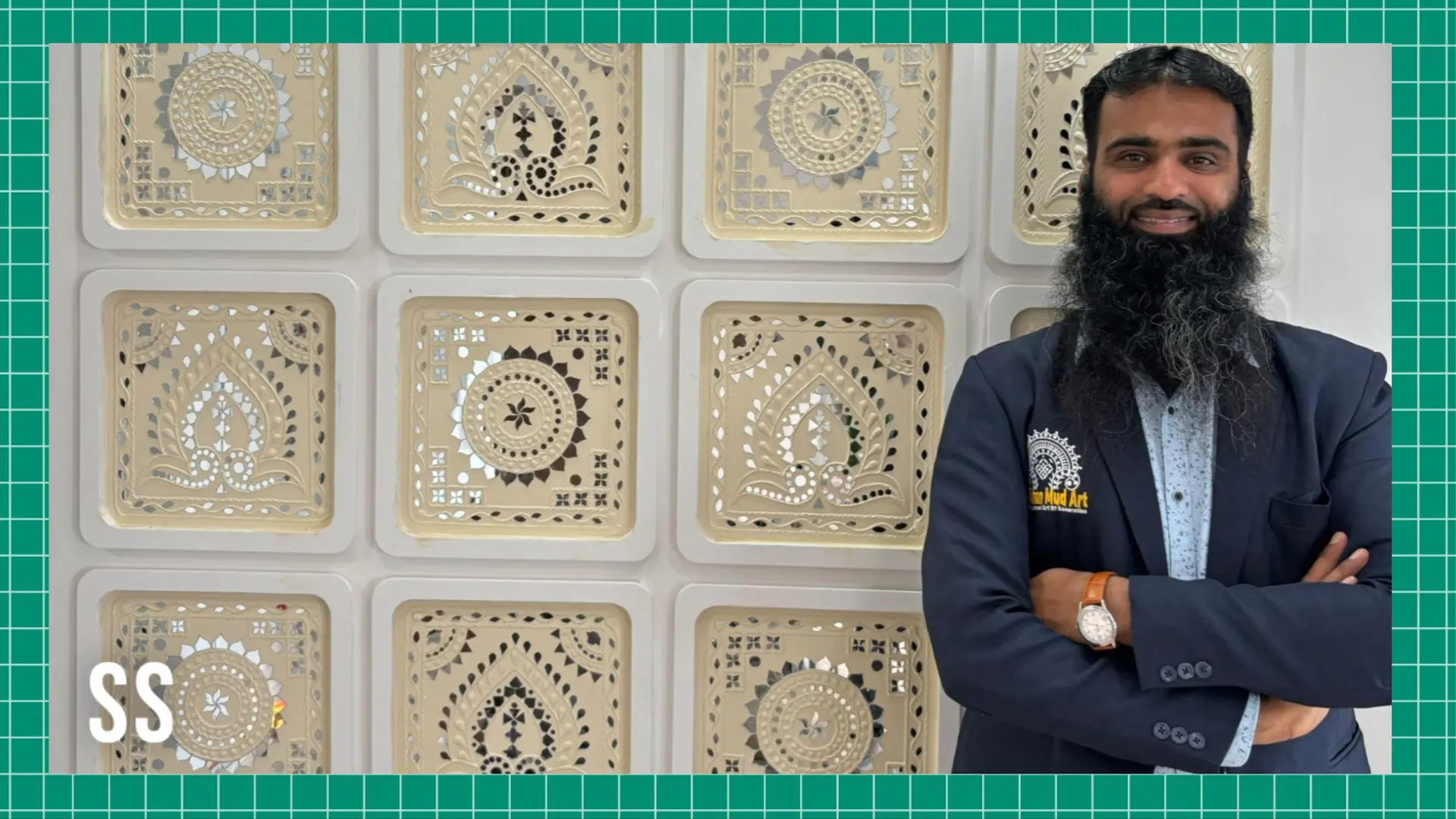

Majikhan Mutva’s rise from a labourer to an acclaimed artisan has been nothing short of extraordinary, and a trial by fire.
Hailing from Siniyado village in the White Rann of Kutch in Gujarat, Majikhan is a proponent of Lippan art, a 450-year-old traditional mural craft of the Mutva community. This intricate craft uses mud and mirror work to decorate walls and floors with intricate patterns.
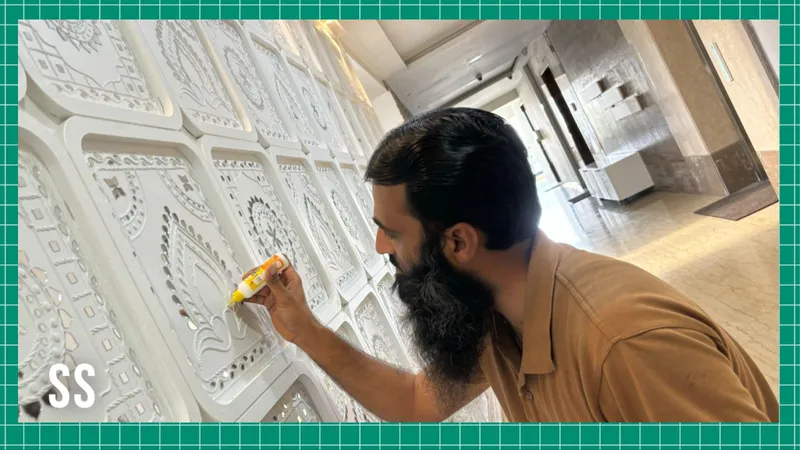
Majikhan Mutva
With few masters of Lippan art left in his community, there was no legacy for Majikhan to inherit. His father, a bus driver, was barely home for a few days in a month. He passed his Class 10 board exams, the only one in the class of 19 students to do so, and, despite his family’s protests, he chose to drop out of school. He was more interested in working and earning a livelihood than pursuing further education.
“My father tried to make me understand how education was valuable for a good future. I was adamant about dropping out. In the end, he became helpless enough to agree,” Majikhan recalls.
From 2006 to 2010, he worked as a mason, constructing buildings and hauling coal and soil on his head, hard physical labour that continued to weigh on him.
“I had studied up to the 10th standard, and yet I was working as a labourer. I thought, ‘was this my aim in life?’” he recalls.
In 2019, he got a job as a security guard at an ATM, which changed his life a little. He no longer toiled under the sun and wore better clothes. But the respect he yearned for was still missing.
A chance encounter and a new beginning
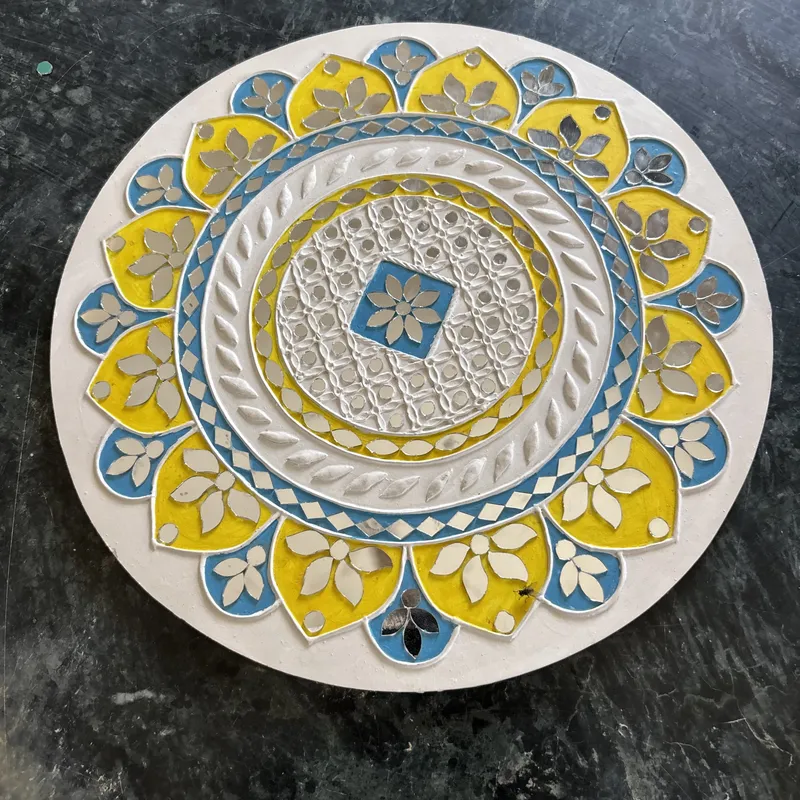
Lippan art
In 2013, a Lippan artist, his father’s friend, came to withdraw money from the ATM where Majikhan was working. They got talking and he learned that the artisan had come to withdraw Rs 55,000 he earned through the art in just 15 days.
“I was shocked that an artisan from the community could earn so much. The information brought a ray of hope. I asked him to teach me. On April 20, 2013, he took me to his workshop and trained me for 45 minutes. He gave me some clay and a 1.5-foot MDF piece and asked me to start practising. My transition from an ordinary Majikhan to artisan Majikhan had begun,” he says.
Armed with the knowledge and practice, Majikhan travelled to Bhuj with only Rs 485 in his pocket to buy material needed for the art.
“I had money to buy the MDF, but none to buy the wood for support or other material. The shopkeeper was kind enough to give me what I wanted for the money I had. When I came out of the shop, I had no money for food, let alone for a ticket to go back home. My friend who had come with me paid for the ticket,” he recollects.
Majikhan showcased his products at the Rann of Kutch Festival and got his first order for Rs 6,000. Though he continued to work at the ATM, the long commute ate up both time and his earnings. In 2014, he took a job as a plant operator in a chemical factory, working 12-hour shifts and pursuing his art later in the night.
The same year, on a lark, he posted his art photos on Facebook, introducing himself as a Lippan artist from Siniyado village in Kutch.
“People began to understand more about the art, and in 2016, I posted videos on YouTube just using a voiceover with images. I started getting calls on the number we shared with the posts,” he says. He also experimented with his art, making nameplates, which took off instantly.
A story that touched millions
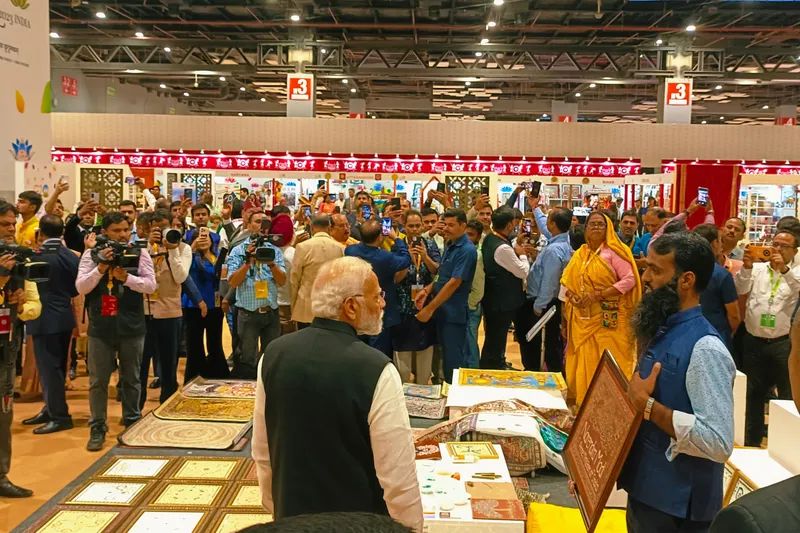
Majikhan Mutva with Prime Minister Narendra Modi
When Amazon India launched its Karigar programme in India in 2017, Majikhan reached out but was rejected in a few seconds.
“They were sceptical because they thought the products would break during shipping. I asked them to give me a chance and promised that if the products didn’t sell, they could remove me from the platform. After a prominent person in Kutch recommended me, they agreed to include me in the Karigar programme,” he explains.
For six months, he didn’t receive a single order. Amazon was surprised to hear this and assigned him a manager. Meanwhile, Majikhan continued travelling to different cities for customised orders. He also did Facebook Lives and posted videos on YouTube.
“In the midst of all this, Amazon decided to do a “story” on my life and art. They came to my village to shoot the video. It was posted on the Amazon shopping app and my image was plastered on billboards in different cities. This received great traction and my media presence grew and people began trusting the products,” Majikhan says.
In his small village, Majikhan transformed a kutcha hut into a studio with just Rs 2,000. He shot professional videos on his mobile phone, and, despite patchy internet, showcased his art to the world. This innovative studio setup earned him an invitation to Google India’s Impact Program in 2023.
Sales grew, and soon Majikhan Mud Art was available on Amazon, Etsy, and its own website, in addition to fulfilling customised orders for individual and corporate clients. He also exports products to Australia, Canada, the US, Dubai, Abu Dhabi, Oman, London, and other countries.
The handcrafted pieces are priced from Rs 1,600 onwards.
High praise and taking the art forward
The accolades poured in. In 2023, Majikhan was invited to present Lippan art at the G20 Summit in Delhi where he met Prime Minister Narendra Modi.
“He greeted me in Kutchi and said, ‘Majikhan ne to kamaal kari didho’ (Majikhan has done amazing work!)” he shares. He has also worked on a Lippan art project inside Rashtrapati Bhavan.
In 2023, he finally left his job at the chemical factory, convinced that this art was his true calling. Today, he employs 35 people, many of them women who specialise in mirror and colour work. He has also expanded his operations to two workshops so that he can employ more people.
Students from NIFT and Karnavati University also visit to research on the art and history of the craft. Majikhan also encourages children from his village and nearby villages to come to his workshop and learn the art. He still shoots videos on his mobile phone, but the old phone has now been replaced by an iPhone, a small but powerful symbol of how far he has come.
Lippan art, a mainstay of the Mutva community, was traditionally done by women for generations to decorate their homes, but it lost its sheen over time. As only a handful in the community still practise the art, Majikhan’s success offers hope for its revival.
Looking back, the artisan acknowledges the pain, hardship, and hard work it has taken to reach where he is today. But his goal goes far beyond himself.
“I want to create 500 more Majikhans who will use this art to lead better lives,” he concludes.
Edited by Megha Reddy