



This IAS officer is quietly revolutionising rural education in Rajasthan’s Dholpur district
Avhad Nivrutti Somnath, IAS officer and CEO of Zilla Parishad in Dholpur, Rajasthan, is helping school children understand the principles of democracy and also setting up digital libraries in the district.

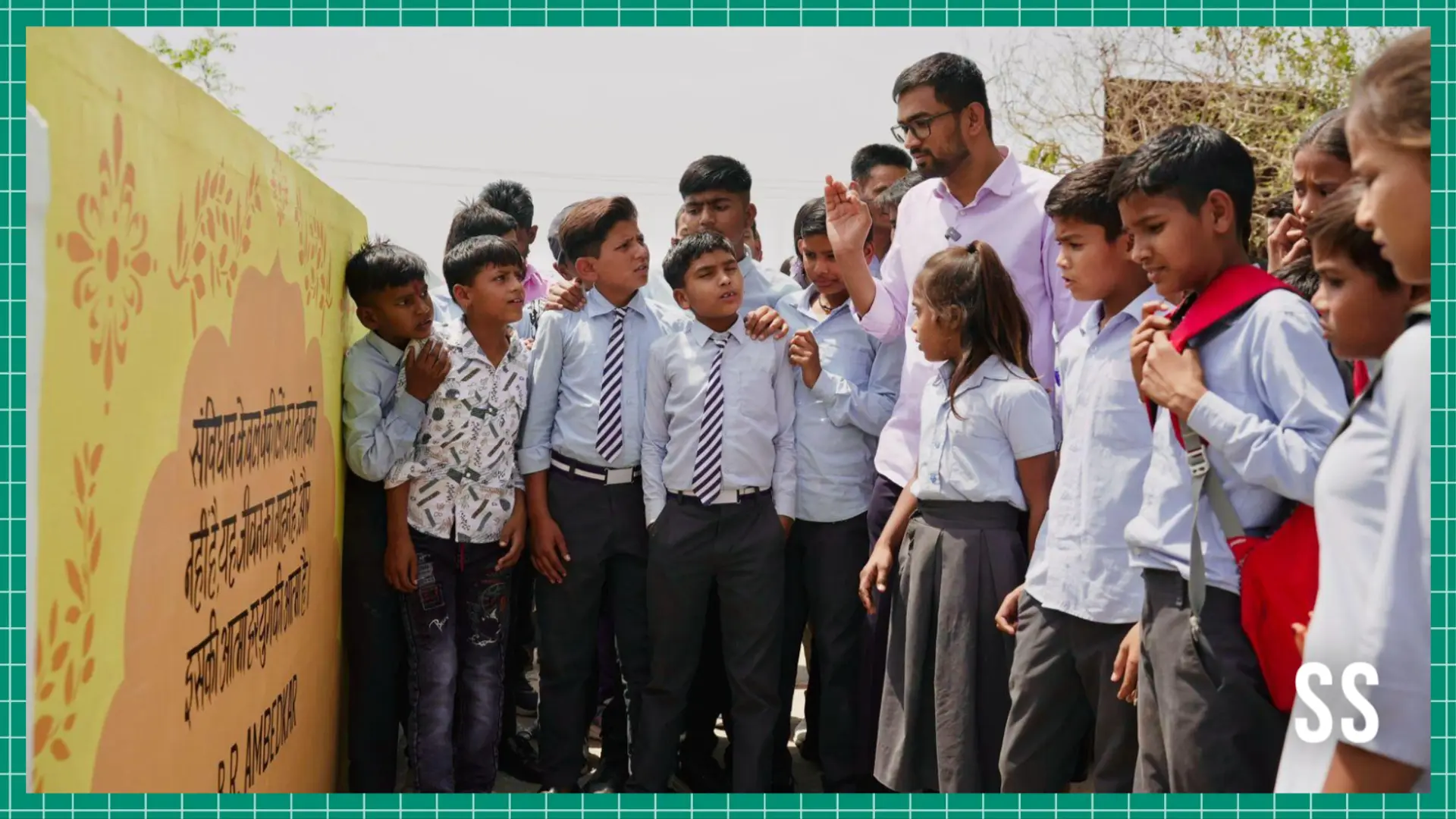

Avhad Nivrutti Somnath made the journey to Dholpur House, the building that houses the Union Public Service Commission (UPSC) in Delhi, five times before finally becoming an IAS officer.
In a serendipitous twist, in 2024, Somnath’s third posting was as CEO of Zilla Parishad in Dholpur, a district in Rajasthan, where he launched two path-breaking initiatives that are quietly revolutionising rural education and creating constitutional awareness in one of the state’s most challenging districts.
Somnath grew up in Gulvanch, a village in Maharashtra’s Nashik district.
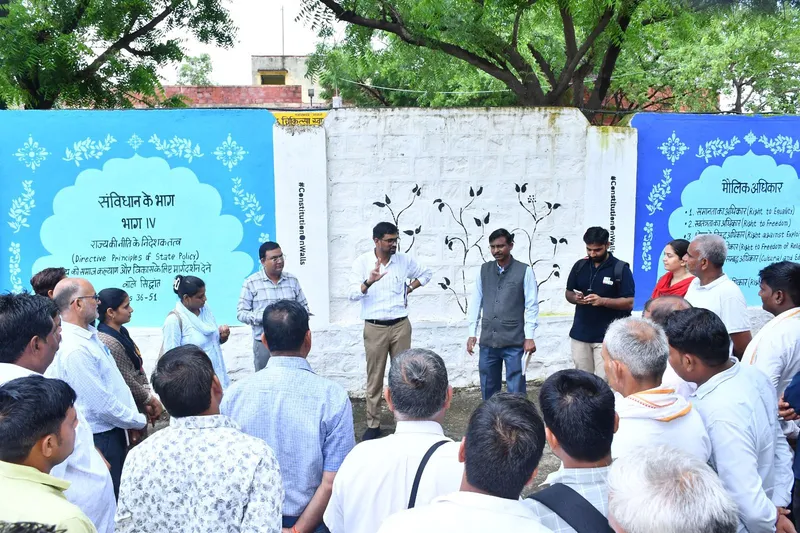
Avhad Nivrutti Somnath speaking at a gathering
After completing his mechanical engineering course, he moved to a tribal district in Odisha to work at a steel plant. He planned to move to the United States for further studies, but the recession of 2011-12 put paid to his plans and he found himself in a corporate job instead.
The isolation was suffocating. "The town had just a single screen theatre. I hardly had any friends, and used to only go to work. I thought this was limiting me as a person. I wanted a space where I could explore and express myself,” Somnath recalls.
His engineering batchmate suggested appearing for the civil services exams. Living in a remote area with not much time to study, he appeared for the state civil services in 2014 but failed. The following year, he cleared it. In 2016, he got into the Indian Revenue Services (IRS) but according to him, it was limiting him as he was not a “debit-credit kind of person.”
He continued attempting the civil services examination and finally, became an Indian Administrative Service (IAS) officer in 2021 in the Rajasthan cadre.
A realisation that led to an initiative
Posted at Dholpur in late 2024 after stints in Barmer and Bhilwara, Somnath found himself in one of Rajasthan's ‘aspirational districts’, a classification reserved for India’s most backward regions requiring focused development intervention.
During the course of routine school inspections, Somnath found his defining insight.
What troubled him was a glaring oversight.
“The first page of the school textbooks contains the Preamble that outlines the fundamental rights and duties. And, how many people are paying attention to that? Why was the preamble not given its due importance,” he observes.
Recognising that the ‘Kitab ka Pehla Panna’ (the first page of the book) encapsulates the soul of our democracy, Somnath launched the Chandrajyoti Abhiyan to bring the Preamble out of obscurity and to life in young minds. Thus was born the Kitab Ka Pehla Panna initiative.
His first stop was at the Purani Chowdhury School near his office where he spent time talking to the teachers and students. After visiting 10-20 schools, he decided to launch it on ‘mission mode’.
In a short span of time, the Abhiyan spread its wings to 350 schools, reaching over 50,000 students from Grade 5 to 11. Through Bal Sansad (Youth Parliament) sessions, children understand the principles of democracy, governance, and civic responsibility.
Primary school children started reciting the Preamble during morning assembly. Over 700 educators, especially political science teachers have received training aligned with the National Education Policy (NEP) to help them introduce constitutional principles as part of classroom discussions. The learning experience includes debates, quizzes, role-play and poster-making competitions.
Somnath points to the walls of the Zila Parishad office painted with different aspects of the constitution.
“What is the constituent assembly, who were the members in its making, what are the fundamental rights and duties, the different schedules of the constitution, inspiring quotes are all on the wall,” he explains.
The Abhiyan has also made a mark in the communities through gram sabhas and child-friendly panchayat meetings where students witness and participate in grassroots governance.
The movement gathers momentum
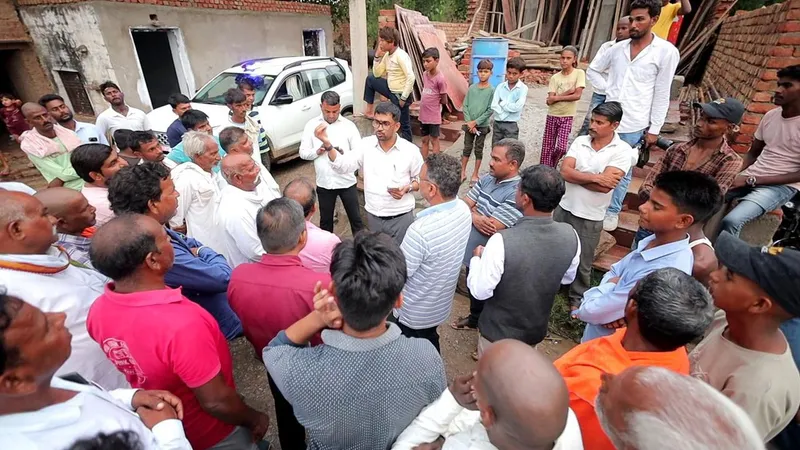
During his field visits for the Kitab Ka Pehla Panna initiative, Somnath noticed many unused government buildings, once functional, were now lying idle.
"At one time, the government invested so much money. Why should that asset go through such a level of misuse or disuse?" he wondered.
His solution was to convert them into Digital Samvidhan Ghars or vibrant learning spaces.
The ‘Digital Samvidhan Ghar’ project envisions 28 state-of-the-art digital libraries in the first phase and 23 in the second phase across all six blocks of Dholpur district. But these are not mere libraries.
"It's a physical community space that has computers, smart TVs, internet, printers, e-access, portal management, library management system and web-based. Physical books too remain part of the collection,” explains Somnath.
Here, civil service aspirants, readers, and community members will have access to newspapers, books on law and governance, and educational material. Fifteen libraries have been opened so far.
Investment for each library comes from multiple sources: government funds, CSR contributions, and contributions from village panchayats.
A library management committee will include the village development officer, members of the community, political representatives and a teacher. In certain areas, these spaces will be known as village resource centres to enable women SHGs to hold meetings.
“It’s not just a library, it’s also money from the community being invested for the community,” says Somnath.
He emphasises that the focus on these libraries will ensure that “youth energy” will be channelised in the right way.
“These will also be safe, inclusive spaces for girls living in a patriarchal society. They have a good place to study,” says Somnath.
These libraries have solar lights, water filters, and a no-plastic policy, ensuring a future-forward 'green' model for learning spaces.
Interestingly, the Digital Samvidhan Ghar calendars are synced with school activities such as Baal Sansad practices, debate clubs, and quiz preparations. They also make it easier to attend Ratri Chaupal (night gathering) sessions, linked to gram sabhas and parent information clinics, drawing in adults and fostering civic discussions.
Problem-driven iterative adaptation
Stakeholder resistance, especially convincing sarpanches to participate in the initiative was a challenge, initially. But this was overcome when they were convinced that their contribution will create a sense of community and ownership.
Behind these initiatives lies what Somnath calls the “PDIA” approach–‘problem-driven iterative adaptation’ approach. Rather than imposing top-down solutions, he continuously adapts strategies based on ground realities.
"My approach is problem-driven. Accordingly, my planning is dynamic. It’s my first project, and I am learning a lot from it,” he says.
The transformation in community attitudes has been remarkable: from initial scepticism expressed as “kachu nahin hoga” (nothing will happen) to enthusiastic participation now.
“Early signs show more use, repeat visits, student-led projects and parental involvement. Through a district-level competition, I plan to select 50 students and take them to New Delhi to show the real Parliament,” he says.
In his early days, Somnath used to take a train from Nashik to Delhi, and alighted many times to have tea at Dholpur station. His life has now come full circle.
“Today, I am serving as an IAS officer here. It gives me a sense of attachment, and connection,” he says.
Edited by Swetha Kannan