



Carbon restoring an urgent need for India’s soils: Equilibrium white paper
From drought resilience to food security, one hidden ingredient in our soil holds the key: carbon. And it’s disappearing fast, says study by Equilibrium.


Across India’s farmlands, the dark, crumbly soil abundant with life and richness that once fed generations of crops is giving way to pale, depleted soil. It holds little water and can no longer nourish plants or sustain life below the surface.
According to Bengaluru-based climate finance firm Equilibrium’s Soil Organic Carbon (SOC) White Paper published in July, the country’s SOC — the measure of carbon stored in soil organic matter — has collapsed from around 1% in the 1950s to an average of just 0.3% today, and to as little as 0.1% in some dryland belts.
Why does this matter? Because SOC is the foundation of healthy soil, it locks in moisture, stores nutrients, feeds microbes, and even traps carbon from the air. When SOC levels fall, soils lose their ability to produce good harvests, withstand droughts, and fight climate change, eroding both livelihoods and food security. It isn’t just crop yields and farmer incomes that are under threat, but water security, biodiversity, and India’s overall climate resilience.
The report frames SOC restoration as one of India’s most cost-effective climate solutions. Even a 0.1% increase in SOC, it notes, could sequester 1.5 to 2.4 billion tonnes of CO2, while improving productivity and lowering input costs for millions of farmers.
The challenge is urgent, because degraded soils now cover over half the country’s farmland, according to a report from the Food and Agriculture Organization (FAO).
Karnataka as a case study
At Equilibrium’s home state of Karnataka, the statistics are telling. According to the study, over 50% of its agricultural soils measure below 0.5% SOC - a level that severely limits fertility. Co-founder of Equilibrium Siddhanth Jayaram explains that the choice to highlight Karnataka was, in many ways, strategic.
“Because we are doing a lot of our work in the south of India, we said let’s take one state and double down on it,” he days. “If we go and speak to anyone in agricultural academia, they know SOC is a big threat, but no one talks about it. We are trying to back everything by science and say, if the carbon markets can incentivise this, why not?”
The white paper points to decades of monocropping, over-tillage, excessive chemical fertiliser use, and reduced organic matter inputs as the drivers of SOC loss. It also documents how regenerative practices such as biochar application, mulching, composting, and agroforestry can reverse the damage.
Biochar, a charcoal-like substance produced from organic waste, - is a particular focus. In regions where it is piloted, Equilibrium has reintroduced the material in ways that echo pre-LPG rural traditions.
“When families cooked on wood stoves, the residual char would be mixed with manure and soil, acting as a natural input,” explains Jayaram. “With LPG and electric cooking, that stopped. What we are doing is almost like bringing Ayurveda back into the soil.”
Farmers are introduced to interventions gradually, starting with small plots of land and supported by financing from carbon markets to offset initial costs. “We will demonstrate results over that small percentage and finance it,” says Jayaram. “Once they see the benefit, we believe adoption will grow.”
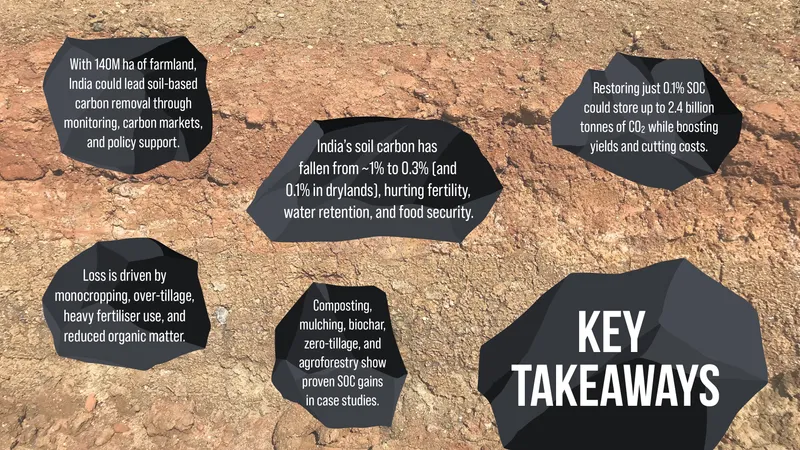
The report frames SOC restoration as one of India’s most cost-effective climate solutions. Even a 0.1% increase in SOC, it notes, could sequester 1.5 - 2.4 billion tonnes of CO2.
Keeping farmers at the centre
The report stresses that SOC restoration must enhance, not compromise, farmer livelihoods. Organic transitions, for example, can cause short-term yield dips, a risk many farmers cannot afford.
“When the transition to organic is happening, there must be no loss of income year on year. At worst, income levels should stay steady. That’s the guidance to our teams.”
Equilibrium works through local grassroots organisations to build trust and ensure interventions are culturally and regionally relevant. Partnerships range from Dr. Reddy’s Foundation in Andhra Pradesh to Sarvodaya Foundations in Karnataka. The company uses a framework to select NGO partners, assessing their track record, local relationships, and expertise.
“Farmers or communities aren’t just going to trust a Bengaluru-based company to solve their issues overnight,” says Jayaram. “We work in a way that any change is built on top of existing NGOs that have done pathbreaking work in their regions already.”
What urban consumers and carbon markets can do
Urban consumers can indirectly accelerate SOC restoration through demand for organic produce, even if only by paying a 10–12% premium, says the study. Jayaram believes this is already making a difference:
“As long as consumers continue to pay that premium, that itself is sufficient. For now. The backend work is to incentivise more farmers to go organic,” he adds.
But the biggest untapped accelerator, the report says, is carbon finance. By integrating SOC gains into carbon markets, farmers could be paid for the CO2 they sequester, turning soil health into a tangible income stream. While the global voluntary market is already valuing soil-based credits, India’s market remains young.
“It’s not fully mature,” admits Jayaram. “The goal with writing such reports is to bring more awareness so markets start to value this. The fun part is to create this category and make it a credible one.”
Recent international studies, including those by the FAO and India’s National Rainfed Area Authority, align with Equilibrium’s findings: SOC restoration not only locks away carbon, but can lift yields in low-carbon soils by up to 25%, improve water use efficiency, and rebuild biodiversity.
The Equilibrium white paper points out that SOC is not an abstract climate metric but a practical lever for rural resilience. Better soils mean stronger harvests, reduced input dependency, and more stable incomes. For a country balancing food security with climate commitments, the stakes could hardly be higher.
Equilibrium’s model—blending science-led interventions, local partnerships, farmer-first economics, and emerging carbon finance—is still in its early stages. But its ambition is national, even global. The company envisions region-specific SOC recovery plans that account for ecological differences between, say, arid Marathwada and coastal Karnataka.
“Why continue to degrade our soils when we have the means to reverse it?” asks Jayaram. “If we can align incentives through carbon markets and keep farmers whole in the process, it’s a win for the climate and for livelihoods.”
Edited by Affirunisa Kankudti