


This CSR football league is shaping the future of Chennai’s government school children
Chennai Kaalpandhu League, supported by LatentView Analytics, is making football more than a game for the children of government schools in Chennai. By nurturing talent through structured sessions, it’s ensuring a sporting culture and building a holistic future for children with limited resources.

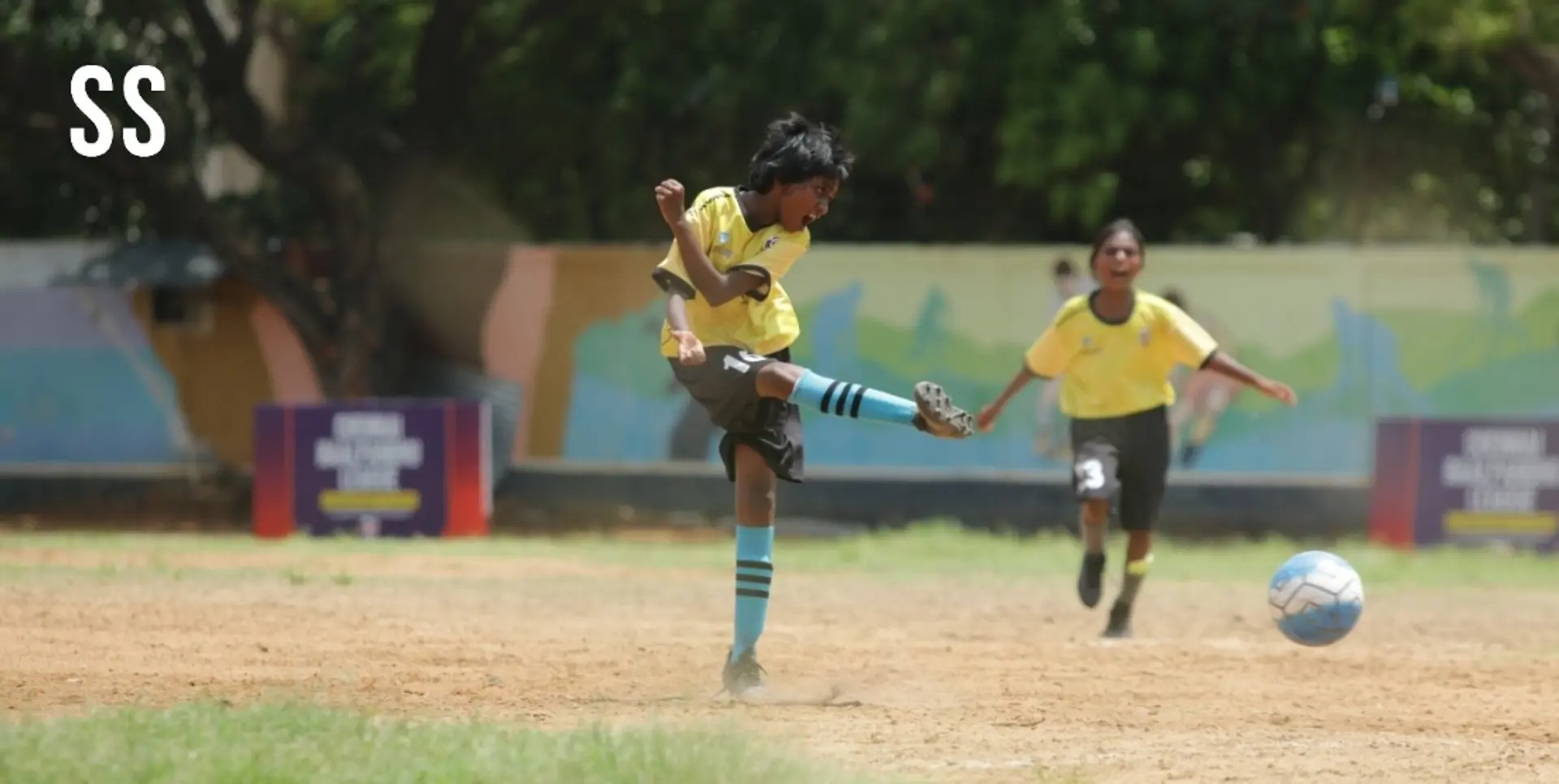

The first time M Umar laced up his boots on the dusty grounds of a government school in Chennai, little did he know that his love for football would one day take him to Bengaluru and even Spain.
The 11-year-old from Chennai found his way into football through the Chennai Kaalpandhu League (CKL), a grassroots football initiative, which has, since 2018, been nurturing talent among government school children through structured training, tournaments, and professional exposure.
Umar’s school-level performance earned him a place in the under-14 team under the CKL programme, implemented by SportzVillage, a grassroots sports development organisation, and supported by LatentView Analytics, a global data analytics company headquartered in Chennai.
From there, he progressed steadily—playing at zonal and district levels, being selected for coaching at LatentView’s Regional Development Centre, training at Football Plus Academy, and eventually securing a scholarship to train in Spain
Fellow CKL star Maruva Farzeen too shot to success like Umar. A student of a government school in Saidapet, a neighbourhood in Chennai, Farzeen became the top goal-scorer of CKL Season 4 and secured a scholarship at an SDAT (Sports Development Authority of Tamil Nadu) sports hostel.
The stories of Umar and Farzeen show what can happen when children from under-resourced backgrounds are given the right opportunities at the right time.
The initiative supporting their journeys, the Chennai Kaalpandhu League is the corporate social responsibility (CSR) programme of LatentView Analytics that has been steadily shaping the football dreams of Chennai’s government school children.
CKL was born out of LatentView’s broader CSR programme, which was initially centred on education.
Pramad Jandhyala, Co-Founder and Director of LatentView, says the idea for a football league grew “organically” from what she considers the company’s biggest strength: employee volunteering.
“A lot of things at LatentView have happened by teams coming together and deciding the future,” she says. “Even our office design was done by employees, and that sense of ownership carried into CSR. We wanted avenues where our teams could participate in a fun but impactful way, and that’s how the idea of CKL evolved.”
Armed with the belief that sport is an ideal way to promote life skills such as teamwork, discipline, community building, LatentView brainstormed and decided on football. “Mainly because it was easily accessible," says Jandhyala. "There’s minimal equipment needed, and large grounds are readily available in most schools."
Poornima Shankar, Head of CSR at LatentView, says CKL is also about building continuity. “We didn’t want to stop at a tournament. That’s why we have a pre-league and post-league phase. Children are not just selected for a season—they are trained, mentored, and supported for years, with multiple opportunities to try out for clubs and state teams,” she says.
The Three-Phase Model
This vision is reflected in the league’s three-phase structure.
The Pre-League Phase begins in June, when coaches visit government schools to identify children with an interest in football and basic sporting skills. Selected students train at skill development centres (SDCs), where they undergo 40 intensive sessions across two months, supported with nutrition and equipment. This year, 33 schools took part in the SDC programme.
The League Phase brings together over 500 under-13 boys and girls for a six-day tournament. The ongoing Season 5 in Chennai, from September 8–13, features 43 teams—25 boys’ and 18 girls’ groups—including 10 lateral entries from schools that already have teams.
The matches are officiated by licensed referees, and scouts from professional clubs like Chennaiyin FC are also present.
In the Post-League Phase, around 20 standout players are selected for two additional years of advanced coaching at LatentView’s Regional Development Centre. In partnership with professional academies, the development centre provides high-performance training, match exposure, and pathways to national-level trials.
Pathways and partnerships
CKL’s growth has been anchored by strong partnerships—with SportzVillage as the implementation partner, and football academies such as Chennaiyin FC and Football Plus providing advanced coaching. Players are also sent to trials organised by India Khelo Football, and get exposure at camps in Bengaluru and Delhi.
“The key is creating sustainable pathways,” says Shankar. “We don’t hold on to children as CKL products. Our aim is to get as many of them as possible into clubs, SDAT programmes, or residential hostels. That is really the way to strengthen the ecosystem.”
This approach has produced results. Over the past five years, more than 1,500 children from 140 government schools have been part of CKL. Two girls have secured SDAT scholarships, and several players are currently training with Chennaiyin FC through the Regional Development Centre.
Gender, culture and change
One of CKL’s quiet successes has been its steady inclusion of girls’ teams. While government schools often lack resources, CKL has worked to ensure that wherever possible, both boys’ and girls’ teams are fielded.
“Today, if we take up 20 schools, at least 18 have girls’ teams. Parents are supportive, teachers are engaged, and principals themselves attend matches to check on the infrastructure,” says Shankar.
Engagement with sports has also reduced school dropout rates. Parents, who once prioritised only academics, now see sport as a viable addition. “We have seen absenteeism fall during CKL phases. Parents even pool resources—like one auto driver who ferries children to training—to make sure their kids don’t miss out.”
Measuring impact
For a data-driven company like LatentView, measurement is critical, says Jandhyala.
However, CSR programmes are often accused of having unrealistic metrics in addressing obstinate, longstanding social issues that take time to show outcomes. This is why there needs to be realism when it comes to metrics, says Jandhyala.
“Education and sports outcomes take years. So we track participation, school coverage, and pathways created. At the same time, we celebrate milestones—like students moving into government residential sports programmes. These things tell us the model works,” she says.
LatentView has gone a step ahead to quantify impact and partnered with Madras School of Social Work to study how CKL has aided in children’s development. Early findings point to improved school attendance, higher motivation, and enhanced life skills.
While football is the medium, CKL is ultimately about shifting culture, says Jandhyala. “The aim is to drive scale and impact, and to ensure a sporting culture for kids. If a few gems go on to become exceptional athletes, they also become role models for their communities.”
Children like Umar and Farzeen are already embodying that role. Their stories are not just about medals or scholarships, but about what is possible when children from government schools are seen, nurtured, and given space for play and expression.
Season 5 of CKL is now underway at the SDAT Grounds in Chennai. As 500-odd children take turns kicking the ball around the field hoping to score a goal or two, they also carry the hopes of a bigger and better future.
Edited by Swetha Kannan