



How TinkerHub grew from a student tech club into Kerala’s largest youth-led maker movement
Since starting as a student-driven tech community at CUSAT in 2014, TinkerHub Foundation has transformed into a statewide youth movement, shaping the journeys of over 100,000 makers in the past decade.

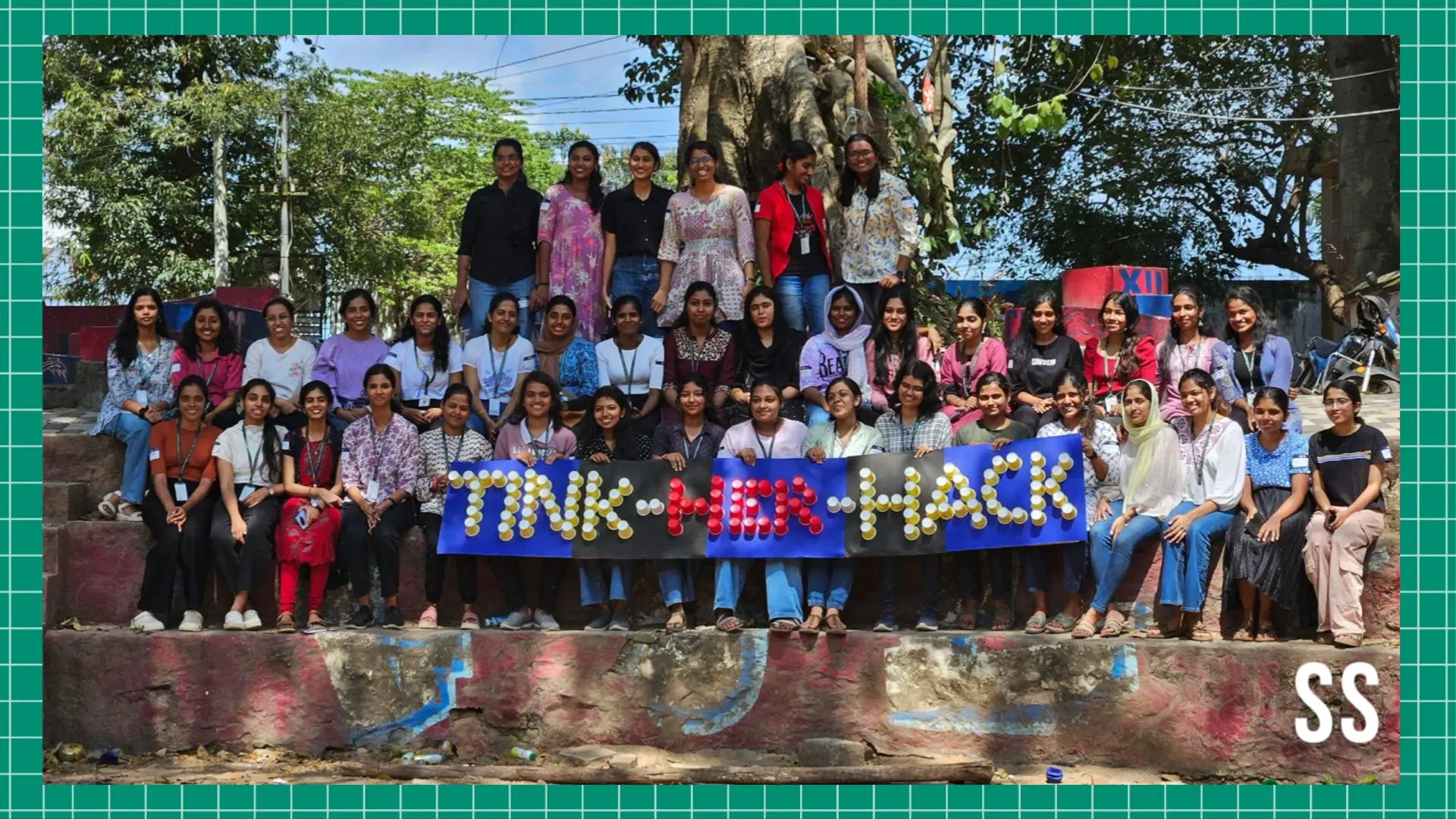

In 2014, three engineering students from Cochin Institute of Science and Technology (CUSAT), Kochi, and a BA English student from Kozhikode, volunteered at a Mozilla Maker party in Kochi.
The annual global campaign, run by the Mozilla Foundation, aimed to teach the culture and mechanics of the web through community-run events.
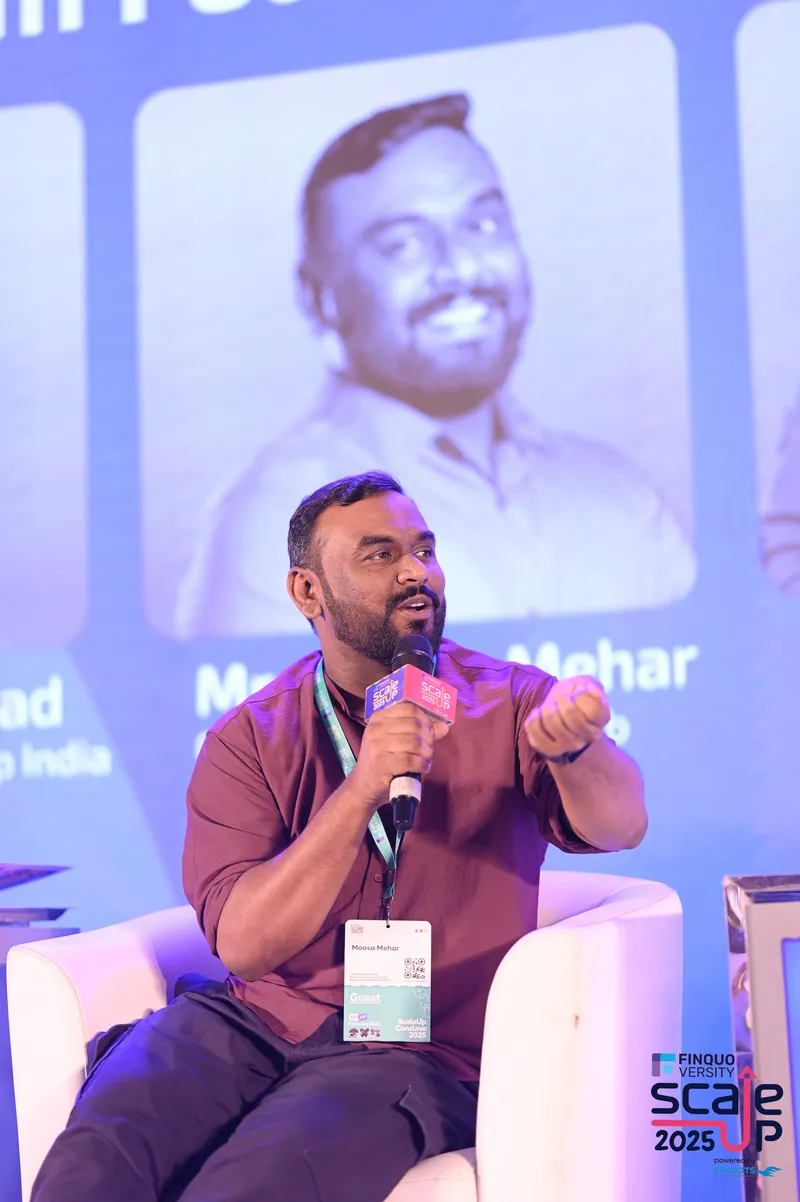
Moosa Mehar MP
At the event, visitors were encouraged to ask, “How do you create technology and own it?”
Unlike typical exhibitions where visitors observed passively, here, they found themselves editing code and watching robots respond in real-time.
The Maker Party in Kochi was recognised as one of the largest events in the world at the time, drawing more than 4,000 tech enthusiasts. Here, the four students discovered that the world of technology was a two-way street, and within everyone’s reach.
Until then, Moosa Mehar MP, Abid Aboobacker, Nidhiya V Raj, and Praveen Sridhar shared a common frustration. The education system taught them to consume technology without understanding it.
This prompted the students to conceptualise the TinkerHub Foundation, a non-profit that aims to make tech learning accessible to young people, especially girls, through open, peer-led, community-based programmes.
The students left the Mozilla Maker Party confident and eager to learn, but CUSAT's infrastructure told a different story. University libraries offered high-speed internet capable of downloading 100GB files, but classrooms had no connectivity. Students could occupy spaces until 8 pm, but without internet access, collaborative building became impossible.
“We needed a space to discuss and learn more about technology. But there was none,” recalls Mehar, CEO of TinkerHub Foundation.
Spaces for collaborative learning
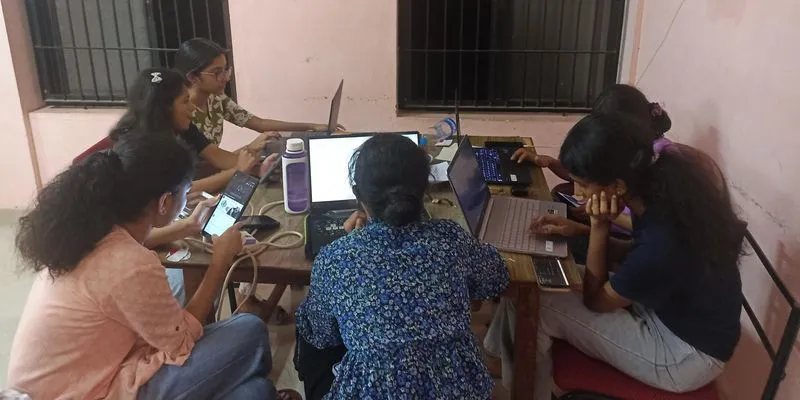
Girls hacking at Government Engineering College Kannur girls hostel at midnight
The students zeroed in on an old library space secured through connections from Startup Village, an initiative that supports entrepreneurs, where Mehar had previously built his BlackBerry applications as a founder.
“Every evening, this became an informal classroom where knowledge flowed freely. Someone taught Canva, another demonstrated robotics,” says Mehar.
It was 2014, with the startup and “building scene” gaining ground. The students roped in experts, and these interactions turned curiosity into a career purpose.
"After hearing these stories, all my friends felt that building something is not a very big deal. You just start exploring,” he says.
But they had their doubts. Was their success due to their proximity to Startup Village, CUSAT’s reputation as a premier institution, and Kochi’s urban advantage?
They decided to test their waters by replicating the model in RIT Kottayam and government colleges in Thalassery, located in remote areas of the state, and away from Kochi.
“It was as simple as a bunch of students sipping on tea in the canteen after college and having conversations. Six months later, girls were getting scholarships at Google and flying to Singapore. AI researchers from Microsoft were visiting a government college in Thalassery,” Mehar explains. As the pattern repeated across Kerala, Mehar was convinced to resign from the Kerala Startup Mission, where he was running accelerator programmes, to focus full-time on community building.
What started as a student-led tech community at CUSAT has now grown into one of Kerala’s most vibrant youth-led collectives, with over 100,000 young makers impacted in the last decade.
Last year, it was present in 36 universities, the year before in 80-85 universities, and this year 66 institutions will tinker to bring the best ideas in technology. On an average, each campus has 300-400 participants. The TinkerHub Foundation trains 5-10 people and organises 5-10 engagements and 3-4 residencies in a campus every year.
In 2024–25, over 16,977 learners were engaged across schools, colleges, and early-career programmes.
“Making startups was not our core plan. Our focus was on building for learning. If we can have fun building things, our friends should, too, and also make good money!” emphasises Mehar.
Women rise above challenges
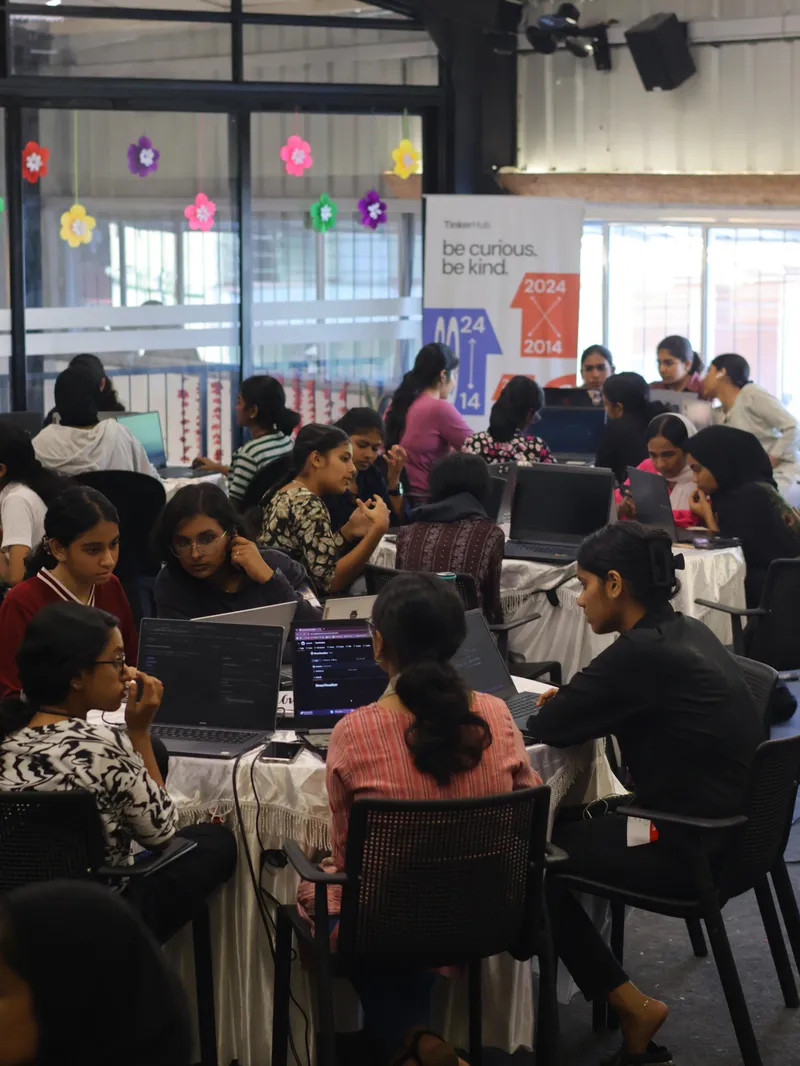
CUSAT girls at Tink-Her-Hack 3.0 at TinkerSpace
The gender dimension of TinkerHub’s work reveals the complex intersection of technology access and social constraints in Kerala. Despite the state’s high literacy rates and a reputation for being progressive, women participants face practical and cultural constraints.
CUSAT's women’s hostel curfew of 7 pm (later extended to 10 pm) made tech events in the evening impossible. Even when the policy changed, underlying safety concerns persisted, creating what Mehar calls a “brain wiring” effect where women are consistently trained to prioritise safety over opportunity.
“When they start careers, they might feel confused about staying late for work,” he observes, noting how these early limitations can translate into professional disadvantages.
However, despite these challenges, Mehar reveals that last year, 50% of applications for campus leads at colleges came from women.
The monitoring evaluation that TinkerHub conducted revealed striking statistics: while 40% of both male and female participants had parents with similar education levels, 55% of mothers were homemakers despite holding graduate and post-graduate degrees, highlighting the systemic workforce participation challenges that extend far beyond individual choice.
TinkerHub developed creative workarounds as solutions for its women-led programmes. Last year, it organised Tink-Her-Hack, its women-focussed hackathon, at 63 locations in Kerala ensuring that no girl needed to travel far or stay overnight away from home.
This became the world’s largest all-girls hackathon with 3,017 participants and 700+ beginner-friendly projects. Apart from this, TinkerHub also hosts a Women in Tech initiative, focused on early exposure and mentorship for girls in STEM.
A space for tinkerers
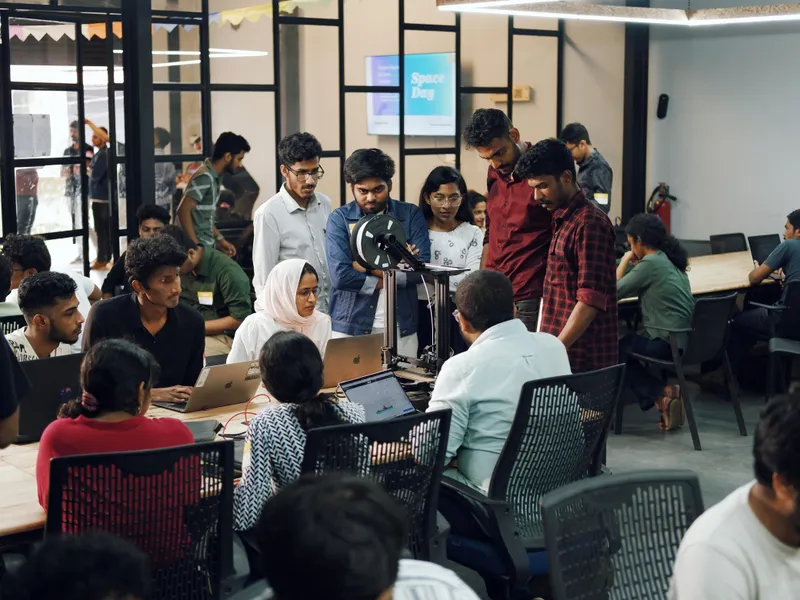
TinkerSpace
Walk into the TinkerHub’s physical space in Kochi, aptly called TinkerSpace, and you can see young boys and girls doing what they are best at: tinkering away.
“Kerala always had a strong reading culture; so it’s like a huge library extension. This is open 24x7, and more than 120 people visit daily. We have a GPU that’s publicly accessible for AI model development, VR, and 3D printers. Around 100 community organisations use this space for developer meetups and hackathons,” elaborates Mehar.
Fasna first learned to use a laptop at TinkerSpace. After failing to get through the NEET exam for three years, she decided to drop the idea of going to medical school and opted for an online BCA course.
“When I first came to TinkerSpace, I didn’t know anything. Everyone was coding, and I felt out of place. But when I started interacting with the others, they stepped in to help, and I felt at home,” she says.
She visited TinkerSpace every day for more than a year, continuously learning and imbibing technology. She has participated in Tinker-Her-Hack where she developed a website. Currently, she works as an associate product manager in a Kochi-based organisation. Her plan is to do a master’s degree and start a company of her own.
Amna, who is currently pursuing BSc in computer science, is TinkerHub’s campus lead at Farook College, Kozhikode, seven hours from Kochi. She is interested in web design and development.
Community-first
TinkerHub’s funding model reflects its community-first philosophy.
The foundation is supported by Kailash Nadh (CTO, Zerodha) via his Samagata Foundation, and backed by Kerala Startup Mission since 2016. Apart from this, 50-70 community members contribute Rs 500-10,000 every month to cover operational costs.
“We never use terms like ‘beneficiary’, it’s about building a community where young people can learn and have fun,” Mehar points out.
TinkerHub’s significant innovation is not just about technology, it’s about creating a social movement. Here, today’s learners become tomorrow’s teachers. It’s about how shared learning can spark creative solutions and the power of local communities can create global opportunities.
Edited by Swetha Kannan