



In Mumbai’s housing wars, Dalit residents of Jai Bhim Nagar write a new script
Mumbai sells itself as Mayanagri, a city of reinvention. For Dalit residents of Powai’s Jai Bhim Nagar, it has meant years of demolitions and displacement. This time, they are fighting back, demanding to be seen and heard.

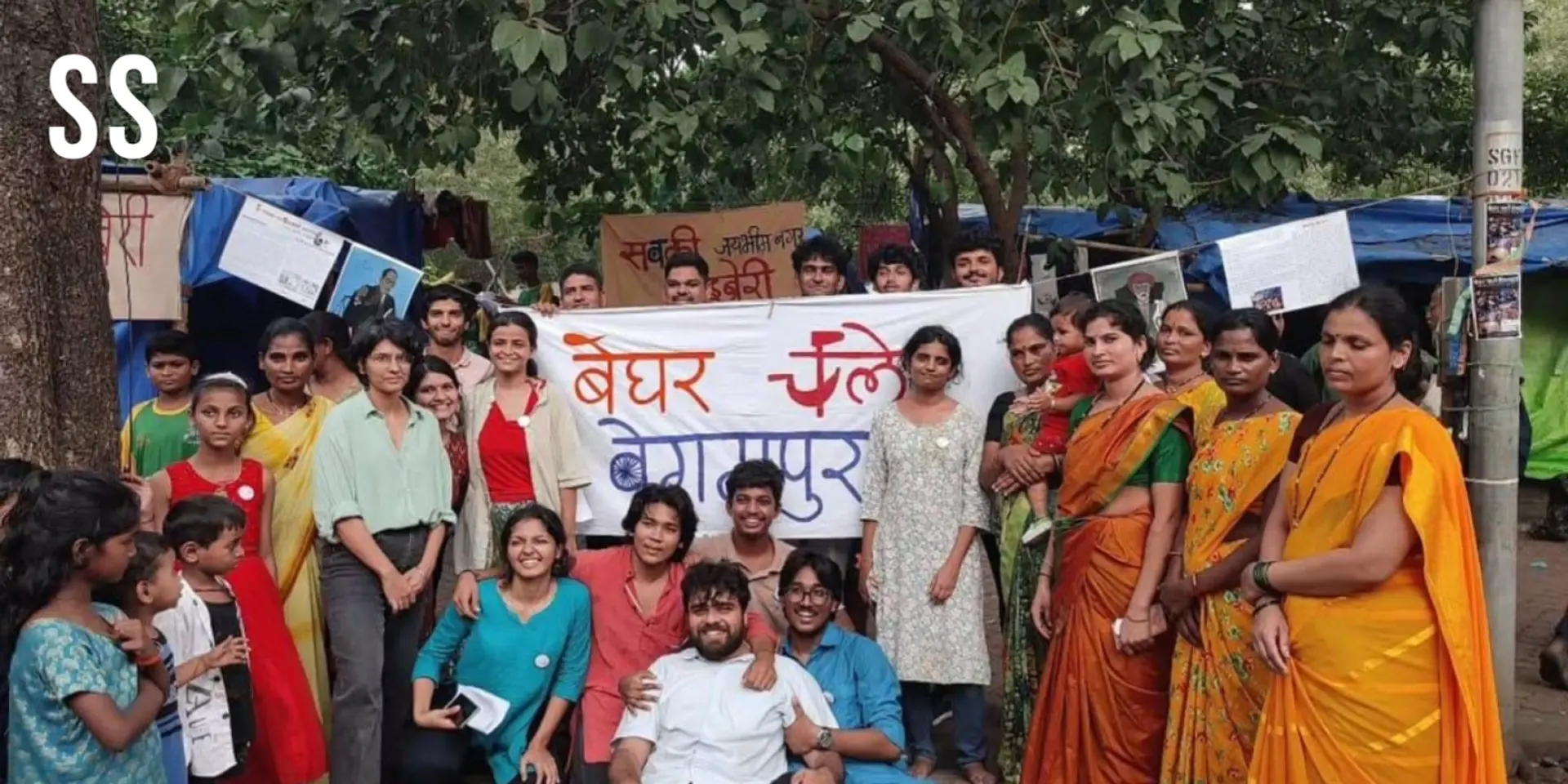

On June 3, 2024, a Brihanmumbai Municipal Corporation (BMC) notice declared the homes in Jai Bhim Nagar in Mumbai’s Powai suburb “illegal encroachments,” giving residents less than two days to leave.
Jai Bhim Nagar came into being as Mumbai’s real estate boom was reshaping the neighbourhood in Powai. It was first constructed in 2007 as a labour camp, sanctioned by the BMC itself, to house workers employed in Powai’s massive real estate surge. Hundreds of Dalit and Bahujan labourers, many of whom built the adjoining Hiranandani towers, made their homes here under a permission granted for ‘temporary labour hutments’.
That legitimacy was short-lived.
By 2014, the BMC had revoked its own permission, and in 2017 it directed the builder to remove what it now reclassified as an “unauthorised” settlement.
In 2023 when, in a move that revealed the city’s inverted priorities, a private individual petitioned the Maharashtra State Human Rights Commission, arguing that the very presence of this basti violated the “human rights” of Powai’s affluent residents.
Citing this claim, on June 6, 2024, the BMC went on to bulldoze 504 houses—at the height of the monsoon and in defiance of a Government Resolution that expressly prohibits evictions during the season. Close to 600 families—many of whom had lived there for decades—were displaced overnight. Residents tried to salvage identity cards, schoolbooks and utensils from the wreckage, and came to the streets with no clear rehabilitation plan in place.
“In Mumbai, finding any room in four days or even forty days is difficult. Housing has always been a crisis, especially for the poor,” says Nivruti Sopan Sabrai, a resident of the locality.
Three days later, Jai Bhim Nagar’s families, most of them Dalit and working class, decided to fight back. Over a hundred residents, led by women,took their protest to the Bombay High Court, demanding recognition, housing, and accountability. The residents petitioned against the demolition, alleging police assault and violations of due process. Their complaint sought action under the SC/ST (Prevention of Atrocities) Act along with sections of the IPC.
Following this, an FIR was registered against a senior inspector and 10 others, including BMC personnel and individuals linked to the Hiranandani housing complex, for their role in the demolition violence. The case, filed months after the incident and under High Court scrutiny, has become part of the settlement’s wider legal battle to hold state agencies accountable.
Two of Powai’s most prominent gated societies—Tivoli Co-operative Housing Society and Evita Co-operative Housing Society—also took the fight to the Bombay High Court. Their petitions framed the shanties of Jai Bhim Nagar as “illegal encroachments” that obstructed pavements and footpaths outside their complexes.
On July 7, the High Court directed the BMC to act on Tivoli’s petition. By July 21, it had narrowed the scope of the case to pavement encroachments alone and ordered police protection for demolition squads.
Yet all this legal back-and-forth did little to deter the community. If anything, it opened a crack for residents to assert themselves. By filing their own applications and appearing in court, they made visible how “public interest” pleas from elite housing societies were being used to sanitise neighbourhoods for the privileged—while endangering the homes and lives of working-class families next door.
A Special Investigation Team later concluded that the eviction had been unlawful.
Fighting back
At the heart of this resistance stands Sabki Library, built in the aftermath of the June 2024 demolitions through the solidarity of student–youth groups and Jai Bhim Nagar residents. It has since grown into much more than a room with books.
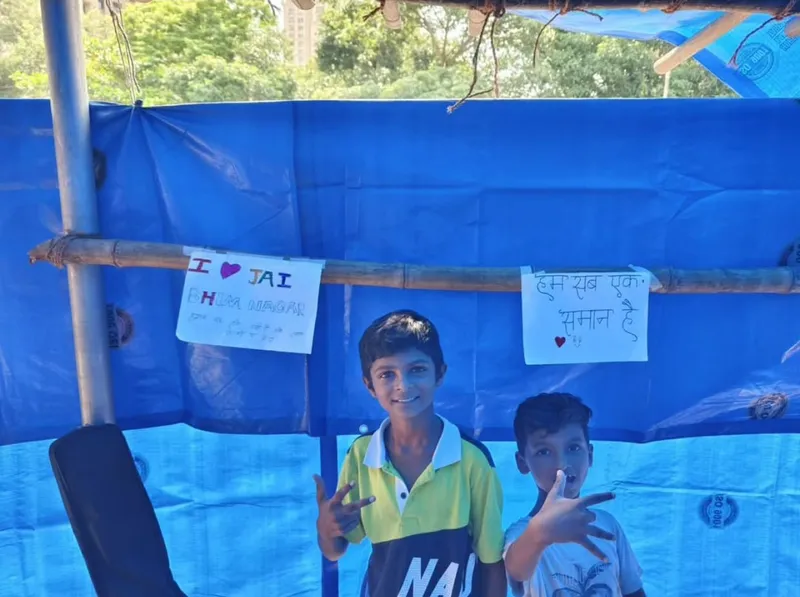
Children use the Sabki Library for art and learning and the adults learn to draft applications, practise speaking to the press, and call it “a room of their own” in a city that rarely offers safety or belonging.
Children use it for lessons and art sessions, finding stability in the midst of upheaval; women gather there to talk about housing, safety, and feminist movements, connecting struggles over shelter with questions of gender justice; the wider community comes together for medical camps run by young doctors, and understand legal processes on how to file petitions and document demolitions, and cultural events like the Beghar Chale Begumpura mela, which drew on Sant Ravidas’ vision of a world free of taxes, property and suffering.
The walls are lined with posters of Ambedkar, Phule and Ravidas, setting the tone for evenings when eviction notices are read aloud, legal terms unpacked, and strategies for mobilisation drawn. Residents have learnt to draft applications and practise speaking to the press, while for women in particular, the library has become “a room of their own” in a city that rarely offers safety or belonging.
“Sabki Library materialises our angst and ideals,” says a woman resident of Jai Bhim Nagar. “It’s our safe space, and a space for assertion. We want to show that we are building our values on education, dignity and self-respect, not fighting back like empty vessels.”
Tejas, a volunteer with the library, says the space gives people a place to understand the system that is stacked against them and to imagine what justice might look like. For him, Mumbai’s housing story is less about growth than about systemic exclusion. He points to how, since the 1970s, government housing policy shifted away from public responsibility toward the private sector: subsidies were cut, cross-subsidisation introduced, and formal finance institutions like Housing and Urban Development Corporation Ltd (HUDCO) and HDFC mainly benefited the middle and upper classes.
“By the 1990s and 2000s, schemes like Jawaharlal Nehru National Urban Renewal Mission (JNNURM) claimed to integrate urban housing with services, but in practice it was the middle- and high-income groups who took maximum advantage of housing finance, while shortages in the low-income and EWS sectors deepened,” he says.
“From the 1970s onwards, slum clearance was carried out in the name of development, but the land was handed to private builders. Communities like Jai Bhim Nagar are displaced again and again, while luxury towers rise next door. The city treats land as a commodity, not as a right for the people who built it with their labour, and the system is designed to fail the poor,” adds Tejas.
His critique echoes what residents have lived for decades: pavements and open plots claimed by migrant workers, domestic helpers, waste-pickers and daily-wage earners who come to the cities for better employment opportunities, are systematically erased when powerful neighbours demand a “clean-up.”
Legally, on August 20, 2025, the court noted that a scheduled clearance on August 18 had stalled for lack of police presence, and rescheduled the operation with explicit backing. The matter remains ongoing, even as residents continue to argue that such petitions, though framed around footpaths, effectively target entire settlements without offering rehabilitation.
Class wars
Mumbai has thrived on several aliases. Among them are ‘Mayanagri’ or ‘The City of Dreams’, used to describe its allure of opportunity and reinvention, drawing millions each year. Up close, however, the City of Dreams often reveals itself as the City of Illusions, most visible in its sprawling labyrinths of slums, which are home to nearly 41% — or nine million— of its 22 million residents, according to World Population Review.
At the opposite end of this spectrum are elite housing societies.
Just six months into 2025, homes priced above Rs 10 crore in Mumbai had recorded sales worth Rs 14,750 crore, marking one of the highest half-yearly tallies ever in the luxury segment, according to a report released by India Sotheby’s International Realty and data analytics firm CRE Matrix. Another report records Mumbai as India’s costliest housing market, with rates averaging around Rs 26,975 per sq ft in many prime zones. Stack these numbers against the other Mumbai — and the city shows you its underbelly.
With shrinking housing spaces, residents across the social hierarchy are engaged in court battles. The tension is most visible in Powai’s Jai Bhim Nagar, where people have often found themselves in the middle of destruction.
In 2007, a “mysterious fire” tore through part of the settlement’s labour camp, destroying around 150 huts and leaving construction workers tied to the Hiranandani project next door homeless overnight. The fire foreshadowed the systemic erasure that has marked Jai Bhim Nagar in the years since — a cycle that has also come to define how slum settlements are treated across India’s cities.
The struggle unfolding in Jai Bhim Nagar goes beyond a single settlement. It forces the city to confront uncomfortable questions: Who are cities really for? Are pavements only for pedestrians, or also for those whose livelihoods anchor the metropolises? Is land only for speculative towers, or also for workers’ families who built those towers in the first place?
Edited by Affirunisa Kankudti