



Only 37% women use mobile internet: Report highlights gender gap in India’s digital workforce
The Decoded: Women and the Future of Digital Work in India report revealed that while women participate in the digital economy, they do not advance in it.

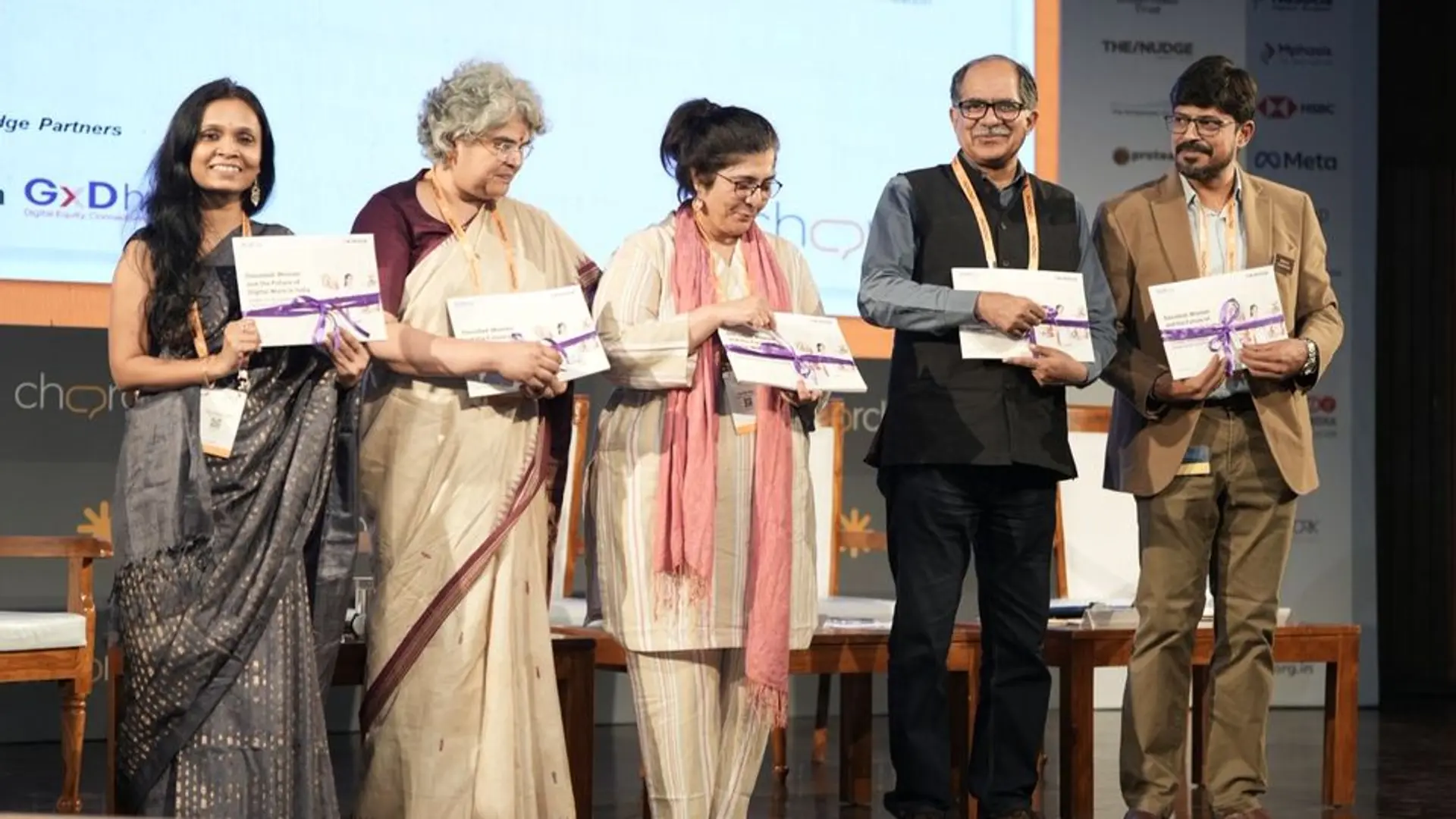

Only 37% of women in India use mobile internet compared to 53% of men, according to 'Decoded: Women and the Future of Digital Work in India' report produced by Gender x Digital (GxD) hub at LEAD, Krea University, in collaboration with The/Nudge Institute.
It also found that nearly a fifth of women rely entirely on borrowed devices, which directly restricts their ability to access digital work, platforms, and progression.
The report was launched at "Women in the Loop: Shaping the AI Economy” session at Charcha 2025, hosted by the*spark forum in Delhi last week. It offers a comprehensive and nuanced analysis of how women in India are entering and being shaped by the digital economy.
The study found that women remain disproportionately clustered at the lowest-value layers of India's growing digital economy, which accounts for 11.74% of GDP and employs 14.6 million workers.
In digitally-enabled jobs, millions of frontline workers, including ASHAs, Anganwadi Workers, BC Sakhis, and SHG bookkeepers, perform mandatory mobile-based data entry, reporting and coordination. However, this digital labour remains invisible in policy and compensation structures.
The report noted that in digitally embedded work, women constitute nearly 40–50% of entry-level data annotation roles—particularly in Tier II and III cities—but their presence declines steeply in intermediate and advanced AI and data jobs.

The gaps arise due to unclear skilling pathways, opaque algorithms, and persistent safety concerns.
In digitally augmented livelihoods, women farmers, teachers, and micro-entrepreneurs are increasingly using chatbots, ecommerce platforms, and ICT (information and communication technology) tools, yet many still lack the digital marketing, pricing, and financial skills required to convert this engagement into real income mobility.
It highlighted that while women participate in the digital economy, they do not advance in it. Digital access for women remains heavily mediated; skilling efforts need a sharper focus, and the burden of unpaid care work continues to restrict the time and mobility required to participate meaningfully in digital jobs.
The report calls for gender-intentional digital skilling that recognises the task-based nature of digital work; formal recognition of frontline workers as digital contributors; local digital work hubs that combine connectivity, devices and childcare; and stronger pay standards, protections and progression pathways for women in AI, gig and platform work.
It also urges digital markets and platforms to make pricing, visibility and algorithms more navigable for women-led enterprises.
Speaking at the launch, Kanishka Chatterjee, Managing Director, the^delta prize and an ecosystem partner to The/Nudge Institute, said, “India’s digital economy contributes 11.7% of GDP and is projected to cross 20% by 2030, yet millions of women remain peripheral to this emerging value chain. Studying organisations that work with low-access women has revealed how capability, confidence, and income evolve when digital tools meet India’s gender constraints.”
Edited by Kanishk Singh