


How Connecting the Dots is transforming science and math learning in schools
Connecting The Dots works to improve how science and mathematics are taught in schools. It emphasises experiential learning, moving classrooms beyond rote methods, and an exam-driven approach.

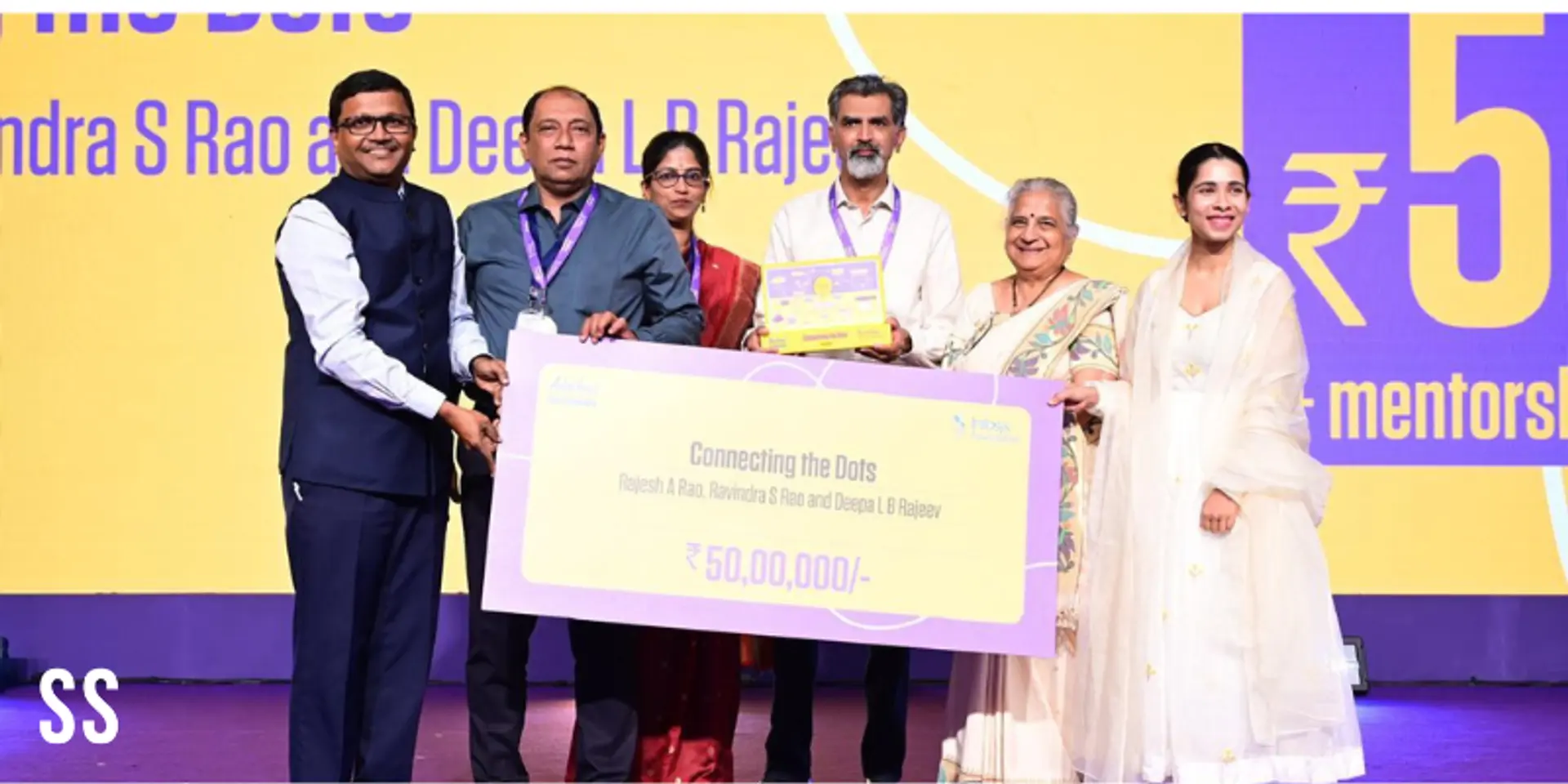

Rajesh A Rao doesn’t have to search far for motivation. He often recalls Lavanya, a farmer’s daughter who worked in the fields by day and, during the Covid-19 pandemic, attended her online science classes seated beneath a tree.
Then there’s Nagaveni, who recently ranked fifth in Karnataka's 12th standard board exams and now aspires to become an IPS officer, thanks to scholarships and learning support from Connecting the Dots.
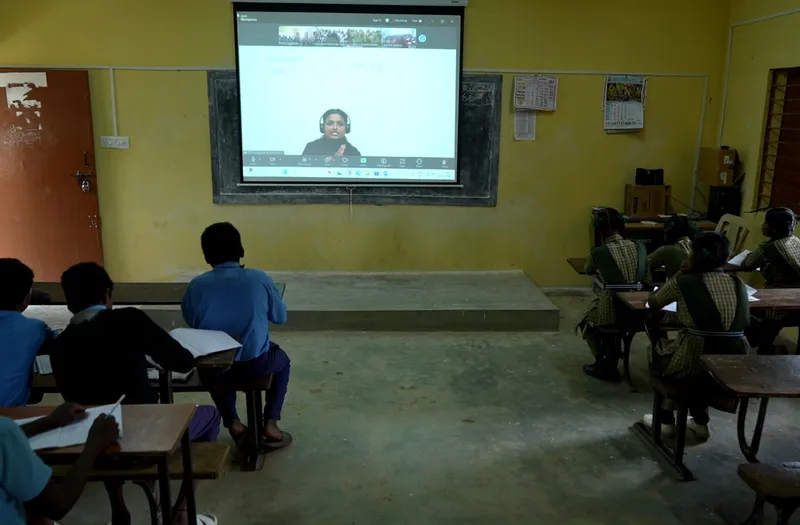
An online class in progress
These stories represent the impact of Connecting the Dots, a Bengaluru-based non-profit that began 12 years ago with a simple but powerful idea—to teach science and mathematics in ways that inspire children rather than intimidate them.
Moving away from the traditional “rote-learning” practice and exam-oriented approach, the organisation focuses on promoting higher-order thinking and stronger conceptual understanding among teachers and students.
Winner of the education category in the Aarohan Social Innovation Awards 2025, instituted by the Infosys Foundation, Connecting the Dots has so far worked with over 200 schools, impacting over 1,80,000 students across Karnataka.
Teaching beyond textbooks
Rao’s father, who worked in the education department, would often talk about the need to improve the system in the country.
“As early as eight or nine years old, I remember thinking why beautiful subjects like maths and science were taught poorly and in a very dull way. None of the students seemed motivated to learn. Surely, there were better ways to learn these subjects,” Rao tells SocialStory.
After completing mechanical engineering from IIT-Madras, Rao left for the US for a master’s in Industrial Engineering and Computer Simulation. His aim was always to return and work in India, and in 1991 he joined Infosys, where he stayed for almost 20 years.
His first exposure to the social sector was when he worked with the Government of Andhra Pradesh as an advisor to the Ministry of Rural Development from 2010-2012.
Making STEM subjects interesting
But a few years before, in 2009, three moments pushed Rao to look at the education sector closely.
That year, India participated in the PISA (Program for International Student Assessment) examinations for the last time, ranking a dismal 72nd out of 73 countries.
Around the same time, a newspaper headline describing India as a nation of "educated unemployables" caught his attention.
These revelations stayed with him, and in 2012, Rao decided to channelise his expertise in helping the education system by tackling the root cause—quality!
His vision found a strong partner in Muralidhar Koteshwar, an IIT alumnus and corporate veteran with deep roots in development work through the Art of Living Foundation. Together, they cofounded Connecting the Dots to improve the quality of STEM education and expand access to it.
In 2012, Rao and his wife visited a bunch of schools, many of them orphanages, in and around Bengaluru to teach science with activities.
“We would talk about everyday experiences, practical applications, and conduct simple experiments,” he recalls.
But they soon realised that impact requires scale, and a few hours a week wasn’t enough. “Unless we made our program mainstream, where every day of the year we would be in front of the students teaching them, we would not make an impact," Rao says.
The first major pivot came when Connecting the Dots went mainstream. While teaching syllabus-aligned topics, they also found a way to link experiential learning to improved exam scores.
“Schools will throw their doors open if we can also say we will teach them better and their marks will also improve,” Rao explains.
They wanted to take their model beyond Bengaluru, which led to the second transformation. Connecting the Dots built 11 studios in its office and connected with schools through live, interactive online classes.
Every morning, students from grades six to ten in schools across the state log into their assigned “feeds” to learn science, maths, and spoken English. The small batches ensure quality interaction doesn’t suffer from overcrowding.
Connecting the Dots provides all equipment, from smart classroom infrastructure to science kits that allow teachers to replicate experiments in real-time. Students get one period per day, five to six periods per week throughout the year. This academic year alone, the organisation will deliver 1.2 million student hours.
To track progress, question papers would appear on screen, students would fill out OMR (optical mark recognition) sheets, and ship them to Connecting the Dots for correction.
“It’s not cutting-edge technology by any means, but it allows us to test students multiple times a year and gives us enough data to track the performance of every student in every subject, every year of the program,” notes Rao.
“To supplement all of this, we put all our online content on a platform and gave access at no cost to students and teachers. They can watch our lectures, experiments, notes, and everything else. They can perform experiments themselves, guided by our videos. They can use our worksheets for practice and our assessments for evaluation,” he adds.
Academics and beyond
Beyond academics, Connecting the Dots offers career counselling and scholarships. Students who score grade A and above (80% or higher) qualify for financial support to continue their education.
Last year, 100% of scholarship recipients, about 200 to 300 students, chose to pursue STEM education in their higher secondary studies.
Working with the Infosys Science Foundation in 2014, Connecting the Dots trained over 700 teachers over a 10-day residential programme in Mysore. Since then, it has trained over 700 government school teachers in the state every year.
All content, including lectures, experiments, notes, worksheets, and assessments, are available free of cost on Infosys’ Springboard platform in English, Kannada, and Hindi, and reaches approximately 960 towns and villages across India.
“The broader mandate regarding boarding schools comes from a sponsor, since Connecting the Dots largely works through CSR programs. Once that mandate is received, we work with government officials to seek their necessary permission and their recommendation on which schools we can work with,” Rao explains.
The criteria consist of two main factors: need and willingness.
“Typically, one in three or four science and math teachers are missing in government schools. So, we look at whether they have teachers or are there vacancies? Have they been struggling with 10th standard performance in the recent past?” he adds.
The schools are also measured on their willingness to adopt the programme. “Are they willing to make the necessary changes to the timetable to accommodate our classes? Do they have the right attitude?”
Impact and outcomes
The outcomes are impressive. By comparing government statistics, which meticulously track performance by gender, caste, district, and subject, Connecting the Dots can demonstrate how their schools perform on multiple parameters like pass percentages, first-class numbers in math and science, and grade A achievements.
The dropout rates have also fallen significantly. Karnataka faces alarming dropout rates after 10th grade, but among Connecting the Dots students, the dropout rate is falling from 40% to 28%, a 12% reduction attributed to improved academic confidence and scholarship support.
Principals, teachers, students, and parents share stories of transformation, particularly for girls facing barriers to continuing education.
While Connecting the Dots depends on CSR funds, it also works with budget private schools that pay them a small fee. While education attracts CSR funding, Rao points out that many prefer visible interventions like toilets, uniforms, and books instead of efforts that meaningfully enhance teaching practices and student understanding.
“I would love for more companies to be involved in learning outcomes,” he says.
Rao is amazed at the resistance to change when it comes to education.
“We have embraced change in the way we manage money, the way we travel, in every walk of life. Even rural India has embraced change. The one part of life where change has refused to enter is our classrooms. That is shocking and frustrating,” he says.
He is critical of how success is measured in education. “What we end up celebrating in newspapers is 'this district achieved 100% pass percentage.' The pass percentage is 33%, and then there are 10 or 15 grace marks in that. We have lowered the benchmark to suit reality rather than raise quality education,” he adds.
In a world transformed by AI and constant technological disruption, how do you prepare students for a future that's impossible to predict?
Rao believes that one has to truly focus on what never changes—the constants in education.
“The fundamentals of mathematics will never change. Every recent development, including AI or machine learning, can be traced back to something basic in mathematics. The building blocks are all there. You can cope with change. That is our effort here,” says.
Over the next five years, Connecting the Dots aims to impact 500,000 students and train 20,000 teachers. It also wants to expand its efforts in the Hindi belt and also make an impact in languages like Hindi, Tamil, and Telugu.
Edited by Megha Reddy