


Healthy nations can educate children, drive growth: Bill Gates
The chair of Gates Foundation was part of a panel discussion on Investing in Humanity - Unlocking Private Capital for Global Progress at the Abu Dhabi Finance Week.

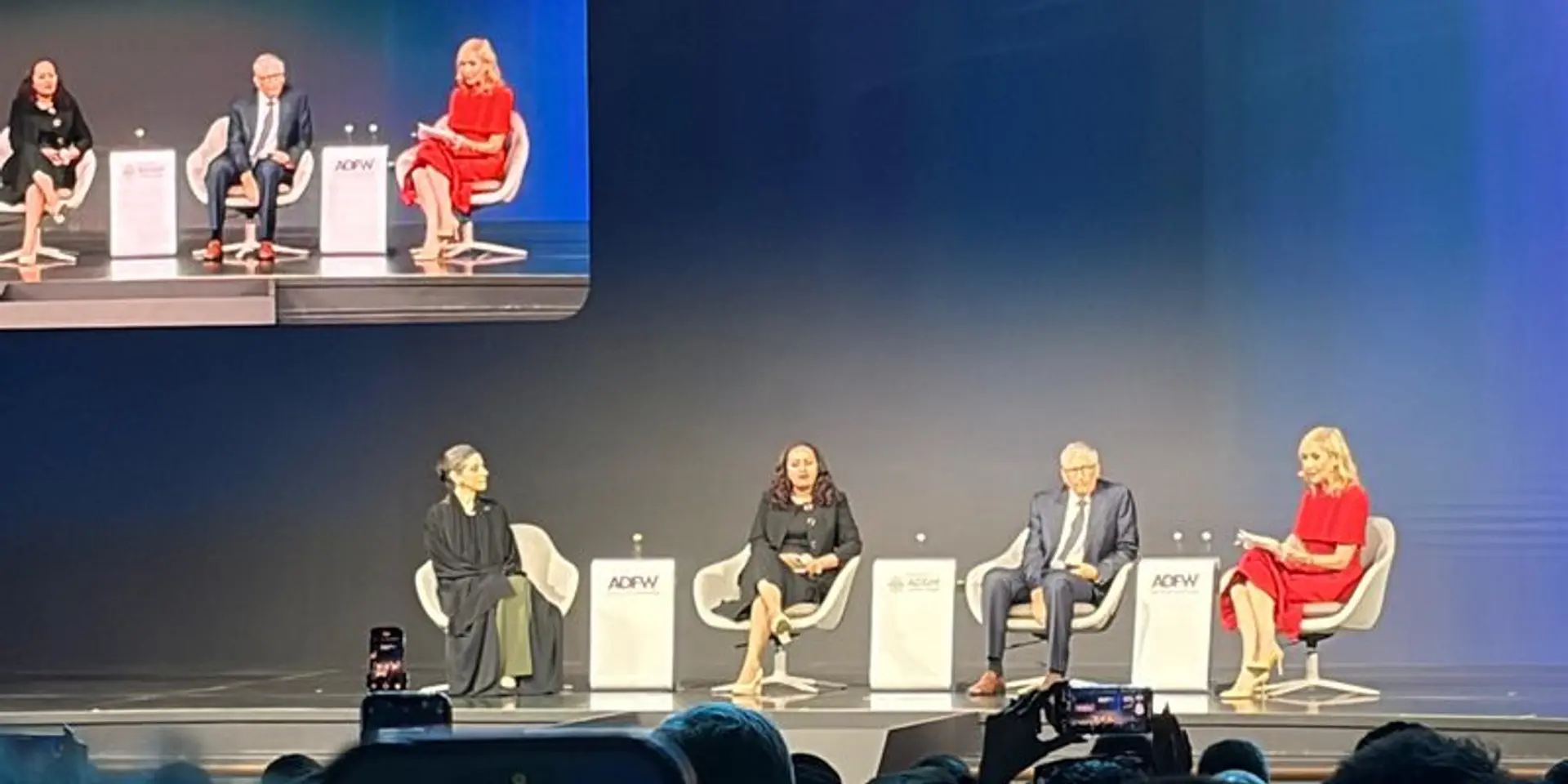

“If a country is healthy, it can educate its children, have economic growth, and become self-sufficient,” said Bill Gates, Chair of the Gates Foundation.
He was speaking at a panel discussion ‘Investing in Humanity - Unlocking Private Capital for Global Progress’ on the sidelines of the Abu Dhabi Finance Week, the flagship financial and investment gathering in MENA.
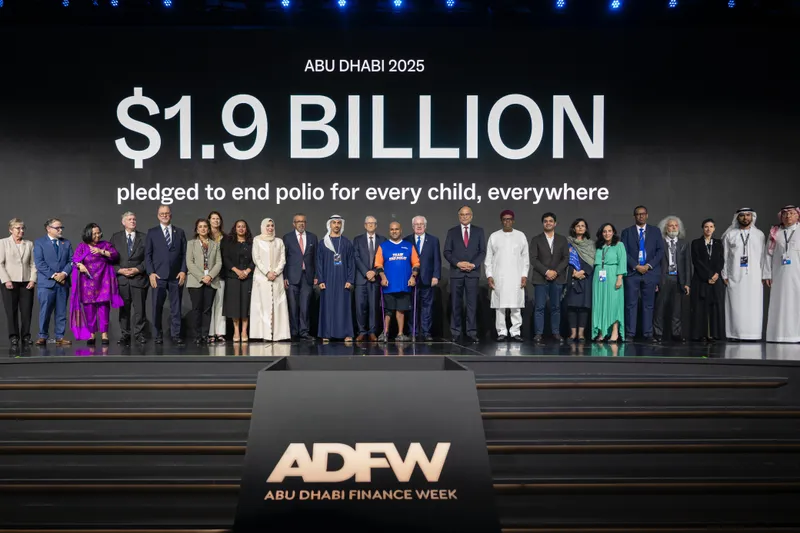
Global leaders pledge $1.9 billion in Abu Dhabi to end polio and protect children worldwide.The global pledging event, ‘Investing in Humanity: Uniting to End Polio’, was hosted by the Mohamed
bin Zayed Foundation for Humanity in partnership with GPEI, and took place at Abu Dhabi Finance
Week.
The other panelists at the discussion were Dr Maha Barakat, Assistant Minister for Health and Life Sciences, UAE Ministry of Foreign Affairs; and Dr Mekdes Daba, Minister of Health, Ethiopia. The panel was hosted by Tanya Bryer, CNBC International.
While the world has seen incredible progress in tackling huge problems like child mortality, what is holding it back from saving more lives, especially from preventive diseases?
Gates said the outcomes in global health depend on the generosity of resources that go towards helping the particularly poor countries run high-quality primary health care systems.
“It's a factor of how much innovation we have creating new low-cost tools, and it's a factor of how well we execute—the quality of those delivery systems, understanding what’s working, what’s not, and learning from the heroes in the field.
“Over the past 25 years, we had everything working in our favour: more generosity, Gavi buying vaccines for all the world's children, the Global Fund working on areas like malaria, HIV, and TB. We came a long way.”
Gavi, the Vaccine Alliance is an international organisation formed in 2000 to improve access to new and underused vaccines for children living in the world's poorest countries.
“Many recipients like India, Indonesia, and Vietnam took Gavi money and other primary health care support, and now are completely self-sufficient. Although we have a long way to go to get every country to that point, our aspiration over the next 20 years is that we get every country to have healthy kids who thrive and are completely self-sufficient,” said Gates.
Dr Barakat said that global health is part of the UAE’s foreign policy and economic prosperity agenda—done through collaborative approaches, specifically long-term and innovative collaborations.
“The UAE mostly gives grants, which is helpful to some of the poorest countries,” she said. She reiterated that global health is not charity, it's an investment in human capital, in economic stability, and in security.
“Polio is a wonderful example of what can be done. Since 1988, the numbers have plummeted by more than 99%. However, we cannot stop. The latest figures from last week show we have 39 cases worldwide, only in two countries: Pakistan and Afghanistan.
“If we stop now, not only will we not finish this, but the numbers will mushroom and spread—not just in two countries, but in most countries in the world. We’ll go back to having hundreds of thousands of unnecessarily paralysed children,” she said.
Dr Daba revealed that over the past 25 years, Ethiopia has eradicated polio, reduced maternal mortality, child and infant mortality rates, and pushed life expectancy by more than 20 years.
“Collaboration has helped us bring women closer to the community, the community closer to facilities, and providers closer to the community. This was possible due to collaboration, efficiency, and trust in each other, government, philanthropists, non-governmental organisations, international organisations, and global and regional collaborations coming together,” she said.
Gates said he was stunned to learn how little money went into saving children’s lives at the turn of the century.
“Over these 25 years, the ability to really measure how many kids are dying, what they are dying of, exactly what new tools we need, invest in those, and bring the price down—it’s been phenomenal,” he said.
International leaders, philanthropists, and global health partners announced a combined $1.9 billion commitment in Abu Dhabi to accelerate the global effort to eradicate polio. The funding includes approximately $1.2 billion in new pledges, reducing the remaining resource gap for the Global Polio Eradication Initiative’s (GPEI) 2022–2029 strategy to $440 million. This investment will help reach 370 million children annually with polio vaccines and strengthen health systems in affected regions to protect children from other preventable diseases.
The global pledging forum ‘Investing in Humanity: Uniting to End Polio’, hosted by the Mohamed bin Zayed Foundation for Humanity in partnership with GPEI took place at Abu Dhabi Finance Week. It brought together a diverse coalition of donors.
The event saw commitments of $1.2 billion from the Gates Foundation, $140 million from the Mohamed bin Zayed Foundation for Humanity, $450 million from Rotary International, and $100 million from Bloomberg Philanthropies.
The country-wise commitments were $154 million from Pakistan, $62 million from Germany,$46 million from the United States, $6 million from Japan, US$4 million from IFANCA, and $3 million from Luxembourg.
Edited by Swetha Kannan