



Brick by brick: how Irula families are navigating land, law, and survival on East Coast Road
Along Chennai’s ECR, Irula families have lived for decades without land rights or permanent shelter, even as luxury development reshapes the coastline. Their struggle highlights how rehabilitation and land policy routinely fail the most vulnerable.

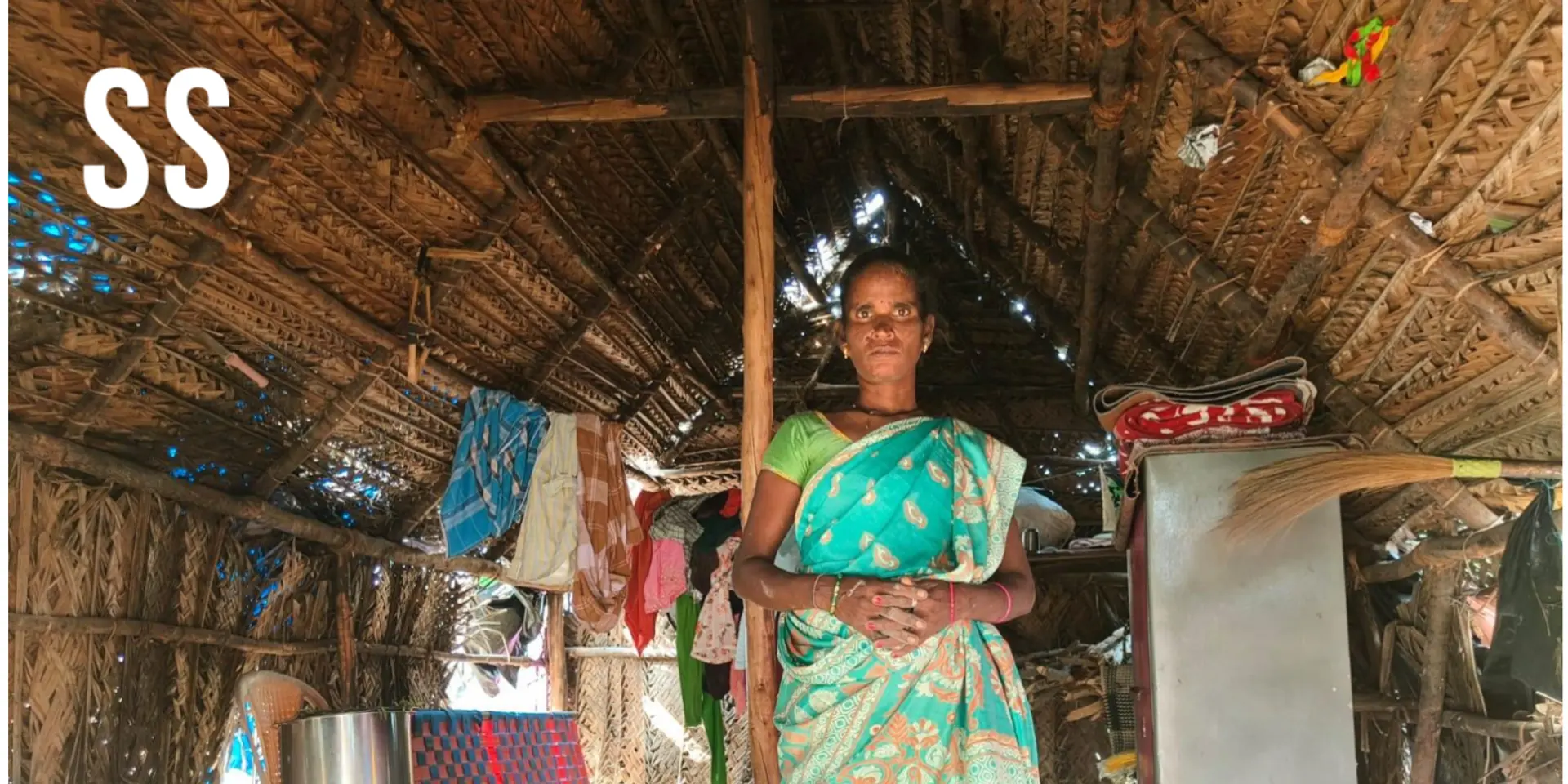

The Association for India’s Development (AID) India, a Chennai-based non-profit, began its housing programme for vulnerable tribal communities in 2015. For years, its team transited across East Coast Road—the gleaming coastal highway along the Bay of Bengal lined with boutique cafés, global brands and rooftop bars.
Three years ago, a chance detour led the team to a hamlet that the coastal highway had long concealed: 22 Irula families living inside a vast dumpyard in Kovalam. Disproportionately home to young mothers and infants, the settlement had survived for decades amid plastic waste and debris, at the heart of the city’s coastal sprawl.
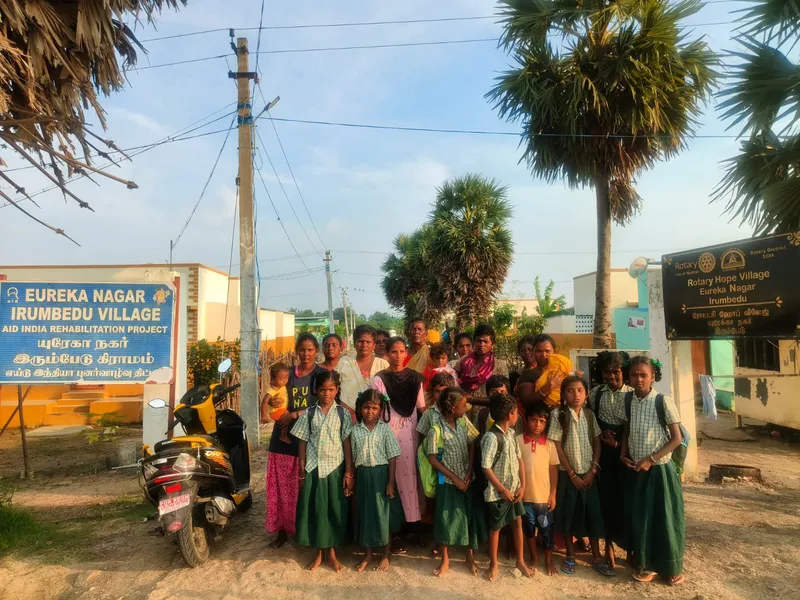
AID India's housing project for relocated Irula families in Irumbedu
This detour later translated into brick and mortar solutions, as AID India began constructing permanent homes for the Irulas around the highway, where longstanding delays and failures in formal rehabilitation remain a constant struggle.
“Until 2015, our focus had been on retaining tribal children in schools by giving them after-school tuition and educational resources,” says M Damodaran, Joint Secretary of AID India—a Dalit man and a first-generation learner from his family, who soldiered through extreme poverty, dropout, the loss of his mother, and domestic responsibilities to complete his education in his hometown in Kallakuruchi district. “After the 2015 floods, when thousands of vulnerable communities were displaced and died, we realised that education had to be approached intersectionally—with shelter and basic needs—because they are all connected.”
In Manja Board, Kovalam, the AID India team found that community women were picking plastic bottles from the dumpyard, drying, cleaning, and selling them to scrap dealers to earn a living. Children, many without footwear or proper clothing, had developed blisters on their hands and feet after spending entire days amid garbage and toxic waste.
It was in this context that AID India began its Patta Programme, an initiative focused on securing land tenure for marginalised communities. Through tenure and land-rights camps, the organisation began supporting residents in navigating the complex paperwork required for the patta or watap process—government documents that formally recognise land ownership or occupancy.
When Irula families had no documentation to prove their existence—as is the case with many informal and tribal settlements shaped by migration—the organisation helped them piece together records, complete applications, and engage local authorities, not only for housing security but also for access to welfare and long-term stability.
What many families did have, however, were voter identity cards—the lowest-bar entry point into state recognition, and often the only document the state actively seeks to provide. While electoral registration is mobile, outreach-based, and time-bound, documents such as pattas, ration cards, Aadhaar corrections, or housing titles require repeated office visits, proof chains, fees, literacy, and time—hurdles that local administrations rarely make the effort to bridge for marginalised communities, says Damodaran.
A glaring systemic oversight maintains this exclusion.
Tamil Nadu law places strict limits on issuing pattas on land classified as grazing grounds, burial grounds, water bodies, or other poramboke categories—government-owned land reserved for public or common use. In theory, these safeguards are meant to protect the commons. In practice, they often do the opposite.
Many vulnerable families—including Adivasi and coastal communities—have lived on or beside these lands for generations, yet remain ineligible for ownership because classifications have never been updated to reflect lived reality, says M Selvam, district coordinator at AID India. “Their long presence counts as encroachment, not tenure. At the same time, along corridors like East Coast Road, large resorts, hotels, and real estate projects have secured access to land, perhaps through reclassification, long-term leases, or administrative clearances, even when similar restrictions apply,” he adds.
The result is a system where legality bends upward for capital-heavy institutions, but hardens against communities whose claim rests on a history of residence, or even survival.
After intense lobbying for a year-and-a-half, AID India finally secured a four-acre parcel of land in Irumbedu panchayat—nearly 35 kilometres from Manja Board—in what appeared like an act of administrative closure.
The site came without water connections, electricity, or proper road access, leaving families formally resettled but effectively without a place to live. Matters were further complicated by opposition from some Most Backward Class and Scheduled Caste families already farming the area without pattas. Struggling with scarce water, agricultural land, and basic services, they resisted the relocation of the Irula families—not out of hostility, Selvam notes, but fear of further dilution of already stretched resources.
“Most relocation processes simply shift vulnerability sideways,” says Selvam. “Marginalised communities are forced to compete with one another, while meaningful rehabilitation plans remain absent.”
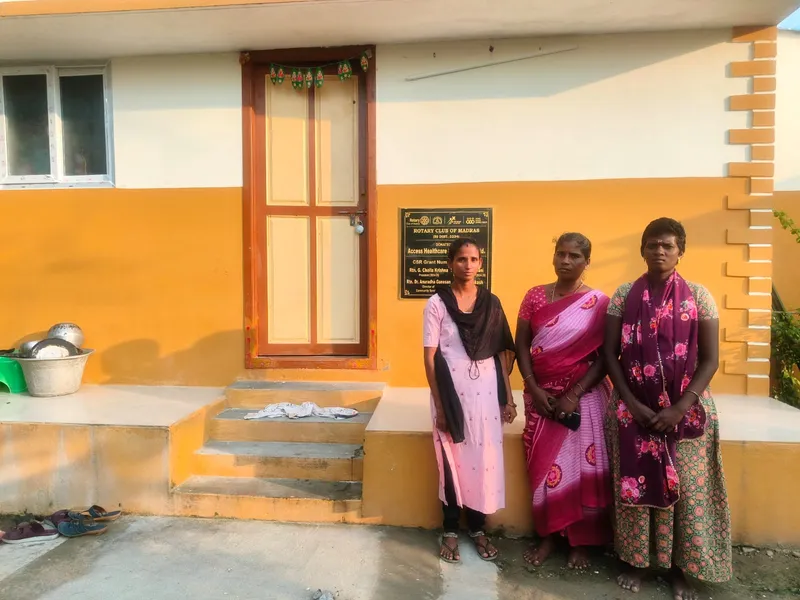
AID India, with support from Ashok Leyland, has built 39 pucca, well-ventilated houses with raised foundations to withstand monsoon flooding, along with electricity connections, toilets, and kitchen gardens at Irumbedu settlement.
After another legal battle at the Madras High Court, AID India began constructing permanent homes in Irumbedu in October 2023, with funding support from Ashok Leyland. Over the course of a year, they completed 39 pucca, well-ventilated houses with raised foundations to withstand monsoon flooding, along with electricity connections, toilets, and kitchen gardens. Twenty-two more are underway.
At the heart of this settlement, the organisation has built an after-school centre under its overarching education initiative, the Eureka Child Programme. Every evening, children from the community gather for classes in Tamil, English, and mathematics, with close tracking of learning outcomes and parental involvement.
The programme’s modules are designed to be multi-dimensional, using interactive activities, role-plays, science demonstrations, and life-skills exercises to move beyond rote instruction and rebuild confidence.
“Children from vulnerable communities fall out of schooling simply because they cannot keep up,” says Damodaran. “Many enter Class 1 without any elementary education and are immediately forced to compete with children from better sociocultural backgrounds. They also face caste-based discrimination—sometimes even from teachers—and school becomes a place of humiliation.”
These experiences, he says, erode mental health and push children toward child labour, substance abuse, or petty crime. Through AID India’s interventions, children who fall behind receive targeted remedial support, including creative methods to strengthen conversational English and mental maths through real-world practice.
Yet resettlement without foresight has had a critical impact on livelihoods. “Most informal work is place-based,” Damodaran explains. “When communities are moved abruptly, job networks collapse. Commutes become longer and costlier, and daily wage work dries up.”
Relocation sites like Irumbedu are often chosen for availability, not viability, lacking transport, markets, childcare, storage, or even reliable water and electricity. The nearest school is 15 kilometres away. For women, these disruptions deepen care burdens and wipe out informal income sources first.
Bhavani, a young mother who moved from Manja Board to Irumbedu, still travels 35 kilometres back to her former settlement to work as a sanitation staff member at a school. While there, she helps families who remain at the dumpyard, where the school provides limited water and shelter. “I want to get all my sisters out of there,” she says. “Even if some of us are better off now, our hearts remain with those still without a roof.”
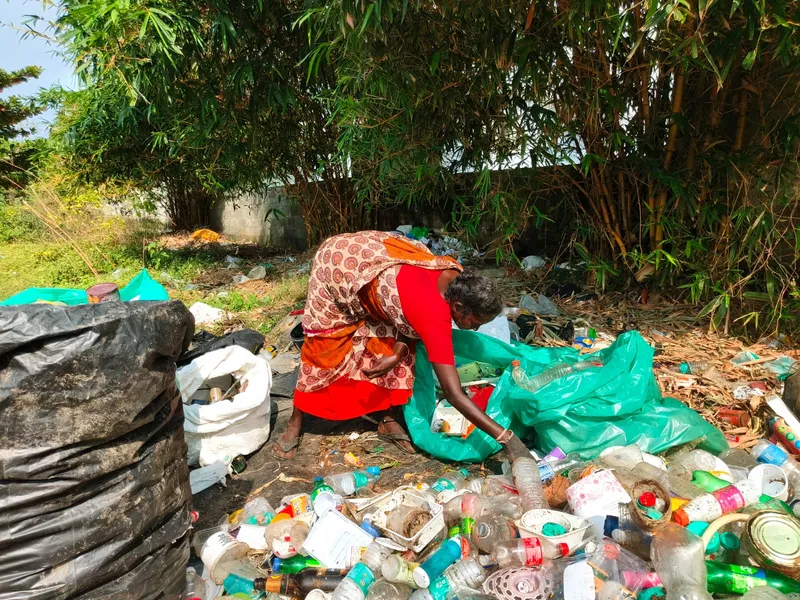
Manju, a single mother of two young children, sorts plastic bottles discarded by nearby hotels, resorts, and tourist attractions, earning around Rs 100 a day when work is steady. She is one of the few people left behind at Manja Board without a roof over their heads.
One of them is S Manju, a young mother who does not have a birth certificate Manju sorts plastic bottles discarded by nearby hotels, resorts, and tourist attractions, earning around Rs 100 a day when work is steady, and does not know her exact age. She lives with her two-year-old daughter and 11-year-old son, who dropped out of school following mental strain and discrimination. Each week, she cooks on firewood outside a collapsing makeshift hut. Abandoned by her husband and family, she followed her sister-in-law to the settlement; the latter has since moved to Irumbedu. “Now it’s just the children and me,” Manju says.
She is the latest applicant seeking housing support from AID India. A few kilometres away in Pattipulam, along ECR, the organisation has begun building more homes for other Irula families from nearby informal settlements like Manju, even without government pattas.
“These families have lived here for generations,” says Damodaran. “But they were asked to move when the street they lived on was reclassified as farmland.”
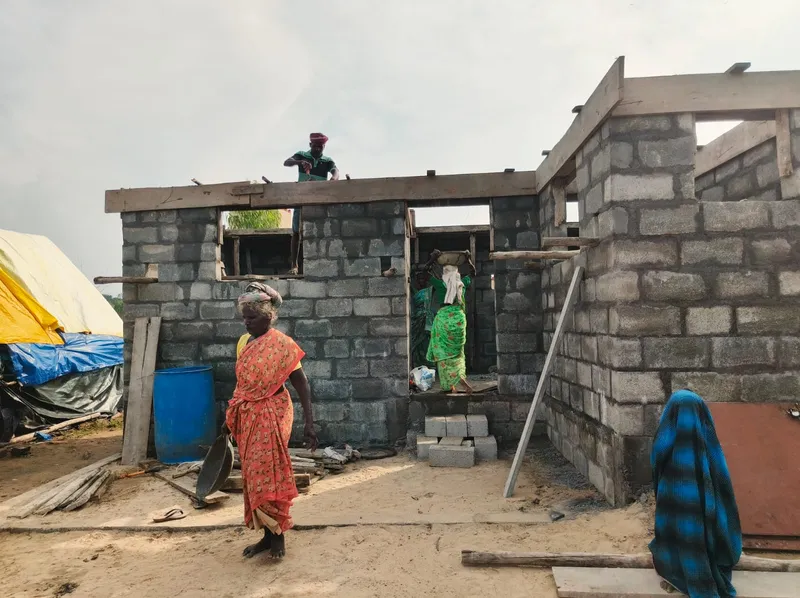
In the village of Pattipulam, AID India has identified four poorest families desperate for shelter, and started constructing homes for them. However, without having secured a patta for this relocated settlement, the homes are under the constant risk of eviction.
Accustomed to insecure and shifting habitation, the families moved to the next street. With limited funds and no patta for the land, AID India asked the community to identify the four poorest families for housing. They did, and construction is now underway, funded entirely by the organisation, under the constant risk of eviction through a court order.
Just a few streets away, a dance school stands on land that locals say appears to fall under the same patta restrictions invoked against Irula families—a contradiction many describe as routine, as hotels, bars, and other commercial establishments continue to operate largely unchallenged.
“Given our experience with the administration and local panchayats, waiting only makes things worse,” says Damodaran. “Every monsoon, settlements flood, elders are stranded, children fall sick, homes collapse. Housing shapes everything else: education, health, work, dignity.
“So we build,” he says. “And if we are told to vacate someday, we will find another solution, another home, another village. This is what we have always done.”
Edited by Jyoti Narayan