


Sound as shelter: Soumik Datta’s search for healing through music
For British-Indian musician Soumik Datta, music has always been a way to listen inward and make sense of a turbulent world. Through his new show ‘Travellers’ and his India tour, he tells SocialStory how he uses sound to hold grief, migration, and memory.

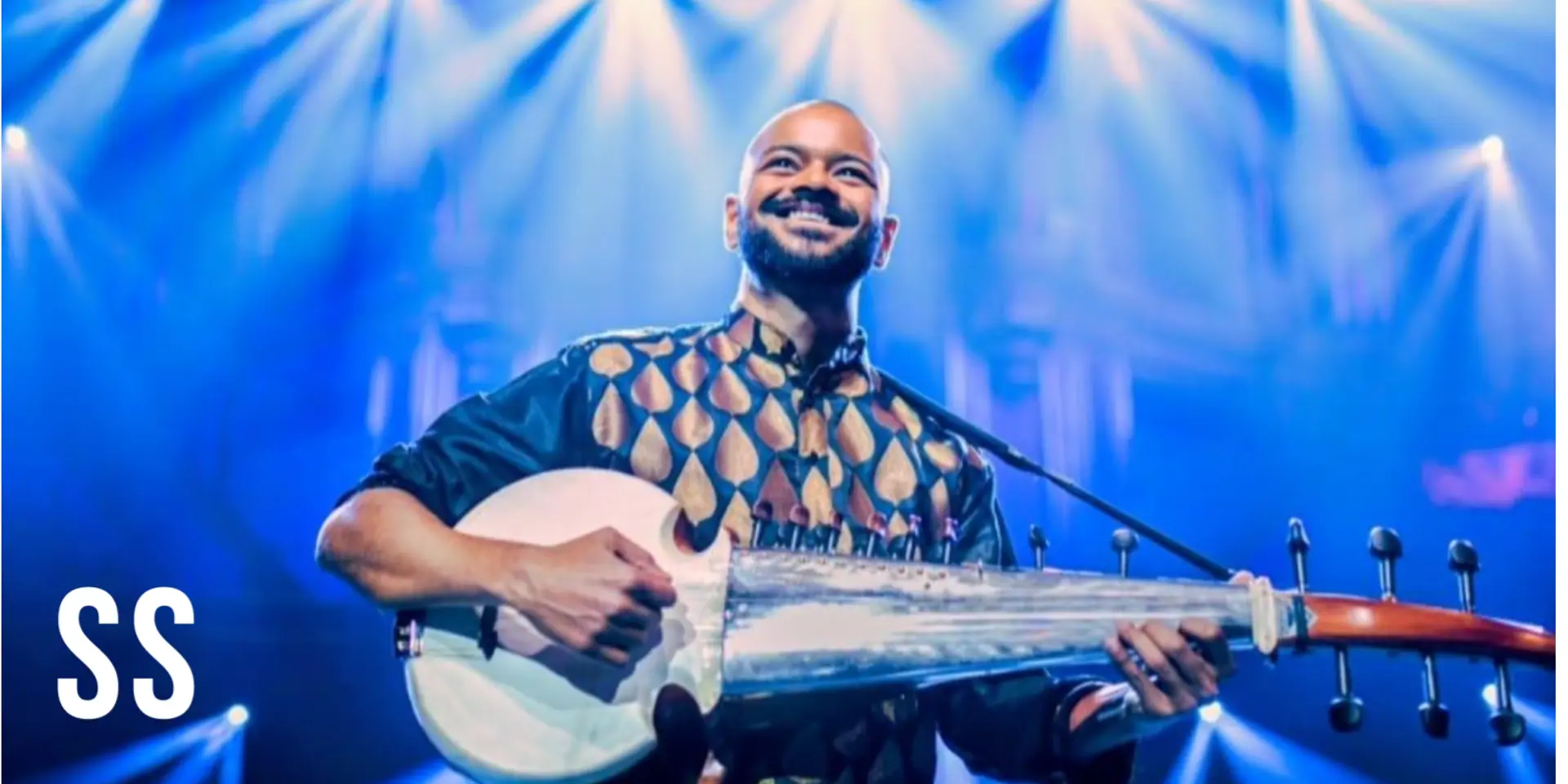

From the time he was a child, British-Indian sarod artist Soumik Datta has practised music not merely as performance but as a way to regulate and repair. It is how he listened to his body when the world felt too loud.
Datta discovered the sarod by chance. At 13, a cricket ball he and his brother were batting around struck a forgotten packing box in the corner of a room, releasing an unexpected sound. They opened it to find his paternal grandmother’s sarod—an instrument that would change the course of his life.
Born to Soumilya Datta, a banker who loved Baul music from Bengal, and Sangeeta Datta, a writer and arthouse film director, who sang Rabindra Sangeet and actively curated cultural life at home by organising shows, rehearsals, and artistic gatherings, their house, first in Mumbai and later in London, was a revolving door of musicians, poets, filmmakers, and artists.
Navigating the quiet dislocations of migration, identity, and belonging, the sarod offered Datta something steady: a way to listen inward, to soften the noise of the world, a way to pause, feel, and recalibrate.
“Indian music is a healing art form,” he tells SocialStory amidst his ongoing tour in India. “The frequencies of sound, the time-bound structure of ragas, the way melody mirrors circadian rhythms, are deeply connected to how humans feel, process, and survive. I’m really thinking about how sound can hold people when language fails.”
His own experience of music acting as scaffolding while navigating a constantly changing world, also guides his seven-month India tour, Melodies in Slow Motion, and his immersive show Travellers, which is a moving soundscape bringing together Indian classical music, field recordings, spoken word, and the echoes of global conflict.
Alongside festival performances, while in India, Datta is working with children and young adults from low-income and marginalised communities. Many of them have grown up amid economic precarity, domestic instability, and limited access to mental health support. Through collaborations with organisations such as the Akanksha Foundation and Mind and Matter, he conducts interactive music workshops in schools across Mumbai, Pune, Nagpur, Bengaluru, Coorg, and Mysore.
In these sessions, children are invited to respond to sound through writing, drawing, and conversation, expressing experiences of grief, violence, and loss that rarely find space in formal classrooms. For Datta, the goal is not performance but presence; creating a brief, safe pause where they can feel heard and emotionally held through music.
A childhood shaped by sound and movement
When his family moved to the UK in the mid-1990s, Datta was 11. He wasn’t particularly interested in music at the time. Like most kids in Bombay, he was crazy about Shah Rukh Khan.
But discovering the sarod would anchor him in a foreign country. As he trained seriously under maestro Pandit Buddhadev Dasgupta, Datta also began to understand the deeper lineage of the instrument, its roots across Hindu and Muslim traditions, its connection to Afghan and Persian histories, and its ability to carry stories across borders.
Over time, his playing began to reflect this layered inheritance: “the gravitas of Ali Akbar Khan, the dynamism of Amjad Ali Khan, and the creative freedom of my guru.”
What he was really searching for, he realised, was an amalgamation—not just of styles, but of cultures and histories that couldn’t be neatly separated.
When reinvention became survival
Growing up South Asian in Britain, Datta acknowledges the privilege of migration, but also speaks openly about racism, microaggressions, and professional pigeonholing.
“Sometimes you’re invited into spaces just so people can tick a box,” he says.
In his twenties and early thirties, this created a sense of frustration. In retrospect, he now realises that while his music was sound, but there was a constant “internal instability” about how he was being heard. That emotional unease pushed him toward experimentation. “I played in bands, wrote for orchestras, collaborated with dancers, scored films, and even learned to code so that my laptop could become a live collaborator on stage,” he says.
“It was great to be innovating, but underneath, it was also about communication,” he adds, “finding a language that could speak both to others and to myself.”
Role models like choreographer Akram Khan and musicians Nitin Sawhney and Talvin Singh showed him that classical roots didn’t have to mean creative confinement, and that reinvention wasn’t betrayal but represented fluidity and evolution.
When the world changed—so did the music
Then came the pandemic, which marked a turning point. Sitting in London, watching the rise of the Black Lives Matter and global conversations around injustice, Datta was pulled into a feeling of civic, “human” duty, and began researching refugee crises, climate change, and displacement.
He quickly realised how interconnected these issues were:; environmental collapse, capitalism, patriarchy, white supremacy;: none of these existed in isolation.
“And suddenly, making ‘beautiful’ art without engaging with these realities felt impossible,” he says.
By 2022, he had reoriented his creative company in the UK to focus on connecting artists with urgent social themes. But he was sure that he didn’t want surface-level gestures. He asked himself, how could the music itself embody these politics?.
“You can’t be abstract anymore,” he explains. “You have to answer why. Why this melody? Why this rhythm?”
And that’s how Travellers was born.
In many ways, says Datta, Travellers moves like memory does—across places, conflicts, and emotional terrains. The sarod weaves through recordings of war, migration, and historical warnings, while tabla, violin, and percussion create a constantly shifting sonic landscape.
Even the rhythm mirrors displacement. Datta plays with time cycles—five beats, seven, eleven—so the listener never quite settles. “It feels like the melody is being displaced constantly,” he says.
“Indian classical music is deeply tied to nature: morning ragas, evening ragas, seasonal moods. I see these traditions as early forms of emotional science,” he says, “reflecting how human bodies respond to light, darkness, and change.”
In his workshops with children, he sees this in action. Afternoon ragas make them sleepy, he says. Morning ragas energise them;, sound doesn’t just enter the ears but the nervous system.
What emerges is often heartbreaking.
Children talk about friends who died by suicide, about domestic violence or living in constant stress. For a short while, says Datta, the music creates a pause; a space where their bodies can breathe and their thoughts can land.
He believes these spaces should exist weekly, not as rare events. But that requires funding, partnerships, and long-term commitment.
With Mind and Matter, his work also focuses on breaking the taboo around mental health language, especially in non-urban, non-elite spaces where emotional vocabulary is still limited. Music becomes the entry point, and if people feel something deeply, they can begin to talk about it.
Elitism, access, and freedom
Datta is acutely aware of why Indian classical music is often seen as elite, inaccessible, and intimidating, particularly for young audiences. Many feel they don’t “belong” in those spaces because no one has ever invited them in.
London, he says, gave him a rebel spirit. Free from the weight of “aunties, critics, and rigid expectations”, he learned to play without fear. He didn’t have to ask permission to break rules.
“If I had grown up here,” he admits, “I’d have many more voices in my head telling me what I should or shouldn’t do.”
This freedom now allows him to create music that welcomes rather than excludes and doesn’t demand prior knowledge - just curiosity and presence.
At Kochi Biennale, after a Travellers performance heavy with references to Gaza, Datta recalls an Israeli woman who approached him in tears, moved by the show. “Without speeches, without slogans, music can create a bridge between histories, identities, and moral positions.
“These moments define the journey,” he says.
For Datta, Travellers isn’t about offering answers but about creating a space where people can listen to the world, to each other, and to themselves.
The show reflects the chaos outside, but it also mirrors what lives inside. Audiences, he says, leave talking about their own family traumas, their own migrations, their own fears.
This is radical at a time of noise, outrage, and fragmentation, as Datta’s music asks, “What happens when we really listen?”
Edited by Jyoti Narayan