


How Winnie Singh built a home and dignity for Vrindavan's forgotten widows
Winnie Singh is the co-founder and director of Maitri Ghar Vidhwa Ashram, which has been working to restore dignity and stability to widows in Vrindavan.

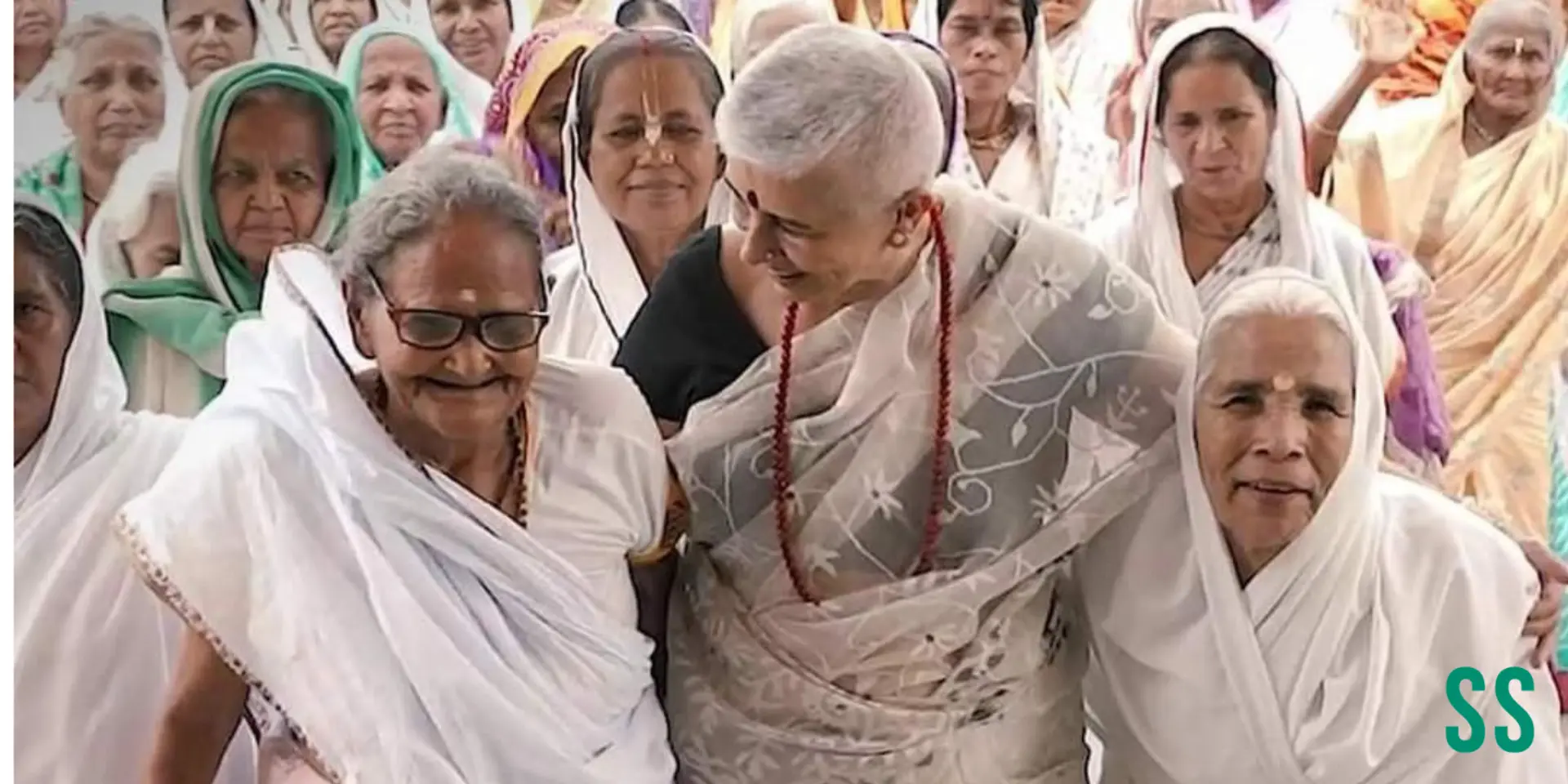

The philosophy of “giving back” was ingrained in Winnie Singh from childhood.
Born in the post-independence era as a child of refugee parents in New Delhi, Singh recalls her mother setting aside the first few chappatis she made to be shared at the nearby gurudwara.
“Every single day, chappatis, dal and subzi would be set aside, and someone from the gurudwara would come to collect them. In those days, gurudwaras didn’t have much money, so the langar came from people’s homes.”

Winnie Singh
Her mother would also gather the children of domestic workers and teach them the alphabet.
These were lessons that simply happened, every day, that would make a lasting impression on her mind.
However, her girlhood saw another type of messaging: you grow up, and you get married. Her husband was a short-tempered man, and her vibrant nature threatened his patriarchal sense of self.
When her husband walked out one day without leaving a single rupee in her name, Singh says she did not feel helpless. She felt empowered upon receiving a sense of freedom. She took charge of her own life and that of her children while her father, an advocate, fought for her rights.
Eleven years later, she met her present husband, General Bhopinder Singh, an Army officer who was kind, gentle and respected her freedom.
She married him, and as an army wife closely connected to her husband’s service life, she recalled visiting a hospital in Shillong where a nurse hesitated outside one room and suggested they move on, explaining HIV patients occupied it.
She insisted on entering the room. When she asked the people inside why they looked so sad, each one gave her the same answer: "Because we are going to die. When you have HIV, you die."
She began asking questions. When you go home, will you tell your wife? No. Will you have relations with her? Yes. Do you not think you are putting her at risk?
What she heard next has stayed with her ever since.
"She has no right to live if I'm not going to be there."
These men were not monsters, but in their fear, they were prepared to pass a death sentence on women who had done nothing at all.
In 2005, the National AIDS Control Organisation (NACO) had not yet launched counselling programmes in the Northeast. To raise awareness, Singh brought together all HIV-related films made in India, along with their actors, directors, and producers. She organised roadshows across the region. The story went national, and the conversation surrounding HIV finally began taking shape.
Not wanting the movement to die, Singh and her husband registered a non-profit, Maitri, that continues to work in the slums of Delhi on reducing violence against women and preventing domestic violence, with HIV as a major constituent of the work.
The women in white
In 2008, when Singh was Rotary president, she visited Vrindavan as part of a donation drive to distribute ration kits to 1,500 women.
“When we arrived, there were more than 2,000 women, and it was a disturbing sight to see the women in a poor state of health, completely destitute. Most of them were wearing torn sarees and blouses,” she recalls.
In Vrindavan, thousands of women who are abandoned by their families seek refuge in the temple town.
She asked her colleagues to finish the distribution, as she didn’t know how to hand someone a bag of rice once and then say, "There’s nothing more." Singh cried all the way back to Delhi.
When she got home, her husband saw her pain and said, “Let’s go back.”
It took two years of planning and consultation — board members with UN experience advised that a daily mid-day meal for a fixed population would allow measurable impact. As a beginning, her husband offered to fund 100 women for five years.
The question then became: who would cook? Singh didn't want to manage it herself. Hygiene was too important, the margins for error too high with women this vulnerable. She and her husband were regular visitors to Akshaya Patra for prasad.
A thought formed: Akshaya Patra Foundation feeds children. Why not the mothers? The official's answer was that older people were outside the scope of their programme, and that their mandate was to feed children. Singh’s response was, "Why should these women go hungry?"
After talking to senior officials in Bengaluru, Akshaya Patra agreed to supply food at subsidised rates. This connection also led her to the Pagal Baba Ashram, a dilapidated building with leaking roofs and no proper walls, housing 280 women in conditions almost beyond description.
On July 4, 2010, they began feeding the mothers. Currently, Maitri Ghar Vidhwa Ashram works with 165 women, 100 in the Vrindavan ashram and 65 in Radhakund. An additional 250 women from the Radhakund community, who cannot be housed, come daily for milk, fruits, and healthcare support. Once Maitri commits to a woman, the commitment runs to her last rites, says Singh.
The day in the ashram begins with meditation and yoga. The eldest is 108 years old, still agile, demanding, and is treated like a baby.
Depending on the day, skill-building activities include making cloth bags and block-printed stools, which are sold through a partnership with a Delhi designer. Pickles are made in Delhi, under Singh's personal supervision for hygiene, and sent to Vrindavan for the women to label. A new partnership with a company in Karnal will soon bring papads and spice processing to the ashram. Women also look forward to pilgrimages and outings outside Vrindavan.
Counselling is a big part of the process. "The pain inside them doesn't simply go away; they miss their children. They miss their grandchildren. Most of them have been abandoned; their children do not come,” Singh reveals.
Maitri tries to bridge that gap, speaking to both sides, encouraging reunion where possible. But the results are not always what they hope.
She recounts the story of a 108-year-old who reluctantly joined her son and daughter-in-law for a few days. On the tenth day, she fled the house and reached the railway station, where a kind stranger spotted the ID card she wore around her neck and called the ashram.
“The doctor found ulcers in the throat and scarring across her back. Scalding hot water had been poured over her, and her meals had been pushed down her throat,” says Singh.
It took more than two months for her body to heal.
The biggest outcomes
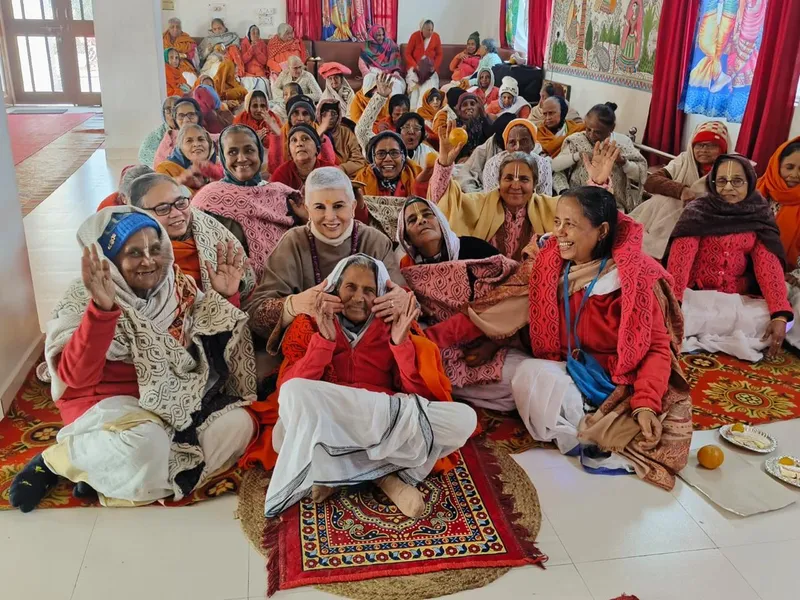
Winnie Singh with the mothers at the ashram
The COVID-19 pandemic brought about a very big change. People began coming to the ashram to share special days in their lives and seek the mothers' blessings.
“A young couple who got married near Vrindavan came to take blessings of the mothers at 9.30 pm. It shows that people are accepting them as human beings. The couple now comes every year, and they bring their child with them,” says Singh.
Counselling has also changed how the women see themselves. They introduced a little colour in the white saree, then a gold border.
For the past two years, they have celebrated Durga Puja in beautiful white and red sarees.
“They now play Sindoor Khela (where women smear themselves with sindoor on the final day of Durga Puja). They are no longer ashamed, they say: "We came here, and it is not our fault that our husbands died. We married Krishna. And now we are playing Sindoor Khela and celebrating all festivals,” Singh says, with delight.
Every night, a prayer of hope
Money remains a major factor that keeps Singh awake at night.
She is constantly raising funds. Unfortunately, not many organisations look at old age as a cause worth supporting. To sustain and expand this effort, Singh has turned to public crowdfunding through Milaap, hoping that ordinary citizens will directly support these women and keep the ashram running.
“Despite all the challenges, when I look at their faces, and the love they have for me, and the love and respect I have for them, I cannot leave. I cannot abandon them when they have already been abandoned. Krishna’s force will help me,” she says.
“Every night I say a prayer: 'Please let tomorrow be a better day, and may somebody come in and be kind and generous,” she adds.
Edited by Affirunisa Kankudti