



How this interactive learning programme is helping civil servants see children differently
KAWACH: e-learning modules, a four-part interactive learning experience developed by Kaboom Impact, use storytelling, animation, and relatable scenarios to help civil servants approach child protection with greater empathy.

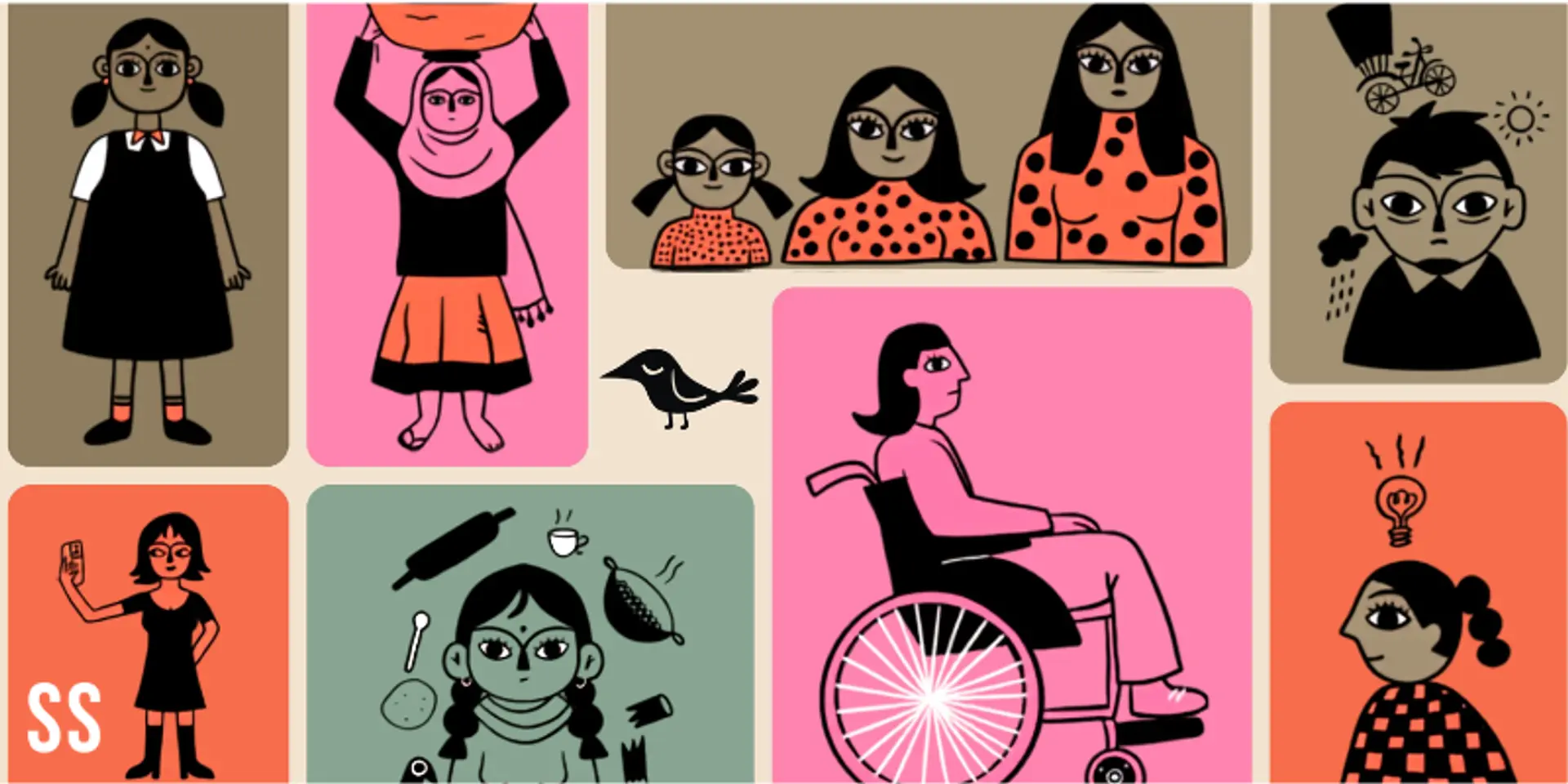

During our conversation, Nirmala Nair, Founder of Kaboom, a social impact agency, asks me to close my eyes and picture a child.
“What did you see?”
My reply is, “A four-year-old smiling in a classroom.”
The question may have been simple, but it carried the weight of expectations about how the world viewed children and child rights.
“We all picture children under 10 years, and forget that a 16-year-old girl is still legally a child. The consequence? If a child commits an offence, the system often stops treating them as one. If a 16-year-old girl runs away, an officer’s first instinct is often woh apni marzi se bhaag gayi (she has run away on her own),” she explains.
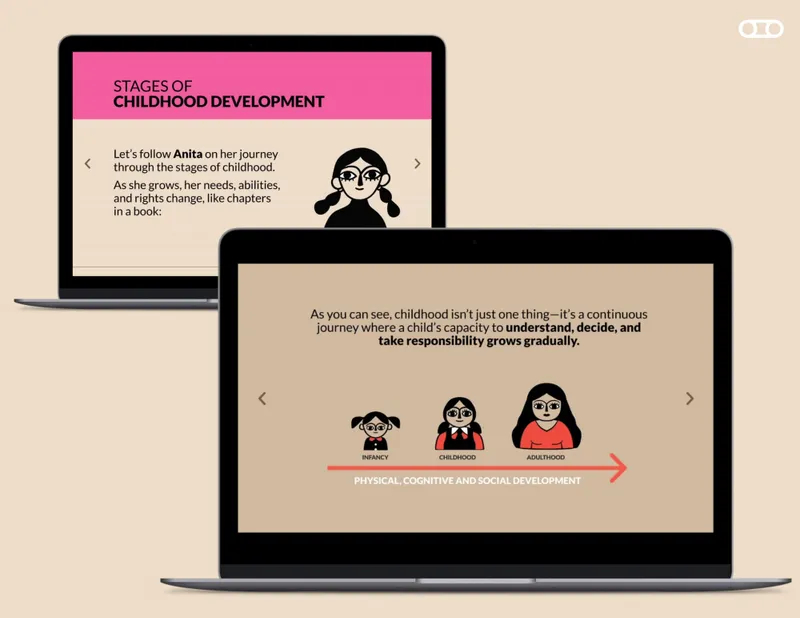
KAWACH: e-learning modules for civl servants
Nirmala uses this imagery to explain KAWACH, a four-part interactive learning experience developed by Kaboom in partnership with the British Asian Trust (an international development organisation) and Mission Karmayogi, the Government of India’s flagship National Programme for Civil Services Capacity Building (NPCSCB).
Designed for civil servants on the iGOT Karmayogi platform, KAWACH takes a subject traditionally approached through legislation, protocols, and text-heavy training and uses storytelling, visual language, animation, and relatable scenarios to create a more empathetic learning experience.
Through its interactive modules, the programme seeks to bridge the gap between knowing the law and understanding the child, encouraging civil servants to recognise children’s lived experiences, vulnerabilities, and rights. This includes adolescents who are often perceived as older than they are.
So far, 1,20,000 civil servants have taken the course.
A graduate of the National Institute of Design (NID), Ahmedabad, Nirmala had always wanted to work in the social impact space. She moved to Mumbai to work in advertising and did documentaries on the side.
While working on India Untouched, an exploration of caste across India, Nair discovered the real India, saw caste in its most gruesome form, and came to understand how rural India functioned.
She later worked with Viacom London on MTV India's campaign, MTV EXIT, a behaviour-change communication campaign on preventing human trafficking funded by USAID, which introduced her to the international development sector.
By 2014, Nirmala felt all of this was still fairly niche and media-led. She really wanted to work with the government and joined WASH United, which had partnered with UNICEF India on the Swachh Bharat campaign to create a large digital campaign called Team Swachh. She joined as campaign director to manage it.
At WASH United, she found herself at the centre of what would become Menstrual Hygiene Day, turning a small, newsletter-sized initiative into a full-fledged digital campaign in 2017.
During this journey, Nirmala watched creative agencies struggle to understand "the difference between selling soap and selling gender equity." This insight planted the seed for Kaboom in 2018, an agency built exclusively around social impact work, staffed by people who understand development-sector nuance rather than treating it as just another brand brief. It launched with the global Menstrual Hygiene Day campaign that won a Gold Shorty Award.
The story behind KAWACH e-learning modules

Nirmala Nair
KAWACH e-learning modules came to Kaboom when things were getting tough. The agency had been social and behaviour-change partners on USAID’s largest nutrition programme in Nepal that was supposed to run for four years but had to stop after two.
The British Asian Trust, which runs KAWACH, a child protection learning programme, approached Kaboom to develop an engaging edtech module.
“We looked at what they wanted and said we would approach it very differently from a typical edtech perspective. Our view: the platform is just a delivery mechanism, not "the change" itself. What matters is how you approach the content,” says Nirmala.
Kaboom proposed creating serious modules for civil servants that would look almost like children’s drawings. The first reaction from some was: “Will this ever be taken seriously?” Their answer was, “Yes, because the content itself wouldn't be frivolous. We wanted civil servants to see things from a child’s perspective and, by the end, start seeing children simply as children.”
Nirmala explains that KAWACH was designed for an audience that was already well-versed in the law.
“We were talking to an extremely smart, sharp audience—arguably sharper than us on their subject matter. They don't need to be taught the law; they already know where to find it. So, we had to make sure they weren't bored, and that they found real value in it. There's no point telling them things they already know.
“Instead, we told them stories and real incidents. In essence, the brief became: take the content from the British Asian Trust and reimagine it as a story that would genuinely work for a very sharp adult audience.”
The team built the modules around animations designed to hook viewers and hold their attention using stories and case studies in place of dry instruction.
The programme also sought to build their emotional capacity to care for children whose lives and potential were at stake.
This led to an empathy-led curriculum in which laws were translated into cases, cases into stories, and stories into choices that explored behaviour and encouraged reflection. KAWACH was thus designed as a choice-led, four-part interactive learning module rather than a compendium of legal provisions.
The starting point was a fundamental question: who counts as a child, and how do gender, inequality, and stigma influence the way children are perceived?
With extensive legal content to cover, the team made learning interactive. Learners’ choices determine how the stories unfold, keeping them engaged while encouraging them to consider the consequences of their decisions.
Nirmala illustrates this with an example.
“Imagine a WASH officer, someone who works on water and sanitation, watching a module on child protection. Their first thought is, “What does this have to do with me?" But a WASH officer decides where a toilet gets built in a village, and that decision affects whether a girl can use it safely. If it's built in a dark, secluded spot, she can't. That's child protection too. Child protection isn't only about preventing trafficking or crimes against minors—it’s about everyday decisions,” Nirmala explains.
The programme is available on the IGOT (Integrated Government Online Training) platform and is part of Mission Karmayogi.
Multiple government agencies vetted the content, including the Ministry of Women and Child Development, CARA (Central Adoption Resource Authority), and the Ministry of Skilling. It took about eight months to build four modules.
“We have had strong qualitative feedback from participants about what they took away from it. The government has expressed interest in creating multiple regional-language versions of the course, which we see as a sign of its perceived value,” Nirmala says of the impact.
But the real measure, she emphasised, will show up over time.
“If even half of the 1,20,000 who've taken it retain something meaningful, that's 60,000 civil servants who may look at children differently for the rest of their careers, and there's no way to document that immediately. Maybe five years from now, someone will tell us a story that proves it.”
Participant feedback has been encouraging. "It clearly explains how childhood is viewed in Indian society, the legal rights and protections provided to children under laws like the Juvenile Justice Act and the Right to Education Act, and the psychological aspects of child development. It is very useful for teachers, social workers, students, and anyone working in the field of child development,” says Sudhir Mishra, a Revenue Inspector.
As Nair puts it, the team never approached KAWACH as a legal-compliance exercise, and never saw civil servants as mere enforcers of statute.
“We saw people who are willing to do better, who are willing to care, to protect, and all they need is to see the life on the other end of their table. Through KAWACH, this is what we aimed to do,” she says.