



Fiji greets you like family: A journey into its heart—the villages
Beyond Fiji’s palm-fringed beaches and luxury resorts lies a deeper story, one told through traditional village visits, kava ceremonies, and the warm Bula Spirit.


To land in Fiji is to be drawn instantly into its warmth.
As I stepped off the plane onto a long, open bridge at Nadi International Airport, the damp floor beneath my shoes reflected a light rain that tapped steadily on the roof above. What cut through the quiet shuffle of arriving travelers wasn’t the mechanical murmur of announcements, but something human.
Something festive. Music.
I turned the corner, and there they were. Two men, dressed in vibrant bula shirts and traditional sulus (a wraparound skirt worn by men), were standing beside the immigration counters. One strummed a guitar, the other a ukulele. Their voices, warm and relaxed, welcomed each traveler not with formality but with song.
This was no gimmick. It’s a tradition. In many Pacific Island cultures, music accompanies arrivals and departures, a way to signal connection, not just travel.
At the airport, the first greeting came before the formalities. “Bula!” the immigration officer said. It’s a Fijian word used for hello, but also connotes life, health, and goodwill. It quickly became a word I’d hear and use frequently.
The officer, cheerful and curious, asked about my trip, chatted about places to visit in India, and stamped the passport with an easy smile. The interaction felt informal, familiar. Like entering a home rather than a border checkpoint.
Fiji is a vibrant blend of cultures. The indigenous iTaukei, the original inhabitants of the islands, live alongside Indo-Fijians, descendants of Indian labourers who arrived in the 19th and early 20th centuries under British colonial rule to work on sugarcane plantations. Today, Indo-Fijians make up around 38% of the population, and their cultural imprint is unmistakable. From the scent of chai wafting from local homes to the Diwali lights that brighten the streets of Suva, Fiji’s capital and most populous city, their presence is woven into everyday life.
It’s not uncommon to find a Hindu temple beside a church, or hear Fijian Hindi, Fijian, and English spoken within the same conversation. All three are official languages.
As an Indian traveler, I was often met with an easy rapport. There was a warmth in the way Indo-Fijian locals would ask, “From India or Fiji?” and then share stories about their grandparents from Gujarat or Uttar Pradesh. These exchanges, often casual, deepened the sense of familiarity.
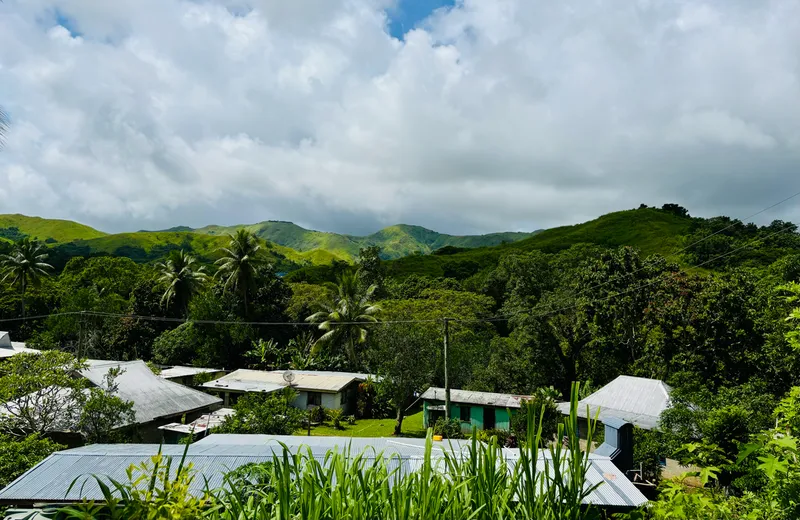
Jubairata village, nestled along the Sigatoka River, framed by hills, trees, and drifting clouds. | Image: Ishan Patra
Beyond the beaches and resorts, I found Fiji’s heart beating strongest in its villages, where stories were shared not in museums, but in meke dances, woven mats, and open palms.
I visited three villages during my stay. Each one offered more than just memories.
“Fiji is much more than swaying palm trees, white sandy beaches, and the resorts,” Nemani from Raiyawa village said, his voice steady with pride. “Fiji is the people.”
Stories of soul
Tucked beside the winding Sigatoka River, the village of Jubairata greeted our group, travelers from the US, Australia, New Zealand, and India, with warm smiles. We walked along a muddy path through groves of trees to a tin-roofed community hall, where we learned that every visiting party must appoint a chief. Ours became an Australian gentleman, the eldest among us, bestowed with ceremonial leadership and a seat of honour.
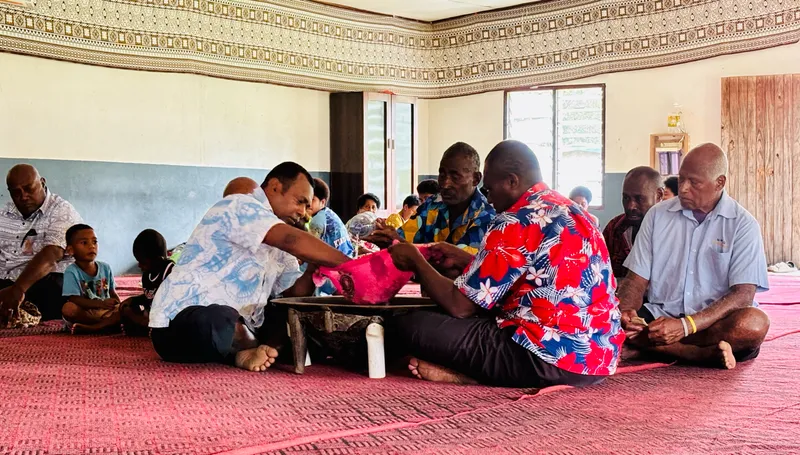
Dressed in sulus and bula shirts, the men prepare kava. | Image: Ishan Patra
Inside, men wore dark sulus and bula shirts. Women were dressed in brightly patterned puletasi (a traditional dress-and-skirt combination), and children peeked shyly from behind their parents. We were welcomed with a kava ceremony, the earthy, mildly numbing drink made from the ground roots of the yaqona plant, passed to each of us in a halved coconut shell. It was a ritual of inclusion, accompanied by rhythmic claps and solemn chants.
Then came the feast: smoky chicken, taro (a starchy root), fruits, cassava, and more. Each dish was deeply rooted in Fijian tradition. After we ate, music filled the hall, with guitars and soft singing in rich harmony. Laughter rose, hands clapped, and feet tapped—the line between host and guest blurred as we danced together to the beat of the village’s joy.
And then, a celebration of a different kind. A villager had just bought an old Toyota pickup truck. It was wrapped in bright fabric, ready for blessing. For the village, the truck represented more than transport, it was cause for celebration.
With the earth steaming under the sun and a curtain of afternoon rain gathered, the villagers waved us off with wide smiles and laughter that lingered long after we left.
A feast beneath the Earth
Another day brought me to Raiyawa, a village nestled near the hills, where the air was thick with the rich, smoky aroma of an approaching lovo feast. We arrived to find steam rising from earth-dug pits lined with banana leaves. The food was buried beneath hot stones, slowly absorbing the flavours of fire, wood, and earth. In Fiji, lovo isn’t just a way of cooking. It’s a celebration, reserved for moments that matter.
By lucky circumstance, or perhaps tradition, I was the only man in our group, and so I was named the visiting chief. They seated me at the front of the community hall, just ahead of my group mates. As the villagers prepared the ceremonial kava, the first cup was brought to me in a halved coconut shell, a gesture of honour and welcome.
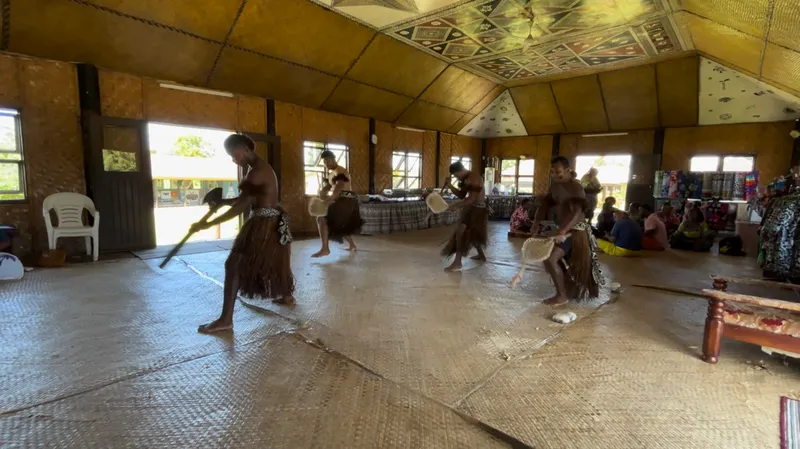
With sticks and mock war-axes, dancers perform the Meke Wesi. | Image: Ishan Patra
Then came the performance. In Fijian villages, music doesn’t begin, it erupts. The men’s meke exploded into life. Dancers wielded sticks and mock war-axes, their movements fierce yet graceful, echoing the old Meke Wesi, a dance once used to prepare warriors for battle. The women followed with melodic singing and synchronised clapping.
The rhythm was infectious. I hesitated at first, but it took only a nudge to get me into the circle. Soon, I was
swaying and clapping, dancing with people I had known for only moments.
When the food was ready, they served us a feast: tender chicken, taro, and tropical delicacies steeped in traditional flavours. The food was rich and filling, but it was the ritual of sharing, the gestures of inclusion, that mattered.
After the meal, villagers displayed hand-woven mats and intricately carved wooden pieces. Nemani showed us how to weave a basket from coconut leaves, his fingers moving with practiced grace. Every technique held a lineage passed from generation to generation.
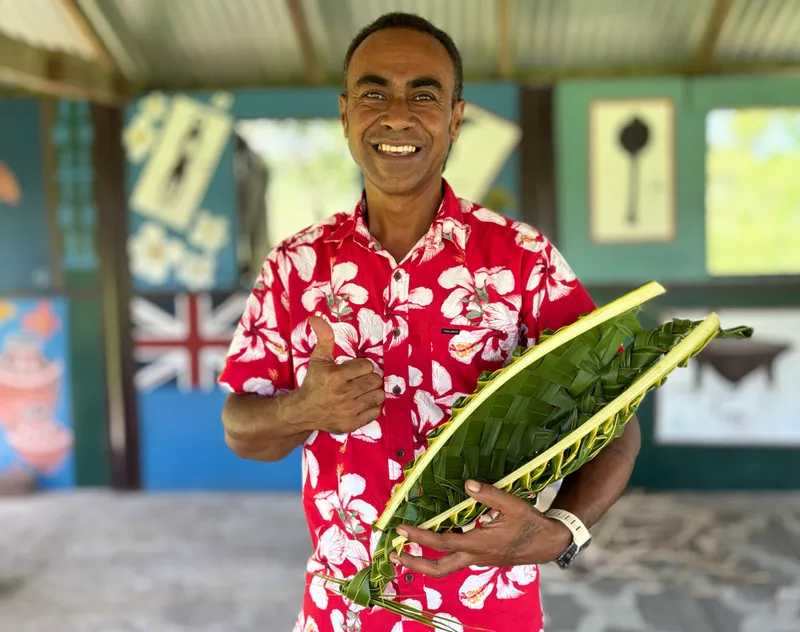
Nemani smiles as he holds up the finished basket, woven deftly from a coconut leaf. I Image: Ishan Patra
As the sun dipped low, we hugged our hosts and made our way back, the path dappled in warm light. It wasn’t the taste I’ll remember most. It was the ritual, the storytelling, and the patient way they included us in every step. For a few hours, I wasn’t just an outsider passing through—I belonged.
A quiet goodbye in Nadiri
My final village was Nadiri, a quiet, reflective place nestled among swaying palms and turquoise waters on Fiji’s Coral Coast, along the southwest shore of Viti Levu, the country’s largest island. There were no chants, no ceremonial kava here. But the welcome was just as heartfelt. Smiling children rushed forward to meet us. Villagers brought freshly husked coconuts, filled with cool and sweet water.
Inside the breezy community hall, teenagers stood tall, speaking with quiet pride about their coral project, a grassroots effort to protect the reef just beyond their shoreline. Their words were quiet but confident.
Local women moved through the room with platters of sandwiches, jugs of fresh juice, and glasses, offering them with care. There was no spectacle here, only sincerity and a deep connection to the ocean that sustained them.
More than a trip
Across Fiji, a quiet rhythm played out everywhere I went. In markets bustling with chatter, in hotels where the staff remembered your name, in spas where care went beyond the treatment, and even on the flight home. People didn’t just serve. They saw you. They asked, they smiled, they listened. And none of it felt rehearsed.
Hospitality here isn’t a performance. It’s a way of being. It’s woven into daily life, shaped by culture and community.
Yes, the beaches were stunning and the resorts tranquil, but it’s the voices singing at the airport, the hands clapping during kava, the children waving from village gates—that I’ll remember most.
When people speak of the Bula Spirit, they don’t just mean friendliness. They mean something deeper, a cultural philosophy of kindness, openness, and respect that flows through daily life.
I came to Fiji for the stunning islands, but I left carrying the villages in my heart.
(Cover image designed by Nihar Apte)
Edited by Affirunisa Kankudti