



Storytelling through kasavu: Artist Lakshmi Madhavan weaves stories with Kerala’s traditional textile
In search of her roots, accidental artist Lakshmi Madhavan landed in Kerala’s Balaramapuram and accepted the traditional kasavu as her medium of expression.


Home is often associated with rich fragrances—the spices from the kitchen, the sweet jasmine in the garden, and the woody aromas of incense. For artist Lakshmi Madhavan, home was synonymous with the smell of her Ammamma’s (grandmother in Malayalam) crisp white kasavu mundu veshti—the traditional white and gold attire of Kerala.
“It was a peculiar smell… she would starch her veshti in rice water. So, it was the smell of rice water mixed with the smell of her sweat and the kitchen,” Madhavan says.
Born in Kerala, but soon migrating to Mumbai, Madhavan never associated with or imagined that the kasavu would become the medium of her artwork.
In 2021, amidst the global pandemic, Madhavan collaborated with painter and curator Bose Krishnamachari for his exhibition Lokame Tharavadu, organised by the Kochi Biennale Foundation. The exhibition revolved around the theme of ‘world is one family’, referring to the spirit of humanity and oneness during the pandemic. Over 260 artists, including Madhavan, were asked to create artwork interpreting their “idea of home”.
“That unravelled in the idea of my grandmother, and I realised that my idea of home was this really feisty lady, far ahead of her time in many ways. If she were born in another time, she’d be breaking class ceilings… When I had to decide what home stands for me, I knew it had to be a tribute to my Ammamma,” Madhavan tells YS Life over a video call.
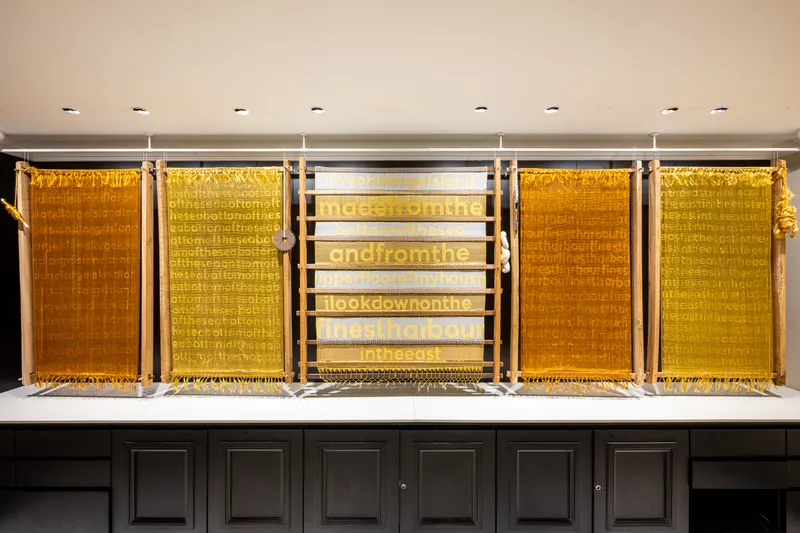
Lakshmi Madhavan's artwork using kasavu
Having been widowed very young, Madhavan’s grandmother always adorned a kasavu in muted colours and with a narrow kara or border. “As a Nair widow, there were a lot of rules around the attire, the border couldn’t be beyond a certain width. Back in the day, shops had a separate section for widows’ kasavu. Growing up, spending so much time around her, I ingested very early that there’s this complicated connection between the woman’s body and cloth."
The idea of reimagining her Ammamma’s kasavu for the project led Madhavan to Balaramapuram—one of the original handloom weaving centres of the kasavu near the capital city of Trivandrum.
Since then, there has been no looking back.
For the last four years, Madhavan has been working with the 200-year-old craft tradition to reimagine the kasavu—bringing forth narratives concerning identity, politics of the cloth and the body, and diving deeper into the socio-cultural hierarchies.
Having worked with the Copengegan International Artists Collective, her artwork has been featured at the Rajiv Menon Contemporary in Los Angeles, Kala Ghoda Arts Festival, Kochi Art Week, National Museum in Delhi, Melbourne Museum, India Art Fair, Hampi Art Labs, and Kashi Arts Residency, among others.
“Before this, I was actually very material-agnostic. I was working with all kinds of different materials. In fact, I was thrilled and challenged by having to use a new material every time,” she says. However, after the Bose Krishnamachari project, Madhavan felt, “We were meant to meet—kasavu and I. Both of our journeys were at similar points when we met.”
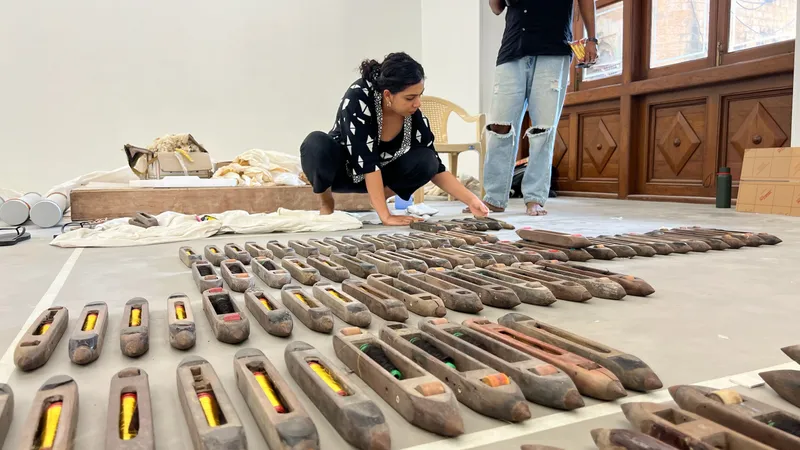
Artist Lakshmi Madhavan at work in the Balaramapuram studio
Finding a calling
Coming from a traditional, middle-class Malayali background, there was a strong emphasis on education at Madhavan’s house. “Art was never considered a viable career option. And not to blame my parents, I don’t even think I could have convinced them back then… What would I do studying this (art)? I remember my dad’s question was if I was going to become a billboard painter… I didn’t have any answers,” she recalls.
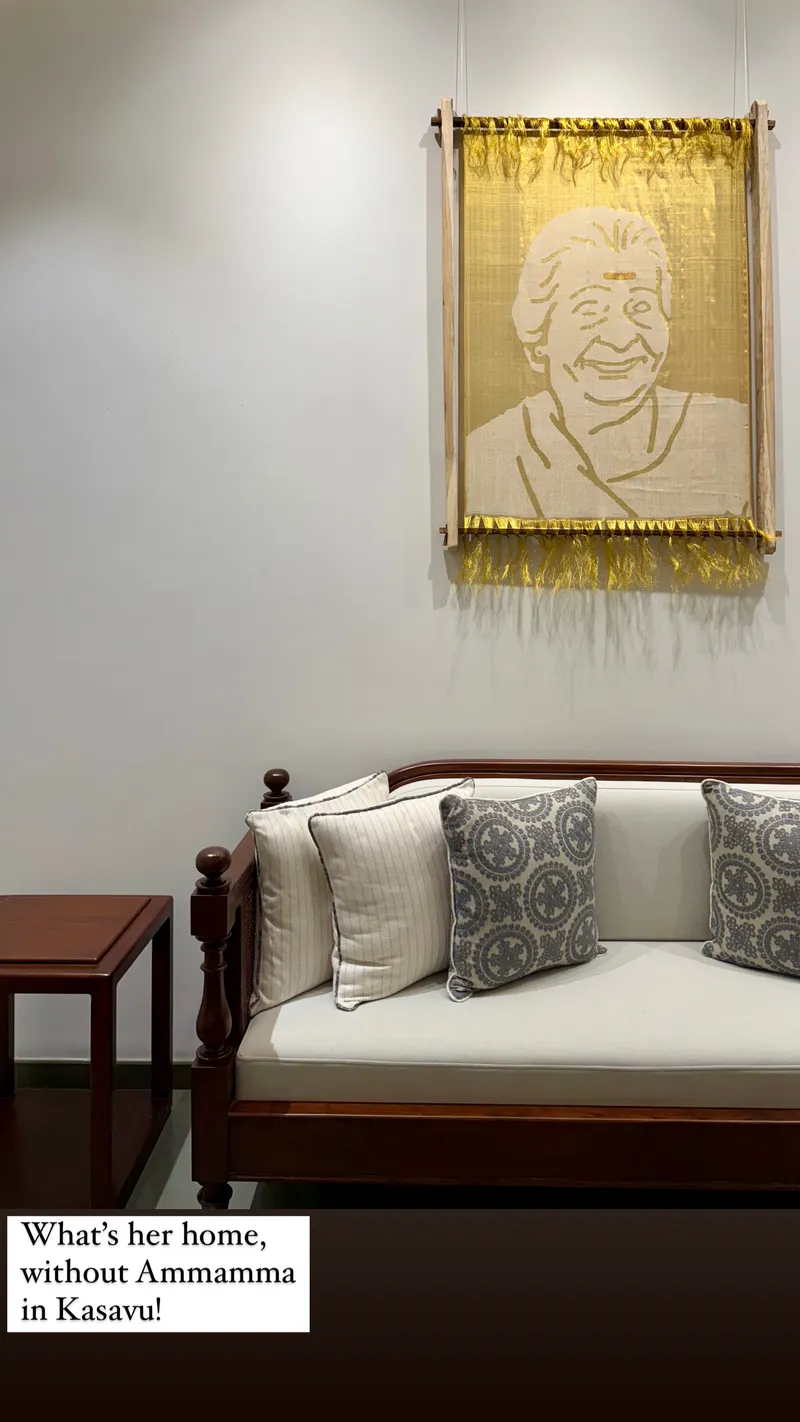
Artist Lakshmi Madhavan's Ammamma's (grandmother) garment became her source of inspiration
Like every other middle-class Indian, Madhavan went on to do her MBA and pursue a career in the corporate world. After her marriage led to settling in Denmark, she finally took a break and went back to sketching and doodling. “The community was very knit and I struggled to find work… art came to me at a point when I was so low that I didn’t have anything to hold on to,” she says.
Eventually, in search of more art supplies, Madhavan ended up in an art gallery and started working there, later using the space above the gallery as her art studio.
Once back in India, she continued pursuing art as a career.
In 2021, when Madhavan first landed in Balaramapuran, she struggled with anchoring her sense of belonging, finding her identity and legacy to pass on to her son. In some sense, the craft and tradition of kasavu were undergoing a similar challenge.
Once a thriving handloom village with more than 1,500 weavers, Balaramapuran had fewer than 50 weavers due to a lack of government support, low wages, lack of resources, and the inability to innovate. The weavers of Balaramapuram had faced financial challenges during the floods of August 2018, and the COVID-19 pandemic made the situation worse.
“The community was dwindling, and if there was no sort of intervention, the craft would lose its relevance… There was a parallel story for me as an artist to deep dive into,” Madhavan says.
Holding on to the craft
With no background or education in textile or art, Madhavan took the plunge and opened a studio in Mumbai , and another setup in Balaramapuram. She collaborated with master weaver Jayan and now works with his son, Aravind Jayan, to produce artwork on the kasavu canvas.
After her initial research, Madhavan starts ideating. ”My work is about the history, heritage, politics of the body and the cloth in terms of community, caste, gender and cultural landscape, and contextualising the cloth.”
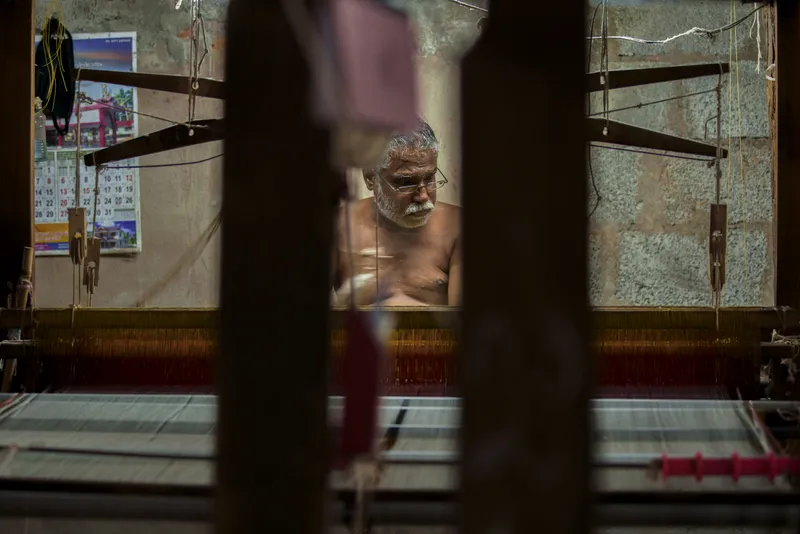
A kasavu weaver at work
Once an idea is finalised, it is first visualised on paper before being produced digitally and taken to the weaver. “We have to remember that, however much we try, I’m never going to get the precision of how I’ve drawn or digitally imagined something. And that’s what I love… There is a certain magic that unfolds on the loom.”
Often, there are challenges with the process. Many times, something visualised digitally is not possible to produce using the loom. “As an artist, I have to let go of a lot of my process in the final execution. I have to respect the weaver and allow his process, skill, and creativity to come together with mine.”
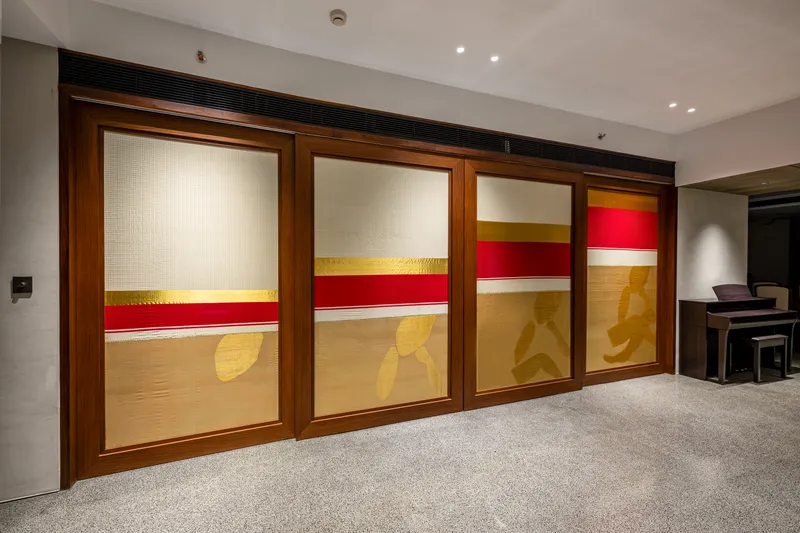
Artwork by Lakshmi Madhavan
Despite this, Madhavan has tried experimenting with the textile. Traditionally produced in white and gold, she has experimented with colours red and black to narrate different stories.
Red comes from the idea of generational lineage—of women’s lineage and bloodline—a parallel she draws from finding her own identity and the generations of the weaving community keeping the craft alive.
In her latest exhibition, Madhavan used black, an otherwise unpopular choice, to portray the distance between the weaving and wearing body. Traditionally, the weavers—belonging to the Ezhava community—were once considered untouchable, although the upper-caste society donned their handmade textiles.
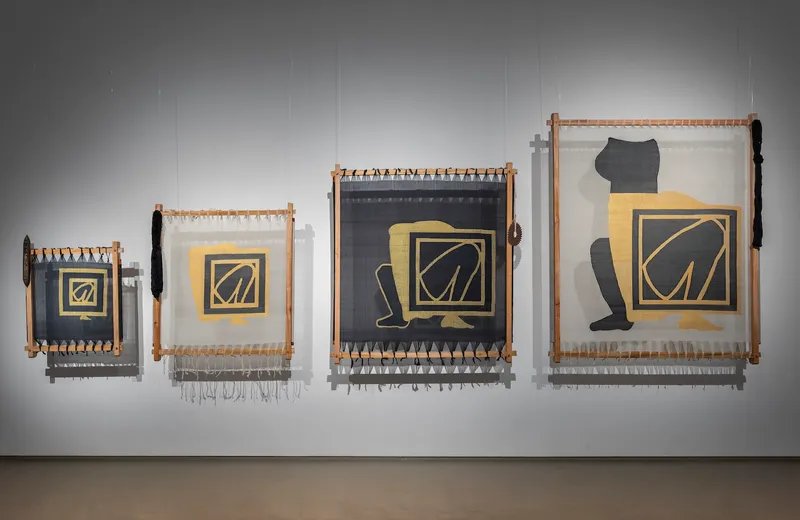
Lakshmi Madhavan uses the unconventional black in a kasavu for storytelling
“When you think of kasavu, the agency always lies with the wearing body, almost negating the weaving body…” The idea of introducing black was to spotlight the body lurking behind, but never allowed to be shown with the cloth—the weaver. “As an artist, I wanted to have this body reclaim the cloth,” Madhavan explains.
Shying away from terms like ‘activism’ or ‘cultural preservation,’ Madhavan feels she, as an outsider, is using the material and telling the stories of the weaver community. This brings on her a responsibility to acknowledge the community in the process.
The artist believes that 40% of this collaboration with the weaver community results in the production of her artwork, while 60% of it is responsible for community-led engagements.
Today, Madhavan’s initiative is responsible for 50% of the revenue generated by her master weaver. It has also raised the wage rate by 200% by pooling the proceeds from the sale of her artwork to support the families in Balaramapura. She is also attempting to garner the interest of the next generation of weavers and women of the community by assigning them work and involving them in her projects.
Her next project, which Madhavan is unable to share the details of right now, is an on-ground community project that attempts to bring the final artwork back to Balaramapuram, enabling the weavers to get closer to the end result, and the impact their work creates.
(Disclaimer: The story was updated to fix typos)
Edited by Suman Singh