



This agritech startup bets on hydrogen-powered lightweight drones to boost Indian agriculture
With hydrogen-powered UAVs that outlast batteries and slash spraying costs, agritech startup Visron is making precision farming affordable for thousands of farmers.

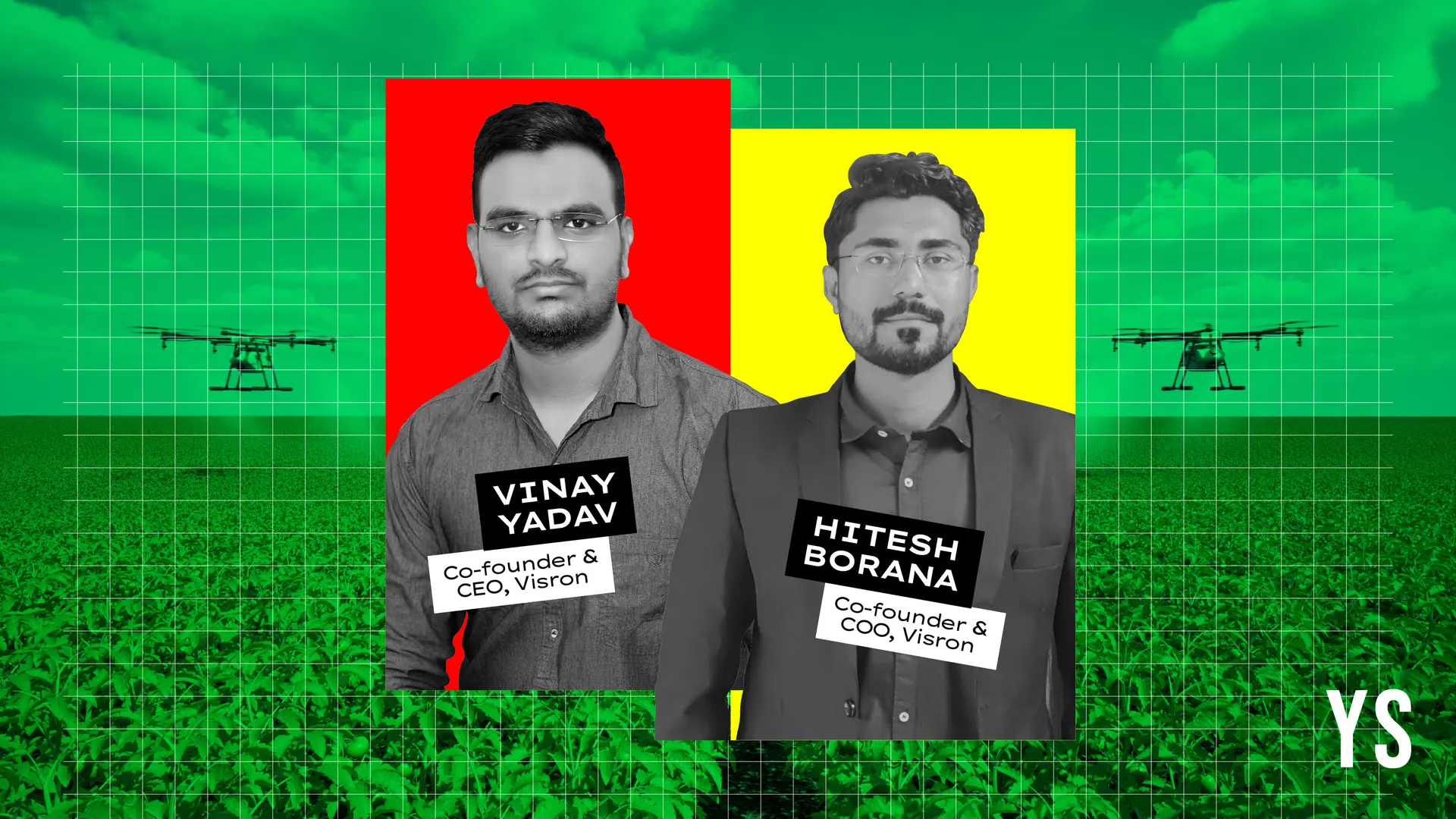

In 2021, engineering batchmates Vinay Yadav and Hitesh Borana co-founded agritech startup to support farmers in Uttar Pradesh and Rajasthan. But the duo encountered many challenges while working with battery-powered drones.
“Battery-powered drones have a short lifecycle, which was a great financial and operational challenge for us as it meant a recurring investment of Rs 2-3 lakh every 210 days. Secondly, their flying time was also quite short. We realised that we had to develop technology that would allow us to fly our drones for a longer period,” CEO Yadav tells YourStory.
The following year, Yadav and Borana, the COO, pivoted their agritech startup into a deeptech venture, focusing on hydrogen-powered drones. Today, their 22-member team operates out of a manufacturing facility at their headquarters in Jhalawar.
“In the beginning, we planned to import the hydrogen cells, but we found that such cells were very bulky. Due to this, drones couldn’t take a higher payload than 5kg. Since that was out of the question for us, we decided to build lighter models ourselves,” Yadav says.
A deeptech solution for an agritech cause
Yadav’s drive to use technology to advance India’s agricultural sector was rooted in childhood memories and nostalgia. His mother worked as a clerk inthe Rajasthan government’s agricultural department, and he was exposed to the ground realities of an agrarian economy whenever he visited her workplace.
“There were always farmers dropping by with various issues, from health diseases to operational hazards. Then, through an episode of Satyamev Jayate, I found out about how many farmers travel to Bikaner for cheap medical treatment after getting diagnosed with cancer upon long-term exposure to pesticides,” he shares.
To reduce such cases, Visron provides drone-enabled pesticide spraying, which minimises contact between farmers and chemical substances. The other major service it provides is spreading seeds over farmlands. Both these services, the CEO says, reduce labour significantly.
But before it reached this point, the biggest hurdle for the agritech startup was to create hydrogen-powered drones that were light enough to carry heavy payloads.
“Developing a hydrogen-powered fuel cell is already a complicated engineering task, and making it lightweight was even harder. But that was also an opportunity for us. Over a couple of years, we managed to crack that code and will be applying for a global patent soon,” he says.
Visron has two types of drones currently: one equipped with an 8kW hydrogen fuel cell and the other with 12kW. The former Unmanned Aerial Vehicles (UAVs) can carry a payload of 10 kg, while the latter can carry 16 kg—a 100% and a 220% increase over the industry standard of 5kg, respectively.
Yadav believes the startup’s hydrogen-powered cells are far more advanced than battery-powered UAVs. For battery cells, one will have to spend Rs 65,000 per kilowatt (kW), but the CEO says his team spends only Rs 22 per kW for their hydrogen cells.
“Hydrogen fuel cells for our drones cost only Rs 22/kWh because 1 kg of green hydrogen at Rs 250 delivers far more energy, requiring just 7 kg for every hour of flight. In contrast, battery-powered drones face extremely high lifecycle costs, with an effective energy cost around Rs 65,000/kWh due to their limited charge-discharge cycles,” he elaborates.
Yadav adds that the lifecycle for hydrogen fuel cells is far greater—close to 22,000 hours compared to just 300 hours for lithium batteries, which dramatically lowers replacement and operating costs for the agritech startup. Additionally, hydrogen cells are recyclable as well. The startup’s UAVs are all autonomous.
Working to empower farmers
As of now, Visron has tested its technology with pesticide spraying and seed spreading over 5,000 acres of farmland across 100 pilots in Rajasthan. The CEO says the startup charges Rs 100 per acre as opposed to “other agritech companies that are charging around Rs 800 per acre”.
Sitaram, one of 50 farmers in Rajasthan who have worked with Visron, says the agritech startup provides the most reliable and affordable agri drone services he has used till now. “They have a customer-centric approach, taking my requirements and expectations into consideration before working on a detailed plan,” he says.
Back in its battery cell days, Visron had worked with the Government of Rajasthan and agritech companies like Syngenta. The startup is now rekindling that collaboration with Syngenta and has taken on a project to spray pesticides over 15,000 acres in Karnataka from April 2026.
“The yearly project will have a steady annual increment of 5,000 acres. We will spray over Ballari, Sindhanur, and Davanagere,” says Yadav, adding that his company also plans to cater to 3.6 lakh farmers in Uttar Pradesh by September 2027.

But before projects of such scale commence, the agritech startup needs to increase its manufacturing capacity multifold. It is working to raise a seed round of Rs 4 crore in the next 30 days, and Yadav speaks about raising Rs 16 crore more in the next 12 months.
“About 52% will go into expanding capital expenditure, and around 30% will go into hiring. The rest we will split between contingency plans and marketing expenses,” he says.
“By the end of the year, we are looking to generate Rs 18.5 crore in revenue by deploying 20 drones. A single drone can generate Rs 36 lakh of revenue each spraying season,” says the CEO, who, along with the COO, bootstrapped the startup with Rs 4 crore.
An eye on the logistics sector
The B2G and B2B startup has a loftier vision in mind. By the end of 2028, it wants to develop a facility that will help it develop and deploy 1,400 drones annually. “We want to go beyond the agriculture sector and get involved in logistics. Our drones would be able to supply materials in high altitude regions helping solve a major logistical supply chain problem,” he says.
Competing with global companies like Shenzhen-based DJI and Guangzhou-based XAG, Visron’s USP is its lightweight UAVs, cost-effective manufacturing, and ‘Make in India’ approach.
“Apart from our technology, we are aware of the ground realities of the farmers. This is something I would help our competitors also realise. The market is huge with a potential of about $1 billion, and we want our share to eventually be 30% of it,” Yadav says.