



SugarStrings.ai uses simple cheek swabs to identify thousands of genetic disorders
Bengaluru-based healthtech startup SugarStrings.ai has developed a non-invasive DNA test that screens users for more than 7,442 genetic disorders, and aims to make genetic testing more accessible and privacy-focused.

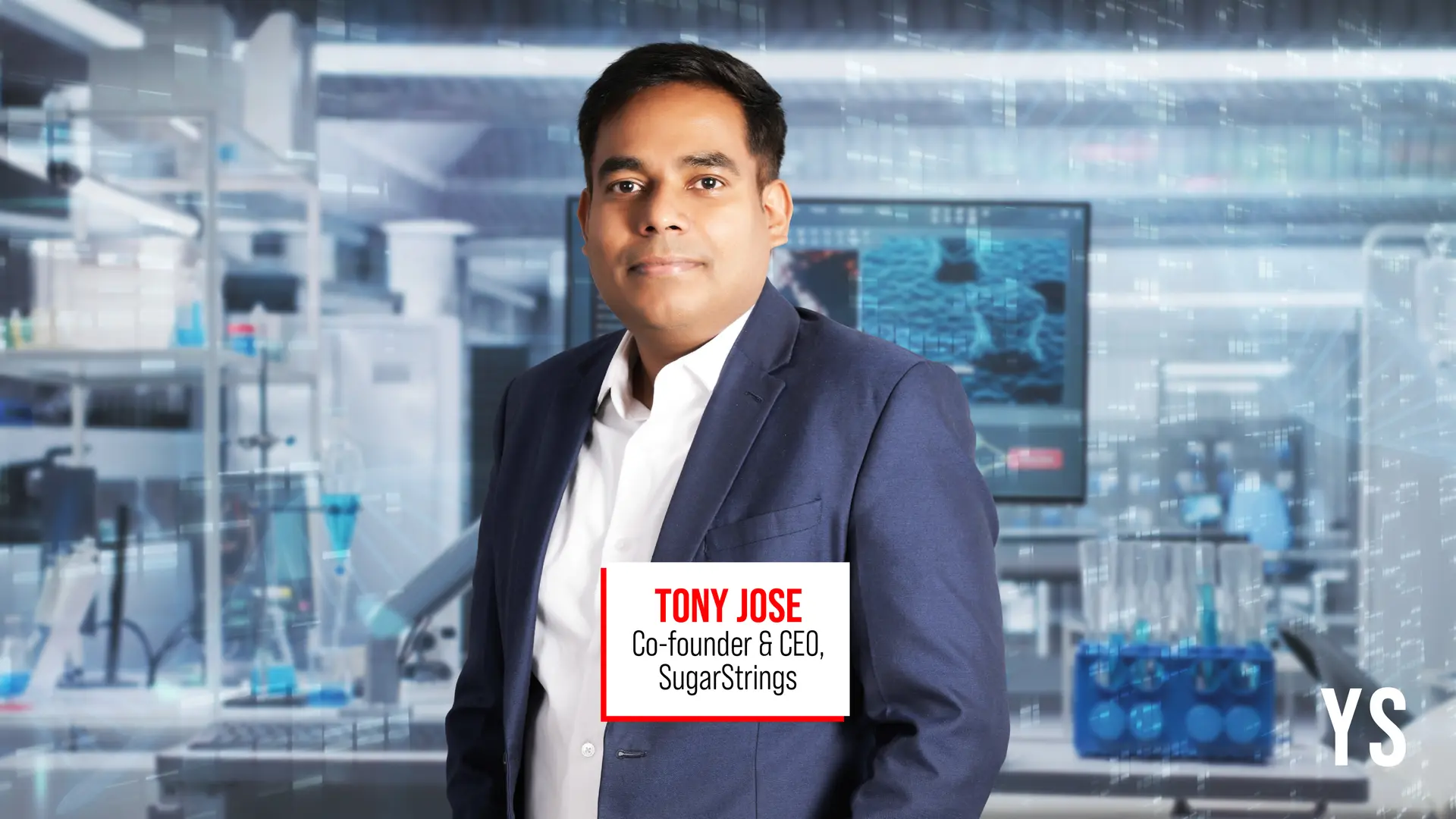

For years, Tony Jose worked in genomics research and diagnostics, studying how genetic conditions shape human health. During his time as CEO of Clevergene Biocorp, one observation kept returning. Many genetic disorders may be classified as rare, but together they affect far more people than most people realise.
“Genetic disorders are essentially rare diseases. But while they are individually rare, as a group it becomes a burden on the population. For instance, hypertension is considered a lifestyle disease now but there are cases of genetic conditions that can lead to its onset,” Jose tells YourStory.
That insight led Jose and Rajasekhara Reddy Ravuri, then Chief Scientific Officer at Clevergene Biocorp, to launch Bengaluru-based SugarStrings in 2023. The startup takes its name from DNA’s sugar backbone (deoxyribose), and aims to help people better understand their genetic predisposition to disease through a single DNA test.
“We realised SugarStrings would be the best way to actualise our idea for the mainstream, enabling people to screen themselves, understand their genetic predispositions, and work on preventing or managing them,” says Jose, now CEO of SugarStrings.
Apart from Jose and Ravuri, the six-member founding team includes co-founder Dhaneesh Jameson. While Jose and Ravuri have stepped away from executive roles at Clevergene Biocorp, Jose continues to serve as its director.
A single test for thousands of disorders
SugarStrings’ flagship product, Healthstring, is a DNA sequencing test that analyses a cheek swab sample to screen for more than 7,442 genetic disorders in a single test.
Unlike blood-based tests, the company uses cheek swabs for sample collection.
"The non-invasive approach is easier for sample collection, bypasses challenges like cold chains, and has a psychological advantage—people are more proactive about their health when they can self-collect samples," Jose says.
In the last five years, the cost of DNA sequencing has become roughly one-third of what it used to be. The test now costs Rs 58,000, with reports delivered between five days and one month.
According to Jose, the company goes beyond identifying an individual's likelihood of developing a condition.
“We don’t just provide the likelihood of developing a disease. We go through the DNA sequencing, find the exact mutation, and create a detailed report on all the possible diseases that can come from that mutation. The report is such that clinical action can be taken referring to it,” he says.
HealthString screens for 7,442 disorders, including 188 hereditary cancers and 302 cardiovascular diseases. By comparison, Jose says New York-based Nucleus Genomics screens for around 2,100 disorders, while Bengaluru-based Strand Life Sciences screens for about 250.
The company has deliberately chosen to offer a comprehensive test rather than condition-specific screening.
“The key reason we are sticking with a comprehensive test is because the human body is a connected system where diseases affecting a primary organ can have effects on overall function of the body,” Jose says.
He adds that the test can become more affordable as DNA sequencing becomes cheaper and larger volumes and technology implementations come into play.
Another area the startup is focusing on is improving genetic analysis across diverse populations. Many global genetic databases are built largely on data from people of European ancestry, which can make it harder to identify disease-causing mutations in other populations.
SugarStrings says its proprietary machine learning-based crawler identifies novel mutations with 94.89% accuracy, allowing it to analyse genetic data across more diverse populations.

Scaling and future plans
SugarStrings began operations in the last financial year, and has served around 100 clients while validating its technology with more than 1,800 patients.
“This year, we aim to scale to 1,000 customers,” Jose says.
To support that growth, the startup has partnered with hospitals, including Narayana Health and Manipal Hospital in Bengaluru, as well as Aster Medcity in Kochi.
Dr Nalanda Jayadev, Regional CEO, Central Kerala & Aster Medcity, believes genetic screening could change the way healthcare is delivered, by shifting focus from treatment to prevention.
“Instead of waiting for disease to manifest, we can identify individual risks early, intervene proactively, and tailor prevention and treatment to each person’s unique genetic profile,” he says. “This transformation will make healthcare more predictive, precise, and patient-centric, improving outcomes while using resources more wisely.”
“In many ways, genomics and precision care will do for 21st-century medicine what imaging did for the 20th century; it will fundamentally change how we understand, prevent, and treat disease,” he adds.
Jose says SugarStrings is seeing traction from doctors on preventive DNA screening. “At this stage, we have 80% of our consumers coming directly. This will slightly change as we go forward with collaborations with five more hospitals.”

Protecting genetic data
As genetic testing becomes more widely adopted, concerns around data privacy have also grown, particularly after the breach at genetic testing company 23andMe that affected 6.9 million users.
Jose says protecting sensitive genetic information has been a priority from the outset.
“We decentralise data to minimise hacking risks and comply with the Health Insurance Portability and Accountability Act (HIPAA) and the American College of Medical Genetics and Genomics guidelines. We are compliant to local certifications as well such as those under Karnataka Private Medical Establishment Act for offering diagnostic solutions,” he says.
What’s next?
Bootstrapped with an investment of Rs 3 crore, SugarStrings generated Rs 20 lakh in revenue during its first year of operations. The startup is targeting annual revenue of Rs 4.5 crores this year.
It plans to raise $1 million to invest in R&D, improve its platform for doctors and patients, and expand into the UAE, South Africa, Australia, and Canada.
Grandview says the market for genomics companies in India is currently valued at $482 million and projected to reach $1.8 billion by 2033. This implies that the scope for revenue is progressively favourable for companies like SugarStrings if they scale properly.
The founder believes advances in genomics and artificial intelligence will continue to reshape healthcare.
“Hospitals and doctors are increasingly adopting advanced diagnostics techniques and AI-driven tools. We’re seeing rising interest in technology for better patient outcomes,” Jose says.