



Ottonomy is building robots for real-world logistics
With a production facility in Noida, Sunnyvale-based deeptech startup Ottonomy has deployed its products across North America, Europe, the Middle East, and India.


Ritukar Vijay believes there is one part of logistics that is always messier than the rest: the middle. While robotics has slowly been incorporated into the industry over the past decade, the “messy middle” of moving samples, meals, parts and parcels between buildings, through elevators, and across campuses remained largely non-automated.
That changed with the COVID-19 pandemic, Vijay says. Hospitals, industrial campuses, and travel hubs suddenly needed contactless movement of goods and supplies.
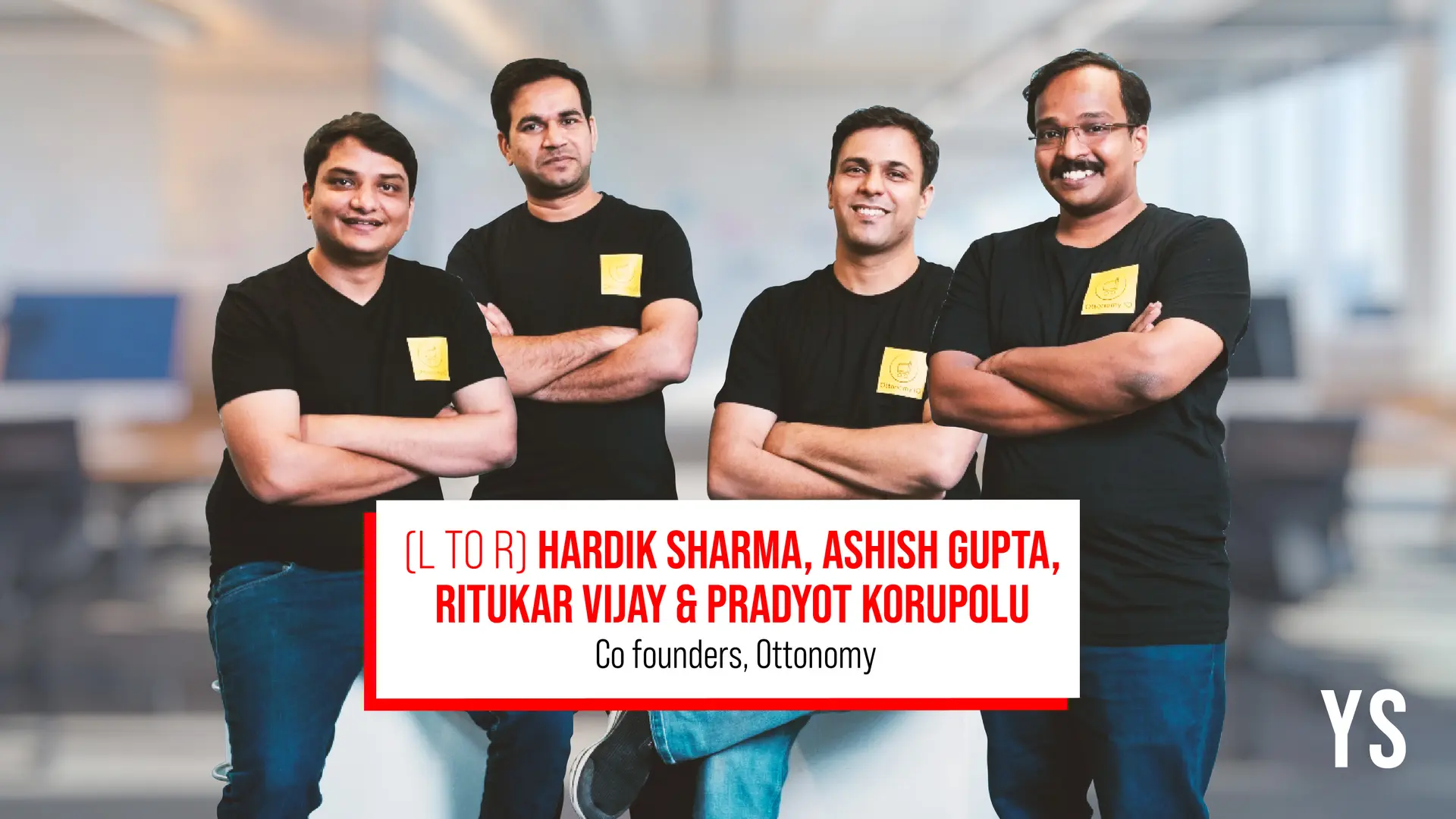
With around two decades of experience in robotics and autonomous driving, Vijay teamed up with his college mate Hardik Sharma, and former colleagues Pradyot Korupolu and Ashish Gupta, to found deeptech startup Ottonomy in 2020.
“Ottonomy was founded on the belief that last-mile and intra-campus logistics are areas where labour shortages are most acute and where autonomous technology can deliver real value today,” he (the CEO) tells YourStory.
Headquartered in Sunnyvale, California, Ottonomy has a team of over 60 people, most of whom operate across Delhi National Capital Region (NCR) in India. The startup recently won the Accenture Tech Next Challenge 2026 in the ‘Supply Chain and Engineering’ category.
Vijay says the win gave the team a clearer understanding of what it takes to scale Physical AI in the enterprise, as well as access to people driving that change inside large organisations.
Aditi Kulkarni, Lead - Advanced Technology Centers Global Network and Advanced Technology Centers, India, Accenture, says autonomous technologies are driving a new era of enterprise reinvention, with deeptech startups at the forefront of this shift.
“Through this challenge, we are bringing these startups closer to clients, industry experts, investors, ecosystem partners and academia, helping advance innovations into real-world applications with the potential to scale across enterprises,” Kulkarni says.

Robots for logistics
Ottonomy’s first product was Ottobot, a fully autonomous delivery robot designed to move goods across indoor and outdoor environments without a human operator.
“We built the earliest prototypes in a guest house in India, tested them in basements, ran early ecommerce pilots, and then launched our first commercial deployment at the Northern Kentucky International Airport, where Ottobots delivered food, beverages and travel essentials,” Vijay says.
Ottonomy later decided to move away from food delivery, leading to Ottonomy 2.0. Vijay says the new version introduced modular cargo compartments, improved accessibility features, and crab-mode manoeuvrability for navigating tight spaces.
“Today, Ottobots transport everything from medicines and lab samples to spare parts and critical supplies, helping organisations automate the movement of materials across complex indoor-outdoor environments,” Vijay says.
The Ottobots navigate corridors, call elevators, and pass through access-controlled doors before continuing outdoors to the next building. Rather than relying solely on GPS, they use High Information Maps to provide contextual awareness of their surroundings and enable navigation across indoor and outdoor environments, including areas where GPS signals are unavailable.
“Contextual AI is the behaviour layer built on top of that map. The robot first understands the type of environment it is operating in and then determines how to behave, including how fast to move, when to yield, and which routes are appropriate in a cancer centre versus a warehouse,” he says.
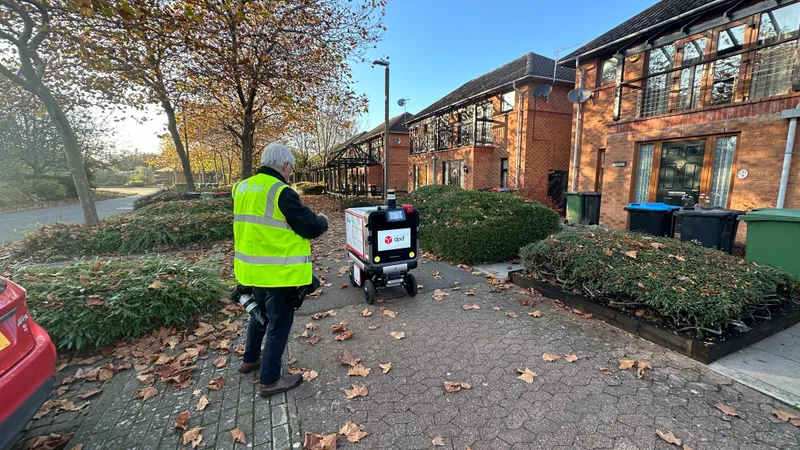
An Ottonomy robot in action. Source: Ottonomy
The goal, Vijay emphasises, is not to demonstrate autonomy in a controlled environment, but to deliver unattended, multi-stop, indoor-to-outdoor logistics with a secure chain of custody.
The deeptech startup is working with 15 customers across healthcare, industrial campuses, airports and last-mile logistics. Its clients include US hospital Wellstar Kennestone, where the robots move blood samples, vaccines, and other clinical samples across buildings with full chain of custody, and multinational corporation Sodexo.
Ottonomy’s clients can choose among its four products: Ottobot 2.0, Ottobot M, Ottobot V and Ottobot X.
“Our customers take Ottobots on a Robots-as-a-Service (RaaS) subscription, typically on a one- to five-year contract. The subscription includes the hardware, software, fleet orchestration platform, and ongoing support with no upfront capital investment,” says Vijay, adding that pricing is tailored to each deployment and depends on a variety of factors.
The startup also has Ottumn.AI, an intelligence layer that orchestrates operations across an entire site.
Vijay explains that Ottumn.AI combines edge and cloud computing with a neurosymbolic AI architecture, bringing together what the robot perceives with the operational rules governing the facility.
“It is designed to be interoperable, allowing customers to integrate existing robots and systems through APIs rather than replace them. This enables organisations to scale from small pilot deployments to a campus-wide autonomous logistics network, while managing all operations through a single platform,” he says.
The future of the industry is Physical AI
The deeptech startup’s target customers are healthcare organisations, where labour shortages and increasing staff workloads create operational and financial challenges. It also focuses on industrial campuses in sectors such as pharmaceuticals, aerospace and manufacturing.
Vijay says the next phase in the industry is Physical AI in complex, human-centric environments. While much of the investment today is focused on humanoids and sidewalk delivery robots, Ottonomy believes the less visible indoor-to-outdoor logistics layer is where it will deliver measurable value first.
“India is now increasingly a place where robotics companies manufacture, develop IP, and deploy solutions at scale. Traditionally, customers have been less willing to adopt RaaS models. That is beginning to change, driven by growing demand from airports, large enterprise campuses, and a policy environment that is increasingly focused on Physical AI,” he says.

Future and growth
With a production facility in Noida, Ottonomy is currently deployed across North America, Europe, the Middle East and India. It is expanding production through a new manufacturing facility in the United States to increase its manufacturing capability.
Over the past six years, Ottonomy has raised $8.2 million from investors including pi Ventures, CoreNest, Connetic Ventures, Wellstar Catalyst, Enrission India Capital and ADR Ventures.
Looking ahead, Vijay says the startup is focused on expanding Ottobot deployments across healthcare and industrial environments, growing Ottumn.AI as the orchestration layer for autonomous operations, and supporting mixed fleets comprising different types of robots and drones.
While the US remains its largest market, Ottonomy also continues to expand deployments across Europe and India. It competes with companies such as Starship Technologies and Serve Robotics.
Vijay says Ottonomy differentiates itself through its ability to enable indoor-to-outdoor logistics through a single, integrated system.
“Our robots are built to navigate the full journey that exists in real-world settings. We have been granted 24 patents from 29 filings, and every deployment helps make our robots smarter. We also have a reinforcement-learning pipeline that continuously improves how robots navigate real-world environments,” he says.
Edited by Affirunisa Kankudti