



OpenAI charts growth through compute-to-revenue flywheel
OpenAI sees growth via a compute-to-revenue flywheel, with recent developments like ads integration, affordable tiers, and healthcare tools adding more layers to the AI business.


For many people, the shift in how we interact with artificial intelligence (AI) has happened almost imperceptibly. People now reach for an AI assistant with the same reflex once reserved for a search engine.
Amidst this shift, ChatGPT maker OpenAI has evolved from its research origins into a commercial powerhouse by tightly coupling its physical infrastructure with its financial growth.
The flywheel
At the core of this expansion is a concept that Sarah Friar, chief financial officer at OpenAI, recently described as a flywheel across compute, research, products, and monetisation. The business is currently in a state where its growth is primarily limited by the availability of hardware rather than a lack of interest from the market.
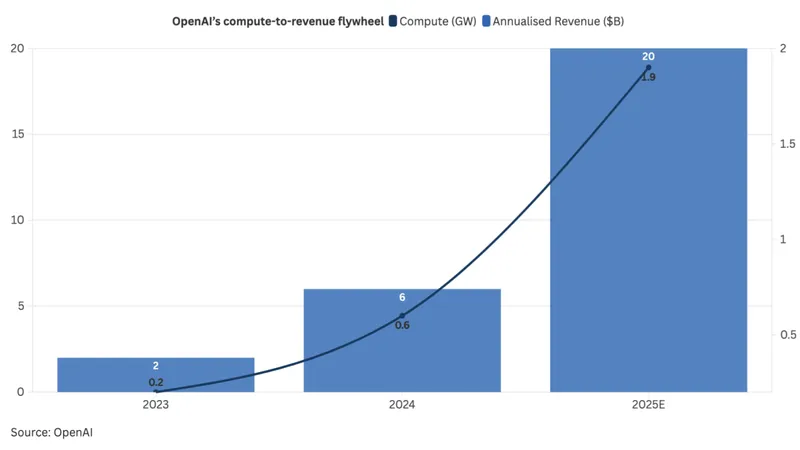
Data revealed by the company shows a near-linear relationship between the power used to run models and the money they generate. In 2023, with 0.2 gigawatts of compute, the company reached $2 billion in annualised recurring revenue. By 2024, this grew to 0.6 gigawatts and $6 billion in revenue. By 2025, the scale reached approximately 1.9 gigawatts of compute, powering more than $20 billion in revenue.
Friar noted that the ability to serve customers directly tracks the available compute. She explained, “Investment in compute powers leading-edge research and step-change gains in model capability. Stronger models unlock better products and broader adoption of the OpenAI platform. Adoption drives revenue, and revenue funds the next wave of compute and innovation.”
OpenAI’s compute grew 3x year over year or 9.5x from 2023 to 2025, while revenue followed the same curve, growing 3x year over year, or 10x from 2023 to 2025.
“This is never-before-seen growth at such scale. And we firmly believe that more compute in these periods would have led to faster customer adoption and monetisation,” remarked Friar.
To maintain this momentum, there has been a shift in how the company secures its resources. Three years ago, the organisation relied on a single provider for its computing needs. Today, it has moved toward a diversified ecosystem of providers to ensure what is called compute certainty.
This allows the company to treat its hardware as an actively managed portfolio. It uses the most powerful, premium hardware for training frontier models while shifting high-volume daily tasks to lower-cost, more efficient infrastructure. This keeps latency low and costs manageable, often measured in mere cents per million tokens.
Widening the net
As the technology matures, the focus has shifted toward capturing the next billion users through more flexible pricing. In January, the company launched ChatGPT Go globally, a new subscription tier priced at $8 per month in the United States. Originally introduced in India in August 2025, this plan is designed for those who need more than the free version but find the $20 Plus plan expensive.
Alongside this new tier, the company is introducing advertisements and commerce into the free and Go versions. This is a major shift from the original subscription-only model. The logic is that people often use AI not just to ask questions, but to make decisions about what to buy or where to go.
OpenAI’s CEO of applications, Fidji Simo, explained the vision for this new revenue stream. “The best ads are useful, entertaining, and help people discover new products and services. Given what AI can do, we are excited to develop new experiences over time that people find more helpful and relevant than any other ads,” Simo noted.
The company said it has established strict principles to ensure these ads do not ruin the user experience. They have promised answer independence, meaning that payments from advertisers will never influence the actual response given by the AI. Furthermore, conversations remain private and are not sold to advertisers.

Integration in healthcare
Each week, over 230 million people globally use ChatGPT to ask questions about wellness, symptoms, or medical notes. This has led to the creation of ChatGPT Health, a dedicated space within the app where users can connect their medical records and fitness data from apps like Apple Health or MyFitnessPal. This data is kept separate from other conversations and is never used to train the company's main models, according to OpenAI.
Beyond individual users, the company has launched a suite of products for healthcare organisations. The company noted that leading hospitals are already using these tools to reduce administrative burdens and help clinicians stay up to date with the latest research.
John Brownstein, chief innovation officer at Boston Children’s Hospital, stated, “ChatGPT for Healthcare offers a path toward operational scale, providing an enterprise-grade platform that can support broad, responsible adoption across clinical, research, and administrative teams.”
By targeting high-value sectors through dedicated healthcare tools, the company is unlocking immediate growth and further diversifying its income channels.
Path to practical adoption
In 2026, the focus is shifting toward what it calls ‘practical adoption’. This means closing the gap between what the models are capable of doing and how people actually use them in their daily lives.
The next phase of development involves autonomous agents and workflow automation. These are systems that do not just respond to prompts but can run continuously, manage projects, and take actions across different software tools on behalf of the user.
This evolution is also changing the way the company charges for its services. While subscriptions and usage-based API fees remain important, new economic models are emerging. In specialised fields like drug discovery or financial modelling, the company is moving toward licensing and outcome-based pricing. This means instead of charging per word or per seat, the cost may be tied to the actual value or results delivered to the client.
Through a combination of massive infrastructure scaling, diversified revenue streams, deep integration into vital sectors like healthcare, and more AI offerings, the ChatGPT maker plans to grow to hundreds of billions by 2030.
“We are looking at commitments of about $1.4 trillion over the next 8 years,” Sam Altman, CEO of OpenAI, said in November 2025.
Having raised more than $64 billion to date, OpenAI is currently valued at approximately $500 billion. The company is currently in discussions for a new funding round of up to $100 billion that could elevate its valuation to $830 billion, as reported by The Wall Street Journal.
Edited by Jyoti Narayan