



How Nua is reimagining women's wellness in India
With a strong focus on safe, science-backed products, honest conversations, and emotional well-being, Nua is breaking taboos and building trust in the women's wellness space.



The idea for Nua, a women’s wellness brand, had sparked something personal and emotional in Ravi Ramachandran, who had seen the women in his life—mother, wife, and sister—juggle work, home, and everything in between. However, wellness, especially self-care, always took a backseat.
“In the women’s wellness space, menstrual wellness was at the lowest pecking order. It still remains a taboo topic for many. My school-going daughter has to deal with cramps. A working woman has to power through the day with her periods, and gets back home and has more work to do,” he tells HerStory.
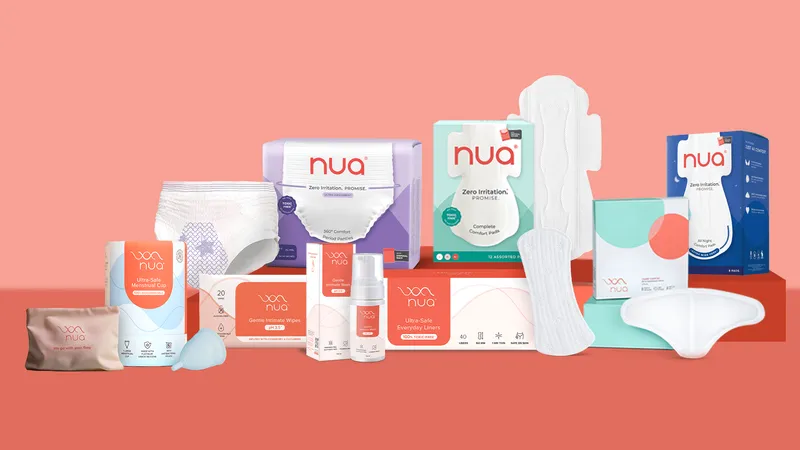
The Nua product line
Ramachandran rightly points out that “the conversation around menstruation—when it exists—is focused entirely on the product, not on the person.”
Branded sanitary napkins have only managed to reach about 30% of India’s population, and continue to grow. Here, Ramachandran found an opportunity to change the narrative, in terms of product and conversation.
Born in Kerala and raised in Abu Dhabi, he returned to India for his higher education—first, engineering at NIT Trichy, followed by an MBA from the University of Oxford. He spent the early part of his career in the FMCG and consulting sectors, including over five years at ITC and a stint at Booz & Company (now PwC Strategy&), where he became the Associate Partner in the consumer and retail practice.
After the acquisition of Booz, Ramachandran took a year off to be a stay-at-home dad. “That year made me reflect deeply. I wanted to build something with purpose—something that mattered,” he recalls.
Rewriting the menstrual narrative
In a market long dominated by FMCG giants, Nua addressed menstrual wellness holistically, besides marketing sanitary pads. “We saw a white space beyond the physical need—a space that includes social stigma, emotional distress, and cultural taboos. These were conversations no one was having,” says Ramachandran.
Nua’s first product was a customisable sanitary pad pack offered via a subscription model. “No one else was doing it. You could choose the sizes you wanted, customise the pack based on your requirement, and get them delivered to your doorstep,” he explains.
On Day Zero, Nua invested in a well-thought-out communication on Instagram.
“We started talking about bold topics such as the daily discharge, its colour, and other topics that were not talked about on social media,” Ramachandran says. Nua focused on product development, packaging, innovation, and design for a year before launching in 2018.
Nua’s product range includes sanitary pads, disposable period panties, panty liners, tampons, menstrual cups, cramp relief products, and solutions for fatigue and period acne. “We are not a sanitary pad brand; we are a menstrual wellness brand,” the founder & CEO asserts.
According to Ramachandran, understanding the user journey was important for Nua, helping the wellness brand become the first to develop a sanitary pad with a paper-based disposable cover.
While he admits that Nua does not have the capex to build its own manufacturing capacity, it has a dedicated one offered by a third-party manufacturer. Nonetheless, the brand invests in tooling to ensure its design specifications are manufactured accordingly.
Interestingly, every new product launch at Nua goes through a three-pronged approach. It begins with understanding the customer preferences through surveys and focus group discussions. The second is a product-backed view, where Nua looks at the customer issues and develops solutions for them. The third is a science-backed view that has led to products like anti-bacterial pouches for menstrual cups and the Cramp Comfort Heat Patch.
“We conduct trials before we launch a new product, and for the first year, it’s all iterations as we hear back from customers,” Ramachandran says.
Challenges, conviction, and capital
Breaking into a taboo category and going head-to-head with global FMCG giants wasn’t easy. “In the early days, fundraising was extremely tough. Everyone asked—how will you compete with large MNCs?” he recalls.
Initial investors like Kae Capital and Lightbox VC believed in his vision. Industry veterans like Vindi Banga (former Chairman & CEO of Hindustan Unilever) and Jay Jayaraman (former MD, Colgate-Palmolive India) came on board as angels.
A major milestone was when Deepika Padukone’s family office invested in Nua. “They approached us. They appreciated our consistency and the thoughtfulness behind every decision—from product design to packaging.”
Mirabilis Investment Trust led the most recent funding round in Nua, where it raised Rs 35 crore.
Through all this, the company has grown steadily, navigating COVID-19, supply chain disruptions, and the startup funding winter of 2022.
Having been EBITDA positive since FY25 Q2, Nua is all set to cross Rs 150 crore in annual recurring revenue by this quarter.
“We don’t just have users; we have loyalists. Our repeat rates are among the highest in the industry,” Ramachandran says with pride. It’s one of the top brands in all the marketplaces it is present in, especially in the premium segment.
He also shares a message that he received on LinkedIn from a young woman, who says she has asked her “girls” to switch to Nua. “The brand love we receive is heartening,” he adds.
During the 2019 Kerala floods, Nua launched Project Prerna, partnering with the Red Cross, to send menstrual relief materials to affected women. Since then, the initiative has expanded its reach, working with organisations like Child Relief and You (CRY) to conduct awareness sessions in schools in South India and provide free sanitary pads.
During the COVID-19 pandemic, Nua collaborated with the Maharashtra government’s Department of Women and Child Development and the Global Shapers community to distribute menstrual products in urban slums. It also supported healthcare workers during the second wave.
As a male founder in a women-centric category, Ramachandran acknowledges the irony and responsibility of his role.
“I sometimes tell my team I wish I could experience one cycle—just to understand. They tell me, ‘Be careful what you wish for.’ But being a man in this space, I questioned a lot —and I believe that helped us think out-of-the-box,” he says.
All customer-led functions at Nua—whether it’s product development, content, or brand management—are led by women. He says it wasn’t intentional; just that the best people for those roles happened to be women.
For Ramachandran and his team, the road ahead is clear. “We want to keep innovating and make Nua more accessible both online and offline. We want to address more needs across the wellness journey, not just menstruation.”
(The story has been updated to correct revenue details.)
Edited by Suman Singh