


How Lado Panchayat is pioneering the rise of rural feminist governance
In the heartlands of north India—where khap panchayats have long dictated the terms of caste, gender, and morality—adolescent girls preside over meetings, and pass formal resolutions on child marriage, menstrual rights, property ownership and abusive language.

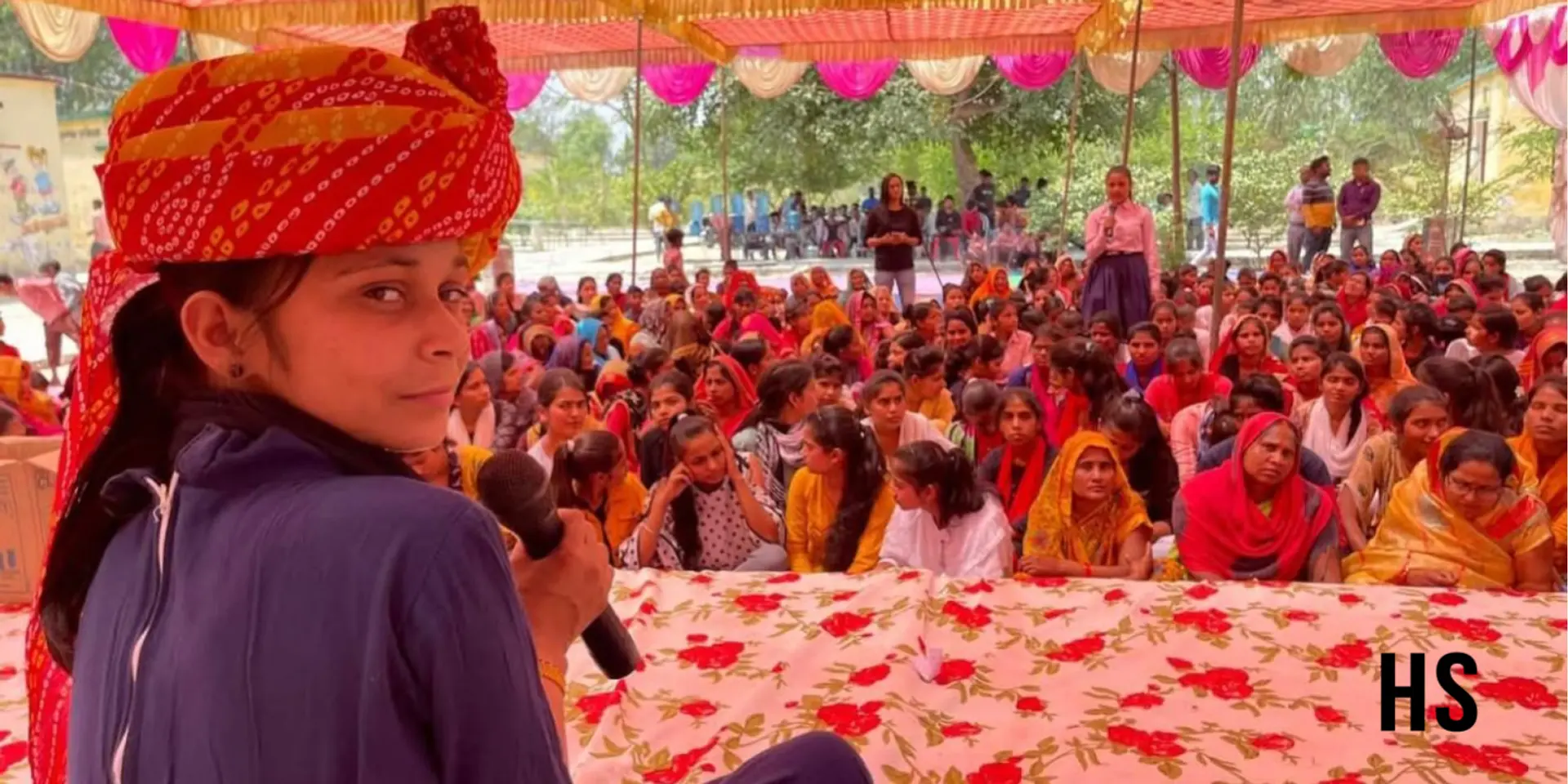

Five years ago, Monika Swami wasn’t allowed to have an Instagram account.
Her family, like many in rural Rohtak, believed social media would “corrupt” girls or influence them to run away with boys. Today, the 26-year-old has found a job that demands of her to bust myths like these and reclaim both virtual and physical spaces for women—starting from social media to the sarpanch office.
Her politics of resistance have been emboldened by a five-year-long training at Lado Panchayat, a women-led collective reshaping village governance in Haryana, Rajasthan, and Uttar Pradesh. In a landscape long dominated by male-dominated gorilla courts or khaps, Lado Panchayat installs women—like Swami—at the centre of decision-making.
But before going anywhere with their training, the girls often must stand their ground at home—considered by many as the microcosm of social hierarchy and the first of many battles.
“If I cannot make my voice heard there, how would I speak for others?” says Swami.
Since joining Lado Panchayat, she hasn’t just created a public Instagram account; she’s also gone on to become Karnal’s Block Development and Panchayat Officer.
In this role, she’s put an end to child marriage in her village, handed girls control over their menstrual health, and made sure no sarpanchpati (a man unofficially running the show behind his elected sarpanch wife) ever occupies the official chair in her office.
In her own words, she tells them, “bugger off”.
According to Sunil Jaglan, social activist, former sarpanch of Haryana’s Bibipur village and the founder of Lado Panchayat, the movement today has mobilised thousands of girls across Haryana, Uttar Pradesh, Bihar, and Rajasthan. The girls, aged 15 -30, many from rural and marginalised communities, conduct village gatherings modelled as alternative panchayats; platforms where they voice their concerns, debate social issues, and pass resolutions.
Each session begins with the symbolic selection of a girl as pradhan, or head, who wears a turban and facilitates the discussion—a model that proudly and deliberately subverts the patriarchy of traditional village councils.
The agenda is shaped by the lived realities of the girls themselves: child marriage, caste and gender-based abuse, menstrual health, access to education, and right to property.
The gatherings culminate in the drafting of formal charters or resolutions, which are submitted to local and state authorities.
These are particularly monumental in communities where female foeticide has long been rampant, and where Lado Panchayats have replaced how governance and power are envisioned by a new generation of rural women, who are recovering from the trauma of generational, systemic violence.
Jaglan’s impetus to start Lado Panchayat however was a deeply personal one. In 2012, overjoyed at the birth of his daughter, he was stunned to find that the village met the news not with celebration, but with silence and pity.
“I was singing, dancing, celebrating,” he recalls. “But people approached me as if a tragedy had occurred. They offered condolences and said, ‘We’ll pray that the next one is a son.’”
Before becoming the sarpanch of Bibipur village in Haryana in 2010, Jaglan was a mathematics teacher. His personal experiences in a deeply patriarchal rural order significantly influenced his activism, and in 2019, he organised what is considered one of India’s first women-inclusive khap panchayat, bringing together over 2,000 women to speak out against issues like female foeticide and dowry.
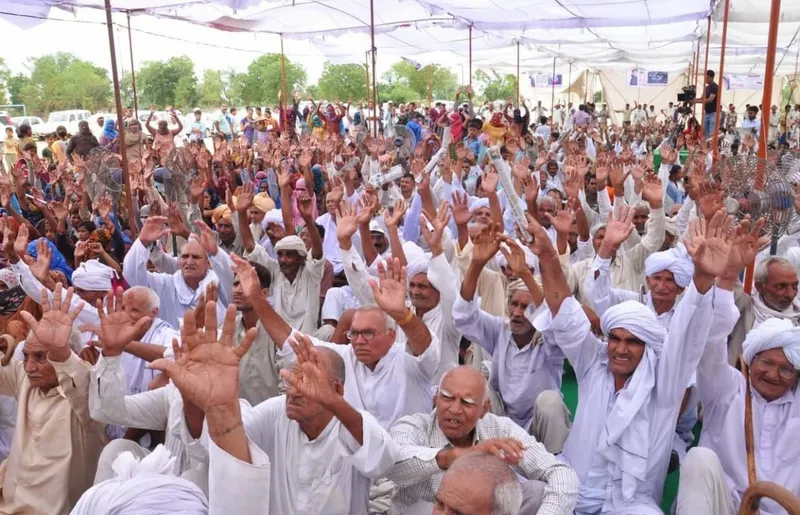
Sunil Jagan organised what is considered one of India’s first women-inclusive khap panchayat, bringing together over 2,000 women to speak out against issues like female foeticide and dowry, which infuriated male khap leaders.
“It didn’t sit well with the male elders,” Jaglan says. “They asked, ‘Are we now supposed to hand over our land to our daughters? Will their husbands take over our property?’”
“I said, why not!”
Jaglan challenged the very premise of protection and patriarchy. “On Raksha Bandhan, I asked brothers: how are you protecting your sisters if you’re not empowering them? In some families, sisters weren’t even allowed to be born. Girls were fundamentally devalued—they were sent to government schools while their brothers went to private ones. They ate last, and only what was left over after the boys had their fill of nutritious food. Everything about this system was a facade.”
Jaglan, now a professor of community engagement at the state-run Maharshi Dayanand University in Rohtak, says social devaluation of girls they work with is so deeply ingrained—it is even reflected in the names they are given.
Kaafi (enough) or Maafi (forgiveness) are common choices for names, as if their very existence is an apology or a plea to end the birth of daughters in the family.
“One of our girls, named ‘Anthim’ (last), recently won gold at a wrestling tournament,” he says.
In 2015, Jaglan launched the ‘Selfie with Daughter’ campaign as a resistance to the stigma surrounding the birth of girls in India. It began with a simple call to action: fathers were encouraged to post selfies with their daughters and celebrate them publicly. The campaign quickly gained national and international momentum, receiving support from Prime Minister Narendra Modi and spreading across over 70 countries.
By turning the act of taking a selfie into a public declaration of pride, it sought to shift cultural attitudes and spark dialogue about female foeticide, girl child education, and equal rights.
But perhaps their most momentous impact was the advocacy campaign to increase the minimum age of marriage for girls from 18 to 21. During its gatherings—comprising adolescent girls, young women, ASHA workers, and sarpanchs—participants debated the social and health implications of early marriage and swore to change that.
Shivalika Pandey was a law student in Delhi in 2021 when she attended a Lado Panchayat session in Hisar, Haryana. There, she witnessed how girls were swiftly married off after graduation, silenced by stigma around menstruation, and burdened with shame about their own bodies—shame that often kept them from reporting more serious dangers like abuse.
What she didn’t expect was to face a similar reckoning in her own life. When her “relatively liberal” family began pressuring her to marry immediately after college, the weight of that contradiction hit hard. “I was shocked,” she says. “I thought these things only happened in rural India.” Isolated at home during the second wave of COVID-19, what held her together was the memory of the girls she’d met in Hisar—unyielding in their solidarity and clarity.
“Their strength gave me mine,” she says. “I decided to fight back.”
Pandey became one of the members of Lado Panchayat to draft and pass a resolution demanding the increase in the legal age of marriage for girls from 18 to 21—arguing that completing their education and gaining agency over their lives was non-negotiable.
“I was doubly angry and doubly determined now,” says Pandey, now a consultant with the National Human Rights Commission.
Their resolution was formally submitted to the Government of India and led to an invitation to the Rajya Sabha in 2022 where the panchayat girls presented their views—an unprecedented move for a village-based, women-led body.
Their framing was not just legal but deeply social: they asked why their futures were being fast-tracked into domestic roles while boys had more time to study, grow, and choose.
The Lado Panchayat helped shift the conversation from protectionism to empowerment and parity, becoming a powerful voice in the nationwide deliberations that eventually led to the Prohibition of Child Marriage (Amendment) Bill, 2021, which sought to raise the legal age of marriage for girls to 21.
The bill was in the legislative process but has not yet been enacted due to a lapse in 2024.
Today, the girls of Lado Panchayat continue to drive shifts once thought impossible. In rural Ayodhya’s Milkipur block, their gatherings led to a formal demand for the establishment of Ma Sita Mahila University—a government-run women’s university to ensure higher education access for local girls. A similar campaign is gaining momentum in Mewat.
In February 2025, at a meeting held in Nalwa village, Hisar district, the girls of Lado Panchayat publicly demanded a strict law to curb the daily practice of abusing women—especially using derogatory slurs directed at mothers and sisters. They emphasised that such language fosters obscenity and social misconduct and is deeply disrespectful to women and community values.
The girls’ president, Khushboo Pawar, urged for legal action to penalise not just physical violence but the normalisation of abusive speech as well.
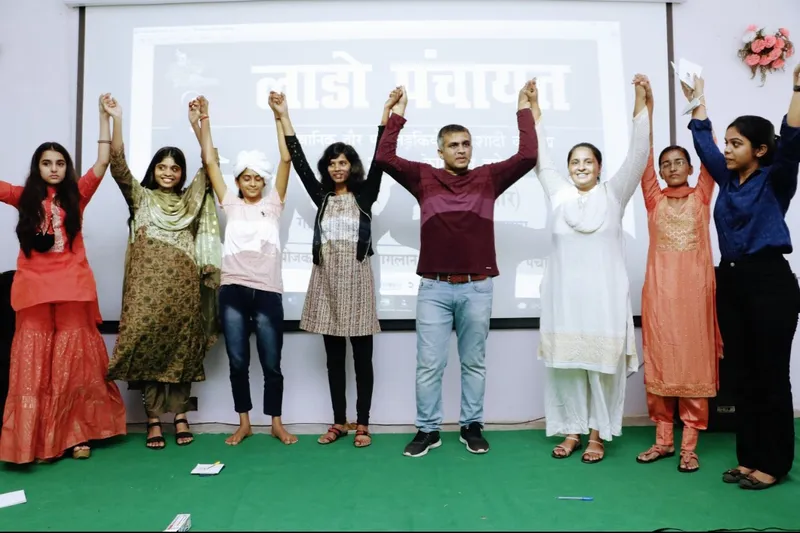
While girls of Lado Panchayat have faced violence in their homes and communities, and harassment online, Jaglan says the ecosystem they have built is a source of unconditional support and community until they are empowered to demand policy-level shifts.
In Bibipur, where even talking about menstruation was once taboo, almost every living room now displays a period chart—hung beside calendars and portraits of deities. The girls are tracking their cycles openly, and their families are learning to treat menstruation as a natural part of their lives.
Uncomfortable but learning.
According to Jaglan, the movement's engine lies in patient, honest communication and years of trust-building with the girls.
“Some of them have faced violence in their homes and communities, and harassment online, simply for taking up space,” he says. “But then they can always come to us. We support them—mentally, physically, emotionally—until they’re strong enough to speak for themselves and others - at home and outside.”
“We aren’t just outraging, but working on the ground, to bring about a cultural change in a pervasive patriarchal stronghold. And every woman in our circle is equipped to think at that scale. And for that, she has our relentless, unconditional support.”
Edited by Affirunisa Kankudti