


‘Name Her Durga’: How Panchkula’s women police helped deliver a baby on the roadside
In a state celebrated for its maternal health schemes and institutional delivery rates, a baby born on the roadside shouldn’t have been a news story. But when 22-year-old Lakshmi went into labour enroute to the hospital, it was a team of women police officers who stepped in.

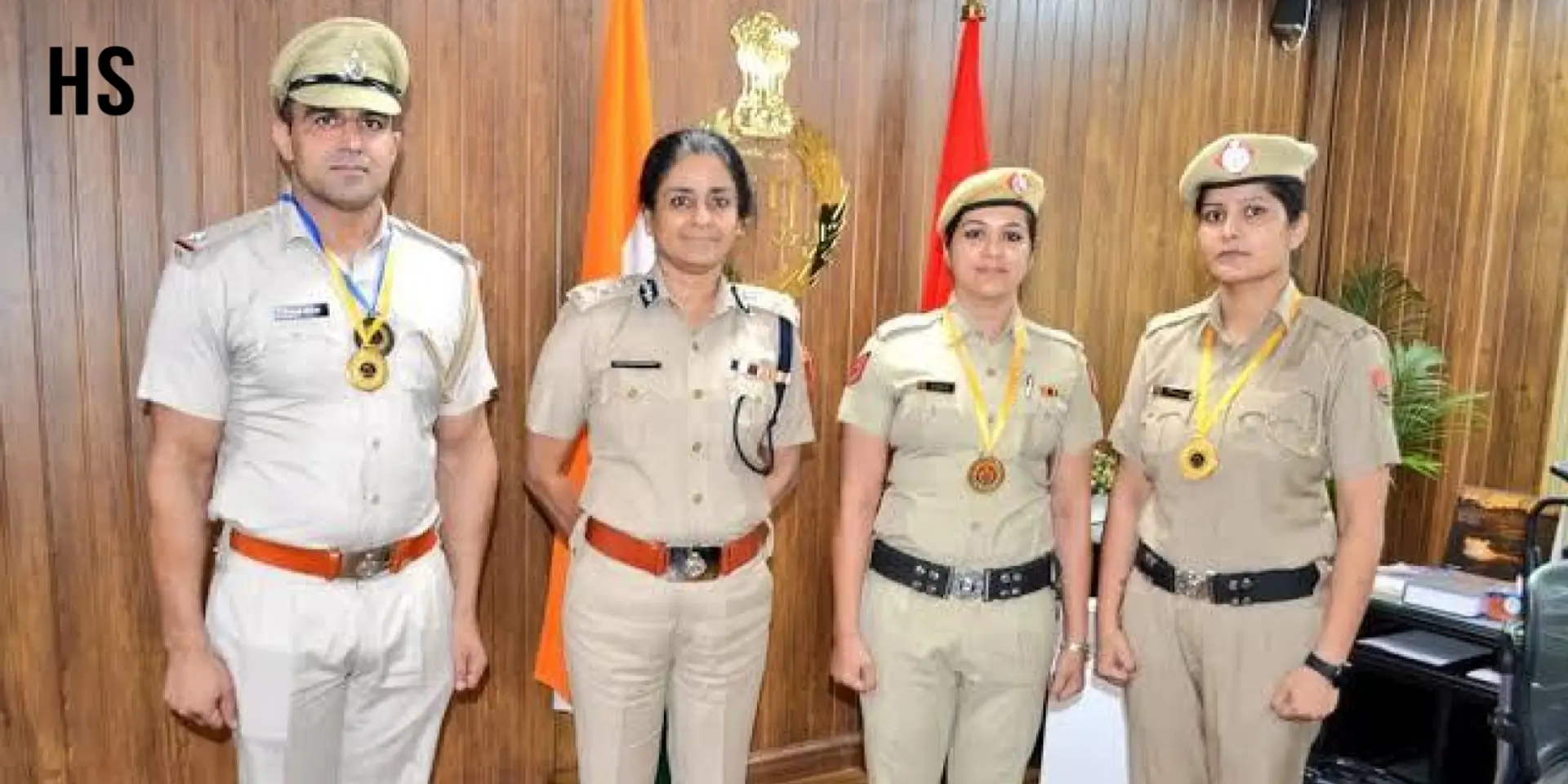

Last week, around midnight on a quiet stretch near Tawa Chowk in Panchkula, Haryana, a routine police patrol led to an unexpected turn of events. Lakshmi, a young woman from Panchkula, was writhing in labour pain by the roadside, her husband frantic and helpless, and medical help still far away.
When Neha Sandhu, the SHO of the women’s police station on Panchkula and a team of police officers were alerted and went to the spot, Lakshmi was in unbearable pain.” “We saw that the baby’s head was almost coming out,” says Sandhu, and there was no way she could be transported in a vehicle.
Officers Sandhu, Inspector Renu, Constable Anjali, and Head Constable Usman along with members of the Durga Shakti Rapid Action Team, Haryana’s women-led special police unit acted swiftly and effectively, brought jackets and shawls for cover, and torches for light, and helped Lakshmi through the birth right on the roadside, bringing a baby girl into the world.
Following the name of the cadre, the parents named her Durga.
In a state known for its infrastructure-heavy maternal health policies, the delivery, while heartwarming, was also a powerful reminder that for many women, especially in rural or vulnerable communities, emergency medical access can still be a matter of luck.
Twenty-two-year-old Lakshmi, was on a two-wheeler with her husband, Anil, was headed to the nearest hospital when the pain became too severe. Unable to continue, they stopped near Tawa Chowk in Sector 20 and flagged down a police vehicle.
An ambulance arrived shortly after the birth and transported both the mother and newborn to General Hospital, Sector 6, where they were declared stable. “Thanks to their prompt response, both mother and child are fine,” said Dr Deepa Dahiya, the attending medical officer.
The moment left a lasting impression on the officers as well.
“While none of us had the expertise, we did what we could. We called on a few older women passersby to help,” says Sandhu.
A glimpse into a larger problem
Though this emergency delivery was a feel-good story in the news cycle, it revealed how access to timely and safe maternal care remains uneven for many women across Haryana and the country.
Despite Haryana’s significant state investment through schemes like Janani Suraksha Yojana (JSY) and Janani Shishu Suraksha Karyakram (JSSK), geographic and caste-based disparities remain stark.
A large-scale state-level study across 12,191 mothers in Haryana highlights stark inter-district and intra-district disparities in maternal health service coverage. In districts including Panchkula, Ambala, Gurugram, and Mewat, more than one-third of sub-centres provided antenatal care below 50% of the district average—a likely reflection of both geographic and socio-economic exclusion.
Another 2020 study published in Health Research Policy and Systems noted that districts like Mewat, Panchkula, and Ambala still lag behind in basic antenatal and delivery care. In parts of Mewat, for example, even basic diagnostic services and trained personnel remain inaccessible. Many women continue to rely on private or informal providers despite the existence of government services.
A grassroots survey in Ambala further underlined this disparity: while villages with fully functioning Primary Health Centres (PHCs) had significantly lower perinatal mortality, those without any health centre saw rates nearly double. Women in villages without access to a PHC were three times more likely to rely on untrained traditional birth attendants.
A miracle with lessons
UNICEF estimates that timely access to skilled birth attendants can reduce maternal deaths by up to 75%. While Haryana has made measurable progress—its institutional delivery rate stands at over 98% as of 2024, according to government figures—incidents like this serve as reminders that systemic gaps still leave women exposed.
Baby Durga was born—not just into a family, but into a story that embodies both the fragility and possibility of India’s maternal care landscape. True tribute will come when the need for such courage is no longer this common, and no woman has to deliver a baby on the edge of a road.
Edited by Affirunisa Kankudti