



How Aayom is supporting women through health, work and dignity
Across villages, cities and jails, Aayom Welfare Society is working with women to break stigma and rebuild stability with programmes on menstrual health and livelihoods to reveal what grassroots empowerment looks like in practice.


In 2019, standing in a low-income neighbourhood on the edge of Noida’s corporate skyline, Nitika Dhiman handed a sanitary pad to a woman in a small gathering. The woman looked at it, puzzled, and asked, “Iss ko lagate kaise hain? (how do you use this?)”
For Dhiman, the memory remains distinct; amidst towering glass buildings stood nearby, a woman from the community who had lived in that same area for years, had never seen or touched a sanitary pad before. “That was her first ever pad,” says Dhiman. “She didn’t even know how it looked.”
The encounter served as a poignant reminder of why Aayom Welfare Society’s menstrual health campaign, ‘Snap the Taboo’, remains relevant nearly two decades after its inception.
Snap the Taboo was launched in 2008 in and around Fatehpur district in Uttar Pradesh, where Aayom is registered. The programme initially focused on nearby villages such as Malwa, Rania and Surathi, where sanitation facilities were limited and menstrual awareness was low.
Volunteers of Aayom observed that many girls were missing school during their periods, while parents felt uneasy about sending menstruating daughters out due to the lack of toilets and basic hygiene facilities. “The parents themselves also carried tremendous shame around menstruation, which meant they denied school admissions to their daughters after they began menstruating.
“Even today, there are places where women are unfamiliar with the biological process of menstruation. They don’t understand it as critical to reproductive health, childbirth and the overall life cycle of a woman,” says Dhiman.
Aayom’s menstrual health sessions begin with simple questions: What do participants already know about menstruation? Have they heard about it before? The team then explains the biological process using charts, covering internal organs, ovulation, and the menstrual cycle.
Workshops also include practical guidance—what foods to eat, what to avoid, basic exercises, hygiene practices, and myth-busting that varies by region and culture. “Myth-busting changes from state to state,” says Dhiman, pointing to differences between North East India, where menstruation may be celebrated, and other regions where it is still treated as taboo, and girls are often still asked to stay in separate huts or outhouses during their period.
Access isn’t the only problem
Aayom doesn’t stop at awareness. During first-time visits to villages, the organisation distributes sanitary pads sufficient for two to three months per person. Follow-up visits happen every three to four months to assess changes and address questions.
But access alone isn’t enough. Many women, Dhiman notes, use a single pad for an entire day to save money, even when it becomes unhygienic. “They say the blood spot has turned brown or green, but they still don’t change it,” she says, adding that itching and infections are common consequences of this.
Disposal is another challenge, especially in rural areas without waste management systems. Aayom teaches women how to dispose of pads safely, discouraging burning or flushing. In some villages, dumping grounds sit at the entrance, and habits are difficult to change. “Habits don’t die very easily,” says Dhiman, as she stresses the need to educate younger generations before unhealthy practices become ingrained.
Bringing men into the conversation
In 2018, Aayom conducted a public awareness experiment at Noida’s Sector 18 metro station, hanging sanitary pads on a tree near the exit. The display made many passers-by uncomfortable. Yet, most of the people who stopped to listen were men, says Dhiman.
Seeing this, the team shifted the session to focus on how men could support women during menstruation. “When you don’t know about something, you cannot do anything about it,” says Dhiman, adding that many fathers and brothers grow up unaware of menstruation, while only husbands are typically informed.
Aayom’s sessions encourage communication, explaining that periods are natural biological processes, and not something “impure”. Men are taught that symptoms vary, and that asking partners, daughters and wives what they need is key to support.
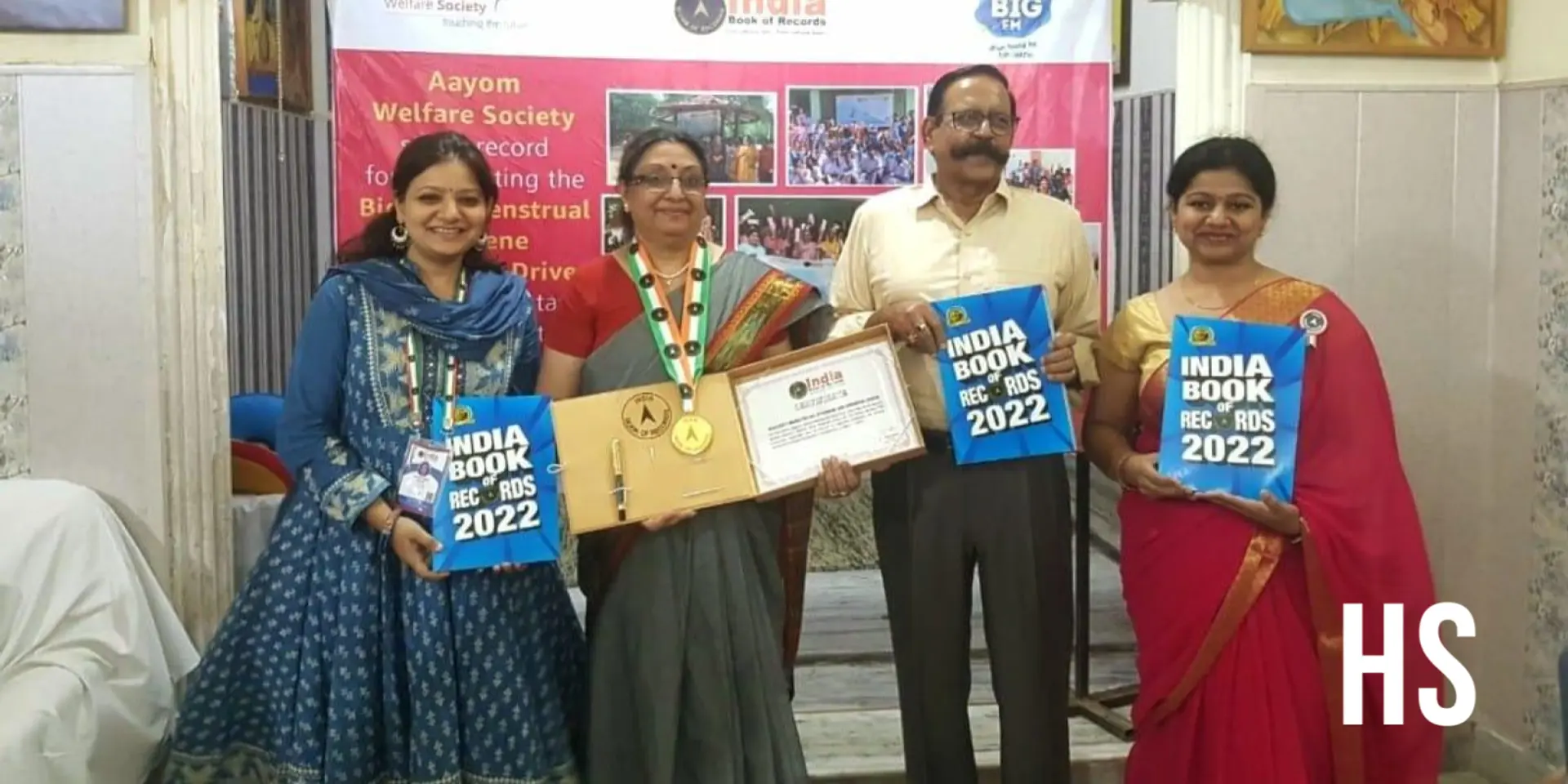
In 2022, Aayom organised what it calls its largest menstrual hygiene awareness drive in India, reaching 2,80,522 women across all 28 states and two Union Territories in a single day. The initiative coincided with International Menstrual Hygiene Day on May 28 and was certified by the India Book of Records, says Dhiman.
The idea came together within a month, partly to re-energise volunteers after COVID-19 disruptions. “We had lost community members and volunteers and were getting up on our feet again,” says Dhiman. “There was little resistance during the sessions, and local communities largely cooperated.”
From awareness to independence
For Aayom, menstrual health isn’t just about hygiene but about independence. After distributing free pads initially, the organisation encourages women to begin purchasing them themselves. “You cannot keep giving forever,” says Dhiman. “By helping women understand their bodies, budget for hygiene products, and talk openly with family members, our programme aims to create long-term change rather than one-time interventions,” she adds.
Next Innings: Giving women a second chance
Aayom’s ‘Next Innings’ programme, which began in 2007, works with people who have lost stability in their lives, including women who have experienced domestic violence, divorce, or incarceration. While the programme supports all genders, Dhiman says a large part of their work focuses on women facing abuse and economic insecurity.
Many women, she says, leave violent marriages with little financial support. “Maintenance money is, at times, merely Rs 6,000. How would she live her life?” Others suffer physical injuries and mental health challenges after prolonged abuse, with no clear path forward.
Next Innings trains women in basic livelihood skills suited to their education levels and local economies. These include tailoring, embroidery, handicrafts, bangle-making, garland-making, incense stick production, and machine-based factory skills.
In Tripura and other northeastern states, women are trained in handicrafts using materials like water hyacinth and cane. In Madhya Pradesh, they learn agarbatti-making. In Dehradun jail, women inmates are trained in stitching bags, clothes and screen-printing.
“These are basic things, but enough for them to earn a living,” says Dhiman.
Beyond training, Aayom helps sell products made by women through initiatives like Artisan Spun, where handicrafts are marketed and earnings returned to the makers. Another initiative, Space Salt, focuses on furniture-making in Raj Nagar Extension in Ghaziabad, employing former inmates and others who need work opportunities.
Dhiman also heads The Fibre Story, a sustainable clothing initiative that uses natural materials like banana fibre, organic cotton, jute, bamboo, eucalyptus, rose and orange fibres. Women trained in stitching and embroidery produce cloth bags used for packaging these garments, she says.
Funding constraints, enduring commitment
For most of its nearly 20-year journey, Aayom has relied on its founders’ personal funds and small donations. CSR funding has only become available in recent years, and even then, it remains programme-specific. “Funding does put a constraint on us,” says Dhiman. Yet, she says Aayom estimates it has reached over 80 crore Indians so far across its various initiatives.
From explaining how to use a sanitary pad to helping a survivor stitch her first product, Aayom’s work often begins with small, personal conversations.
Dhiman says most change that has sustained their work over the last two decades has happened this way, not from grand gestures. “It comes from meeting women where they are—whether in a village, a jail, or a crowded neighbourhood—and working up from there.”