


Rootless and Restless: Writer Shivya Nath redefines travel and adventure in her new book
In her book ‘Rootless and Restless’, storyteller, author, and social entrepreneur Shivya Nath traces her journeys to some of the world’s most remote places while reflecting on how those experiences reshaped her understanding of home, freedom, and herself.

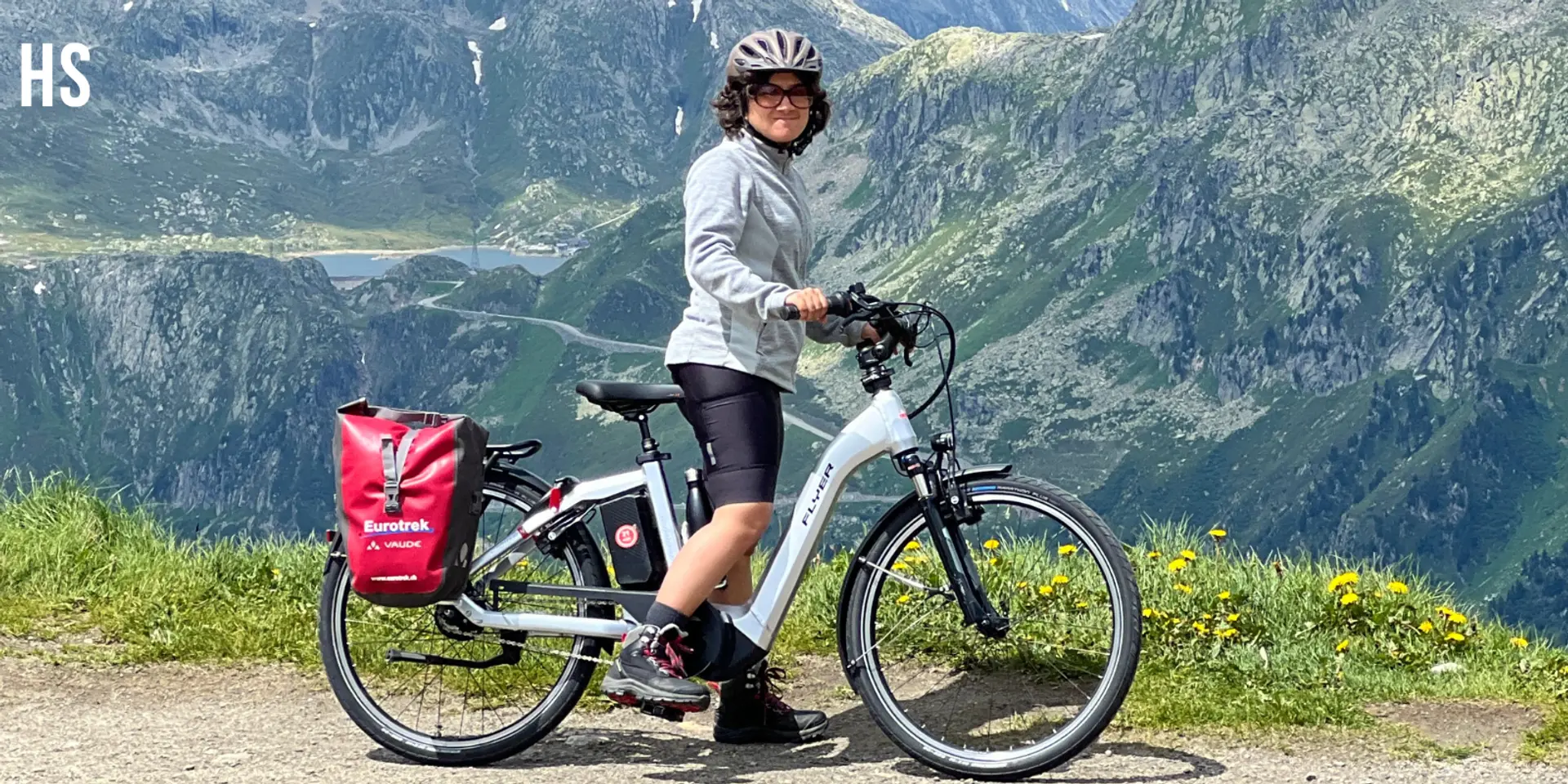

In her first book, The Shooting Star, travel writer and blogger Shivya Nath chronicled her many adventures across the world. From traversing remote Himalayan villages and living with the indigenous Mayan community in Guatemala to hiking solo in the Andes and sleeping under a meteor shower in Gujarat, Nath’s wanderlust took readers on many unforgettable journeys.
In 2011, at the age of 23, Nath quit her corporate job to travel the world as a free spirit, seeking out off-the-beaten-track destinations while striving to minimise her environmental footprint.
However, as the years went by and she built a slower life in the mountains of Himachal Pradesh, her restless mind gradually found some solace. It was there that the urge to write another book took root once again.
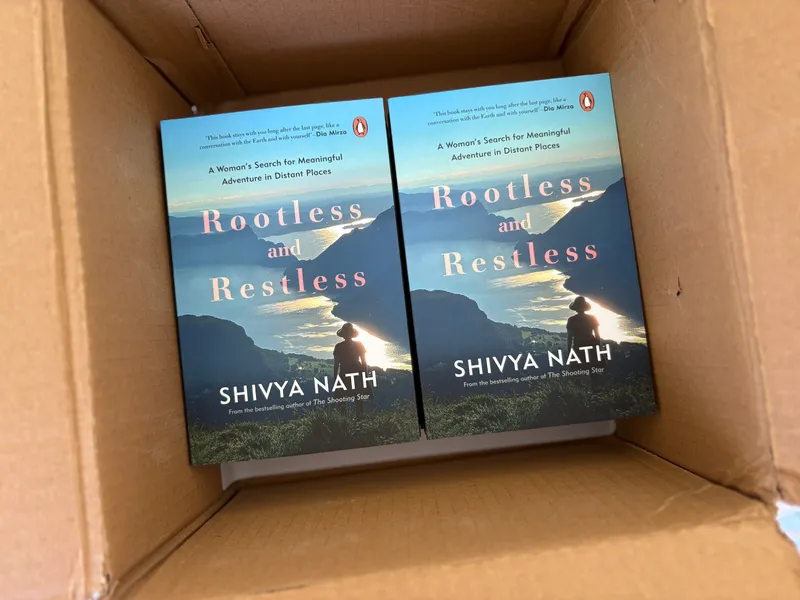
Her new book, Rootless and Restless, published by Penguin Books, revisits some of her most extraordinary adventures—from fleeing the morality police in Iran and spending over a month on one of the world’s most remote islands, 700 kilometres off the coast of Chile, to motorbiking with two complete strangers through off-the-grid villages in Myanmar that don’t even appear on Google Maps.
But this time, the focus is not just on where she travelled, but on how those journeys transformed her understanding of home, identity, and herself.
In an interview with HerStory, she discusses the evolving definitions of adventure and meaningful travel, choosing an unconventional path, and embracing a slower life in the mountains.
Edited excerpts from the interview:
HerStory (HS): Rootless and Restless feels less like a travel memoir and more like a search for meaning. Was that always your intention?
Shivya Nath (SN): I think travelling is inherently a search for meaning. It’s a way to make sense of the world around us and our place in it, to examine our shared humanity, and to question the roadmap society has handed down to us. It’s only in recent times that travelling has become a means of seeking social validation or fighting the FOMO our social media feeds constantly make us feel.
HS: How has your definition of ‘adventure’ changed between your first and second books?
SN: When I first started travelling, my idea of adventure was very literal. Jumping into a volcanic lake at sunrise, boarding down a volcano, stand-up paddling in the Pacific— all of which I’ve done. But over the years, the idea of adventure has evolved into travelling to live with remote communities in some of the farthest reaches of our planet.
One of the adventures I hold closest to my heart is spending over a month on Robinson Crusoe Island, one of the world’s remotest islands, 700 km off the coast of Chile, home to only about 1,200 people. Islanders here share a different kind of bond with the island’s endemic species, and I feel extremely lucky to be invited into their lives. It was also one of my favourite chapters to write in Rootless and Restless!
HS: You write about being rootless while also seeking a sense of belonging. Did writing this book help resolve that tension?
SN: I’ve had so many questions about the book’s title, and I love how everyone interprets it differently. To me, rootlessness signifies freedom. The Persian poet Shams-i Tabrizi once said, ‘With a home nowhere, I have everywhere to go.’ I feel similarly about being rootless—with roots nowhere, I can grow them everywhere! That kind of freedom allows me to find a sense of belonging wherever in the world I am, from the mountains of my home state Uttarakhand to the Peruvian Andes.
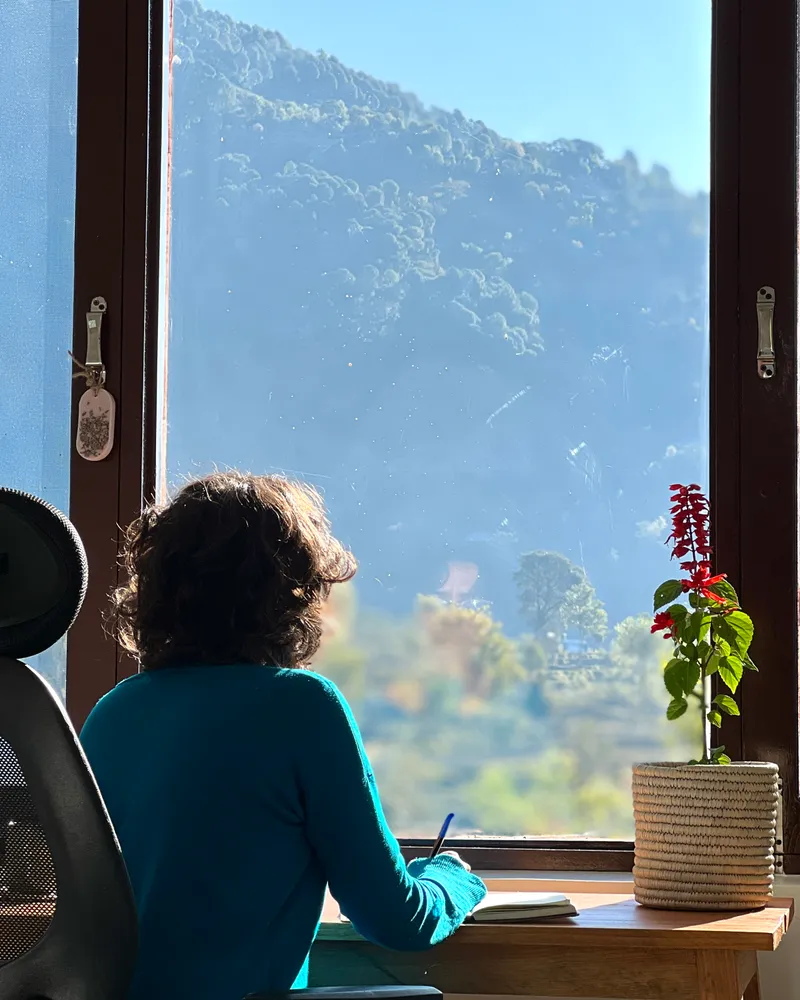
Writing in the mountains
HS: In an age of Instagram itineraries and bucket lists, what does meaningful travel look like to you?
SN: To travel meaningfully in this age is to turn Instagram-inspired FOMO into JOMO – the joy of missing out. Instead of rushing everywhere trying to check off lists created by someone else, we need to find what moves our own heart, what allows us to build deeper connections on the road, what has the power to transform us as travellers, and also what enables us to give back to the places we’ve come to love.
It can be as simple as choosing to go somewhere off the beaten path, or, in the off-season, living in a small, family-run homestay or boutique hotel, seeking out local experiences that support the community, and treating travel as a genuine cultural exchange.
HS: Has social media fundamentally changed the way we travel—for better or worse?
SN: On the one hand, social media has made travel more aspirational than ever. Many of us are challenging the idea that travel is something to be done only for a short escape or after retirement. Instead of spending our money on things we don’t need, we’re choosing to spend it on experiences that can change how we show up in the world.
On the other hand, social media is making us forget that destinations are someone’s home first. Travel content often treats the world as one large selfie backdrop. When places go viral on Instagram, they often become overrun with tourism, drain their natural resources, and negatively impact the lives of those who live there.
HS: You often choose destinations that most tourists overlook. What draws you to the margins instead of the mainstream?
SN: I often think the places I spend time in choose me.
I’ve always been drawn to regions that not many have travelled to, where locals are still genuinely curious to meet and connect with people from other parts of the world. It always helps to be in places where I don’t have to bear the burden of the prejudices that are often linked to Indian travellers. And as a travel writer, it gives me great joy to shape some of the earliest narratives about places that little has been written about.
HS: As someone who advocates conscious travel, how do you reconcile frequent travel with concerns about climate change?
SN: I see travel as a great way to learn about the perils our planet faces—climate change, biodiversity loss, species extinction. It’s one thing to learn about the retreat of glaciers in a newspaper article, quite another to witness it from the lens of a community that has grown up revering it and now faces the unfair brunt of losing it due to climate impacts. When we travel with presence and awareness, the incredible beauty of our planet cannot NOT move us to become its custodians.
HS: What was the biggest lesson uncertainty taught you?
SN: That we can’t control what happens, but we can control how we react and adapt to it.
HS: Has the conversation around solo women travellers changed since you first began travelling?
SN: Back when I began travelling solo in 2011, solo travellers, especially women, were the exception. I was often asked how my parents allowed me to go alone, and was called crazy for taking such a big risk to my safety.
Luckily, we’re becoming a more common species. And the travel industry is a bit more geared towards receiving us too. As more women travel solo and share their experiences, more are inspired to take the leap and feel the liberation that often accompanies it.
HS: Society still celebrates women who are rooted—in careers, marriages, and families. Your life has often been the opposite. Did you ever struggle with the guilt of choosing yourself?
SN: In my twenties, and then during the pandemic’s limbo, I questioned every choice I’d made. The choice to quit my steady job, downsize my life into two bags, build a life that allowed me to pay my bills through travel storytelling, chase the constant high of new horizons.
Now in my late thirties, I feel much more grounded in my choices and thank my younger self for choosing the unconventional path, often against all odds.
HS: Have you ever felt that women have to justify their desire for freedom in a way men don’t?
SN: I think women’s desire for freedom often looks very different from men’s. I’m thinking of my childhood growing up in a conservative family, when walking down the road alone to a friend’s house was considered an act of rebellion. I’m thinking of the conventional roles women are often assigned at birth, and that families, society and even peers compel us to fulfil. I’m thinking of women who spend their lives as daughters, wives, mothers, and grandmothers, often losing their own unique identities in the process. So yes, when we begin the search for our freedom—whatever that means in our individual context—we often challenge the very fabric of society and are often required to justify it every step of the way.
HS: After years of being nomadic and now embracing a slower life in the mountains, what does ‘home’ mean to you today?
SN: After a slow life in the mountains for nearly two years, my partner and I decided to ‘uproot’ ourselves in search of other horizons. We spent time in East Africa and Indonesia, and are now based in Berlin, Germany. Home to me has long been a feeling, rather than a place. It’s a deep conversation with a complete stranger, a long solitary walk in nature, a writing desk that compels me to show up every day, a creative vegan meal in a cosy café. It’s that familiar feeling of pushing my comfort zone, butterflies in my stomach, in search of a new adventure.
Edited by Swetha Kannan