



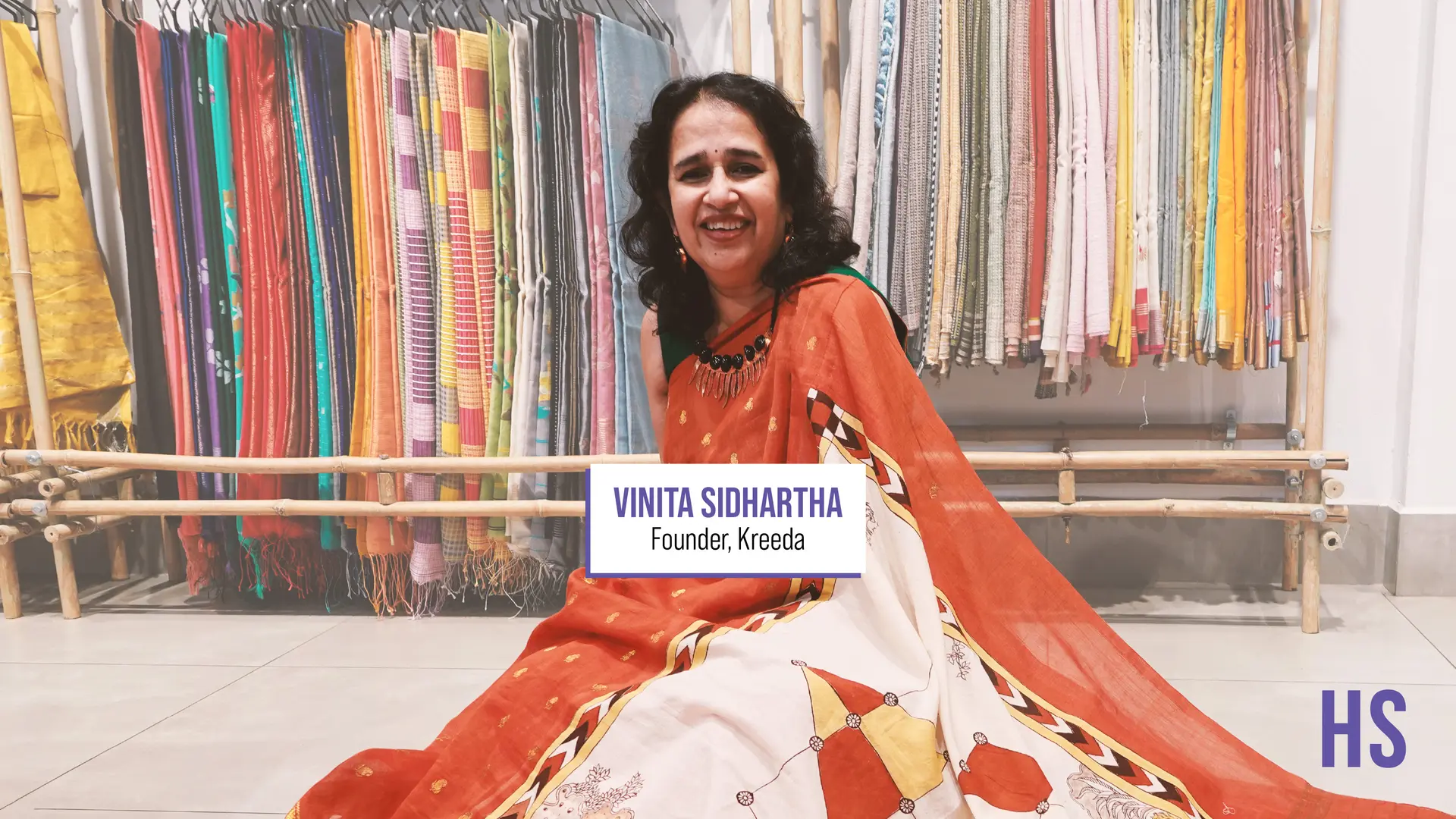
Vinita Sidhartha is on a curious quest to revive the games people played
Vinita’s unending fascination for traditional Indian games is the fuel that keeps Kreeda going. The Chennai-based organisation is dedicated to researching, documenting, and promoting the rich heritage of Indian games.


When Vinita Sidhartha visits temples, she’s busy scanning the floors and corridors. One might find that odd, but that doesn’t stop her from scouring every stone and slab there is.
What she’s looking for are grids, circles, patterns—anything that gives her a clue to the games people played ages ago.
“Traditionally, people played games on floors. They were etched on cement in homes, on thinnais (verandah), and temple floors too… So, migrant people were building a temple for 5 or 10 years, living in a place. How did they pass time once the sun set? They probably played games on stones," explains Vinita.
She pauses before offering other angles.
“The games could have even been carved in quarries, before the stones were cut by workers (and taken away for construction). Some temples became fortresses during the Anglo-French wars; so games could have been etched by the bayonets of soldiers too."
Of course, one can only make an educated guess but cannot say with certainty when and how it was done, she adds, with a twinkle in her eyes.
This curiosity and fascination is what keeps Kreeda—Vinita’s passion project—going.
Kreeda is a Chennai-based organisation dedicated to researching, documenting, reviving, and promoting the rich heritage of traditional Indian games.
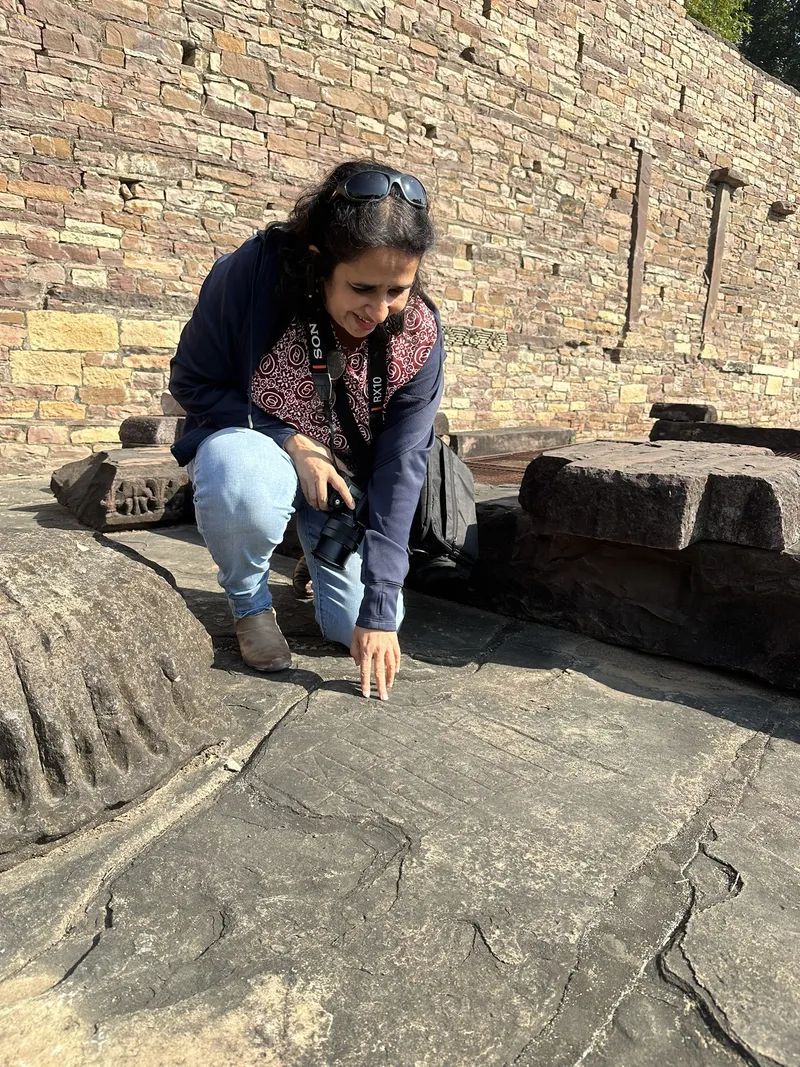
Vinita is on a fascinating quest to find games in places of historical and cultural significance, such as temples and monuments.
Birth and growth of Kreeda
The seeds were sown in the early nineties. With the longing of home hitting her hard, Vinita, who had a background in communication, moved back to India with her family after a stint in America. Upon her return, she set up a content development firm named Masterpage.
While her children were growing up, Vinita would often turn to her grandparents for support. As they spent time with the children, her grandparents started teaching them some of the traditional games they knew.
“I was initially guilty of leaving the kids with their great grandparents. I thought they’d be bored, but I found they had a ball. They learnt many games. They would eagerly ask my grandma what new game she was going to teach them that day,” she says.
This got her hooked. She began asking people about the games they played as children. Somebody would recollect something; some others would suggest an old game played .with seeds or shells.
“It was all very fascinating for me,” says Vinita, in an interview to HerStory, at Kreeda’s experience centre in Chennai.
Years later, Masterpage came out with a special feature for a client on Indian sports, including a section on folk games. This was followed by a column in The Hindu’s Young World supplement on the subject.
By now, Vinita was well entrenched in the world of Indian games.
Soon she began working with the teachers of a school in Chennai to put together a learning module based on these games. Working on this project helped her understand that one needed proper tools to play these games, and ad-hoc materials would not work.
In those days, people drew the board on the floor, but this was not feasible in the modern world. This realisation eventually led to the birth of Kreeda to create proper boards and pieces that people could play with easily.
This also marked a turning point in Vinita’s career with Masterpage pivoting to game development.
Kreeda, which means ‘play’ in Sanskrit, started out in 2002 as a fun project with eight games—a few pieces for selling and some for gifting.
Today Kreeda is a well-known brand with a repository of over 28 games, thousands of years old, played across the country in various forms.
They include Aadu Puli Aatam (Bagh Aur Bakri/Goats and Tigers), Gilli Danda (played with two sticks, large and small), Panch Kone (Nakshatra Villayattu/Star game), Kattam Vilayattu (Grid game), Bambaram (spinning top), Chaupad (which inspired the modern Ludo), Pallankuzhi (featuring pits and shells), and Dahdi (Three Nested Squares).
The games are sold primarily through Kreeda’s own website and Amazon, and a few retail outlets in Chennai, Hyderabad, and Bengaluru.
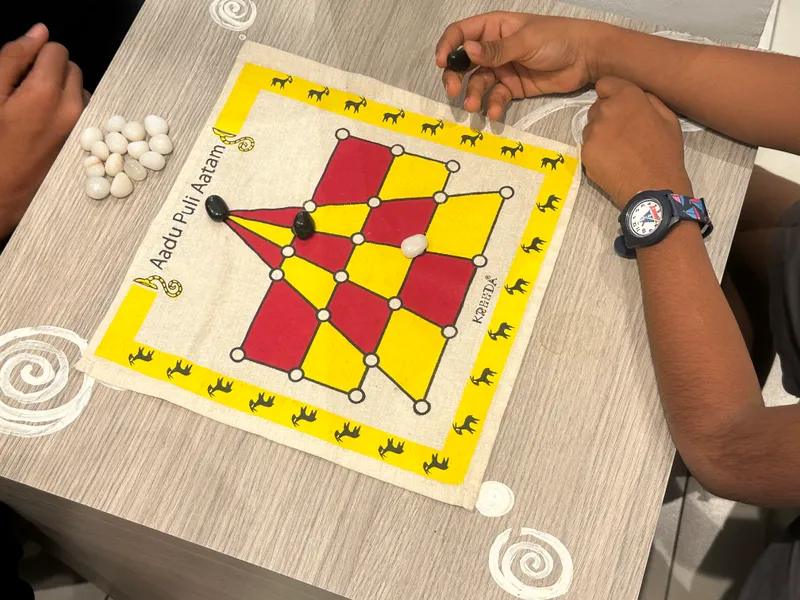
Aadu Puli Aatam is a classic hunt game with two players engaged in a battle of the mind.
As much as possible, Kreeda uses natural materials such as cloth and pebbles, and stays away from synthetic materials.
While traditionally cowrie shells have been used to play games, Vinita decided not to use them—“mass removal of cowries affects biodiversity; cowries help in keeping coral reefs healthy,” she says.
With no background in retail, she learnt the nuances on the job.
“Initially, there wasn’t anyone to guide. The internet was just starting. So I was learning on my own, making mistakes, and figuring it out.”
When she started out, nobody was interested in traditional games. So, Vinita had to spend time and energy educating people about these games, before she could actually sell them.
Today, there’s growing awareness about traditional games—they are fun, charming, easy to play with, bring people of all backgrounds, ages and cultures together, and teach us how to look at situations calmly and with objectivity.
“But I’d still like more people to play them,” she says.
While building Kreeda, Vinita has focused on three things: quality, usability, and making games that transcend age.
“My belief has always been that Kreeda should be Indian in spirit but global in quality,” she says, pointing to the colourful and elegant game boards around her.
Secondly, Kreeda makes games that are functional and affordable. While it’s nice to design intricate boards in Kalamkari cloth made by artisans, the costs go up, she says. “Then people will keep them as display pieces. Our purpose is to get people to play games.”
Kreeda’s games are priced between Rs 290 and Rs 2,205.
Thirdly, Kreeda has never been focused on children alone. “Our games are for ages 5 to 105; anyone can play them,” Vinita insists.
Kreeda has grown steadily over the years, but Vinita has never looked at it as just a brand that sells board games. To her, Kreeda serves as a treasure trove of stories and memories that help keep the rich heritage of Indian games alive for years to come.
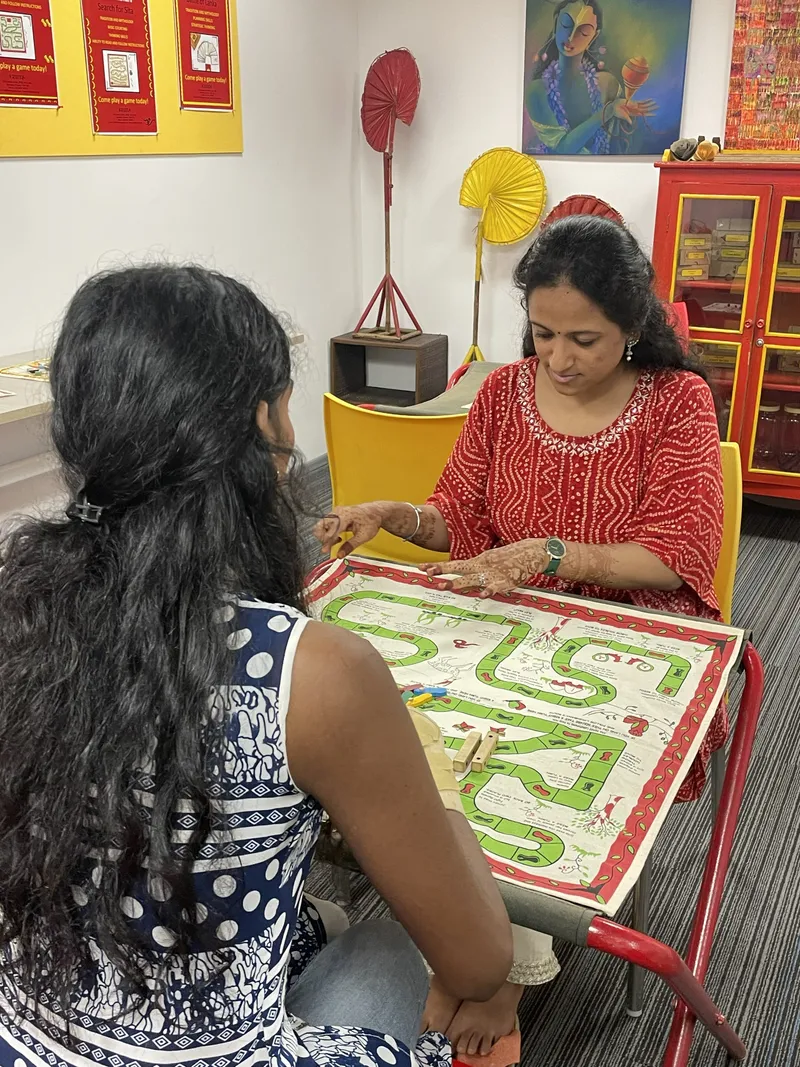
People engaged in a game at Kreeda's experence centre in Chennai.
On a unique pursuit
Research and documentation has been an integral part of Vinita’s pursuits for the last 25 years or so as she digs deep into forgotten games and the connections they share.
“I’m not just looking on the internet and saying, ‘Oh this game is cool, let's bring it out.’ Each game is well documented, we understand its history, culture, and ramifications. In fact, I can write a whole book about every game though no one may want to know that much,” she laughs.
Her commitment to research and her relentless quest to find games in places of historical and cultural significance, such as temples and monuments, has taken her to many parts of the country and abroad too.
Her adventures began around 2006 when she tripped and fell in Parthasarathy Swamy temple in Chennai—where she first realised games were etched on floors. “I saw something on the floor and didn’t get up. Everyone thought I was hurt, but I was actually staring at a game,” she shares.
The more she researched and documented, the more she understood about games and the quiet tales they hold.

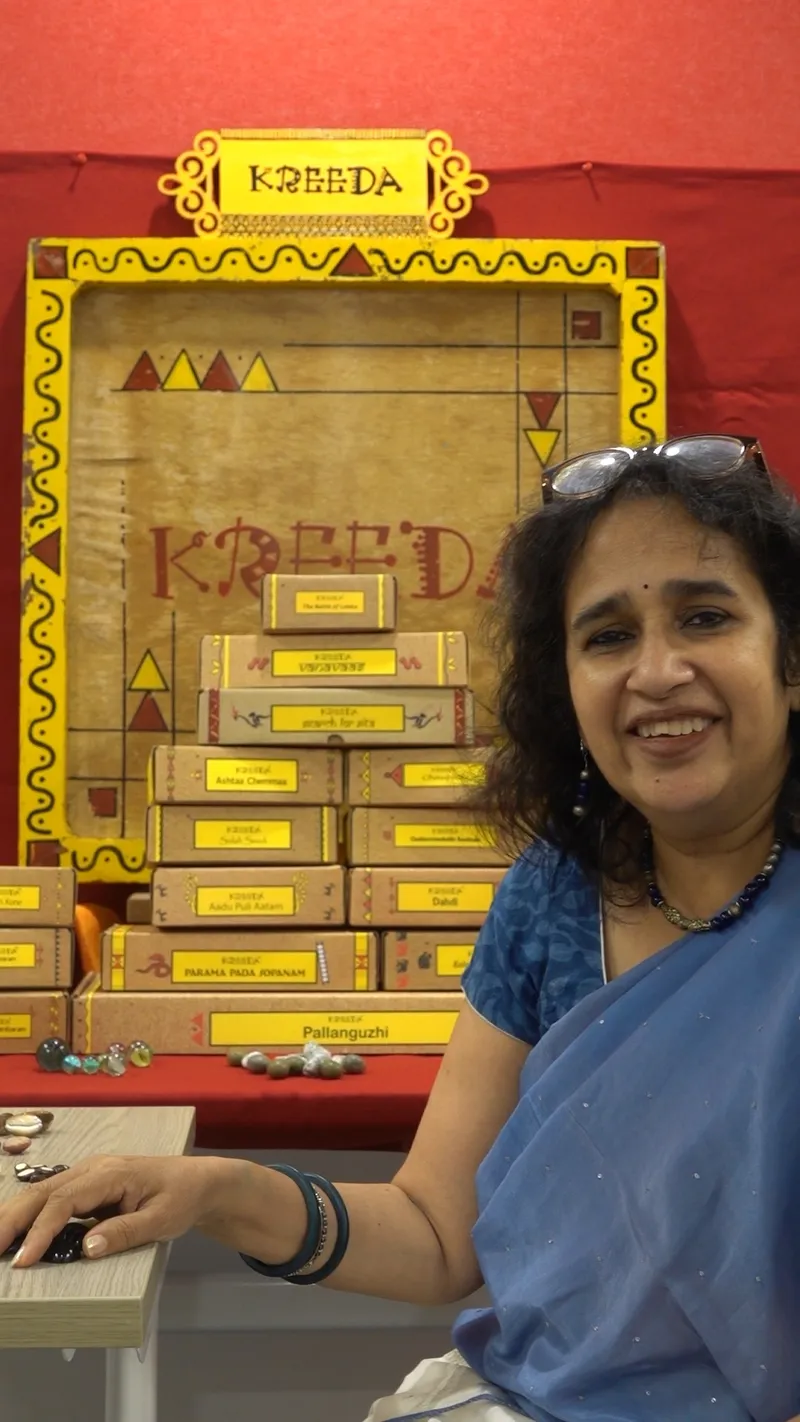
Vinita wears many hats: entrepreneur, revivalist, researcher, consultant in the social sector, corporate executive, and writer.
To tweak a phrase from Alice in Wonderland, Vinita grows 'curious and curiouser' when faced with the prospect of a discovery. Her unending wonder has pulled her down a rabbit hole many a time—as she peeps into this and that, rolls under stones, tears through shrubbery—just to find that faded piece of history.
In 2009, on a visit to the Kapaleeshwarar temple in Chennai, Vinita and her team discovered several games deeply cut into granite floors—Aadu Puli Aatam, Kattam Vilayattu, Nakshatra Villayattu—reflecting the workmen’s efforts to recreate a feeling of home, away from home. A few faint boards, eroded over time, were also found.
Vinita has found carvings in many other temples in Chennai, Gandikota Fort in Andhra Pradesh, and the Mamallapuram shore temple. Unfortunately, over the years, we end up losing many of the etchings to the ravages of time or restoration, she rues.
During a visti to Mamallapuram, she literally crawled under Krishna’s Butterball, a massive granite boulder balancing precariously on a slippery slope, to discover the long-forgotten game of Dahdi.
Interestingly, there’s a Spanish connection, Vinita reveals.
The game of Dahdi features in The Book of Games at a Spanish Renaissance library at El Escorial, near Madrid. The book, commissioned by King Alfonso X of Castile in 1283, talks about a game called ‘Mill’, which is nothing but Dahdi, a complex version of Noughts and Crosses.
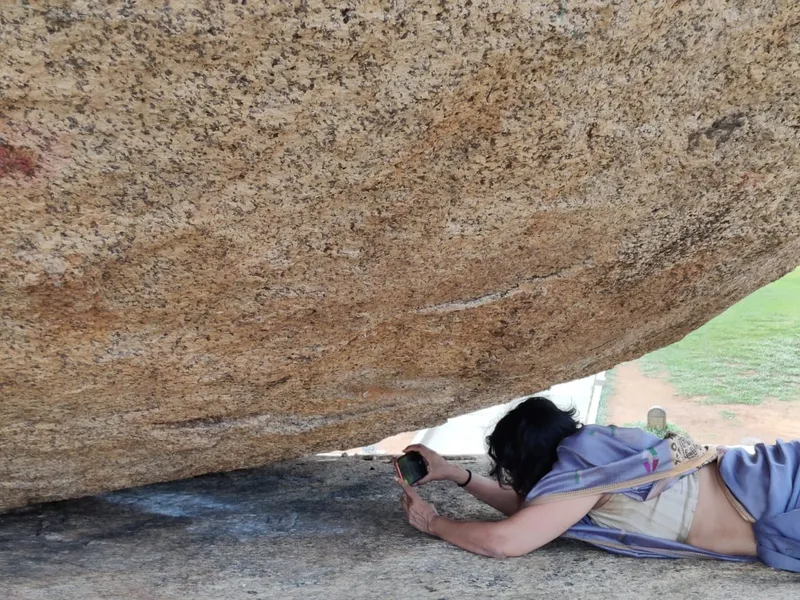
Vinita literally crawled under Krishna’s Butterball, a massive granite boulder balancing precariously on a slippery slope, in Mamallapuram to discover the long-forgotten game of Dahdi.
Besides documenting her research via her writings and YouTube videos, Vinita also organises workshops, exhibits, and events to educate people about the games of India.
When not researching or travelling, she writes blogs, consults in the impact sector, and helps her husband in his IT services business. She has also authored a book titled Just Play, highlighting life lessons from traditional Indian games.
Does it bother her that today’s generation is spending more time on devices?
“Many people say children must stop playing video games. I don’t agree. Children must do everything but it’s a question of balance. I’m not looking to replace or wean them away from the screen. I’m just saying here’s another way of having fun. The problem children have today is whom do they play with. Unstructured play is disappearing.
“That said, at Kreeda events, we see children having a ball. What you take away from traditional games is timeless, goes across age, language, and culture. They can bridge an 80-year age gap between a modern child and a grandma. Monopoly, Settlers of Catan or a video game may not be so easy to play with such an age gap.”
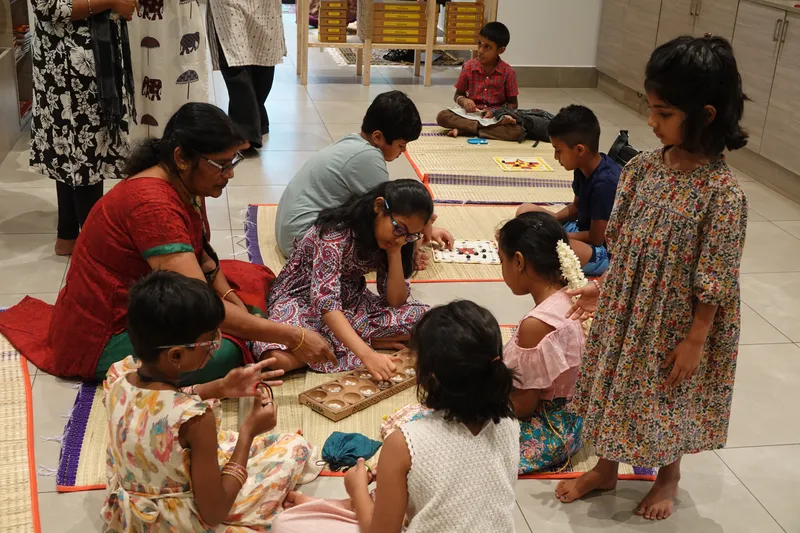
Kreeda organises workshops, exhibits, and events to educate people about the games of India.
Asked to pick a memorable moment from her journeys so far, her eyes light up.
Vinita was visiting a temple in Thiruvanaikaval in Tirucharapalli, Tamil Nadu. It was late in the evening, and as usual she was sweeping the floors using light from her cell phone torch.
An onlooker asked her if she was looking for her earring, and Vinita pointed to the Aadu Puli Aattam board she’d just spotted. Thrilled, the woman called her family and showed them the board. Soon the entire family pulled out their torches and got involved in the quest for games.
As they went around combing the floors, more people joined in. Vinita chuckles as she recalls, “By the end of the evening, around 10 people were walking around doing this. It was great fun."
Images: Kreeda
Edited by Megha Reddy