



Chennai’s Marina Beach is becoming a hub for coastal consciousness
Just metres away from the shoreline on Chennai’s Marina Beach, a once-forgotten public library has been reimagined by the Environmentalist Foundation of India into a marine education hub. The Ocean Station invites people to explore the city’s deep, often overlooked relationship with its coastline.


Chennai’s iconic Marina Beach is emerging as a public space reimagined for inclusion, awareness, and community-led change.
A couple of years ago, the beach made headlines for the installation of its first-ever permanent ramp for persons with disabilities, offering dignified access to the shore for all. Now, not far from that stretch of sand, a 25-year-old defunct public library has been transformed by the Environmentalist Foundation of India (EFI) into Ocean Station—a vibrant marine education hub that’s conceptualised to redefine how coastal cities engage with their ecological heritage.
The Ocean Station—the first in Chennai—aims to be a vibrant marine education hub that rekindles the city’s connection with its coastal heritage, and also its public libraries, according to Kavitha, District Legal Officer, Greater Chennai Corporation.
“The government is on a mission to breathe a fresh lease of life into at least 23 public libraries in the city—some about a century old. The library on Marina beach was renovated by the government in the early 2000s. It is next to the swimming pool where families throng with their children, but do not know about it,” says Kavitha.
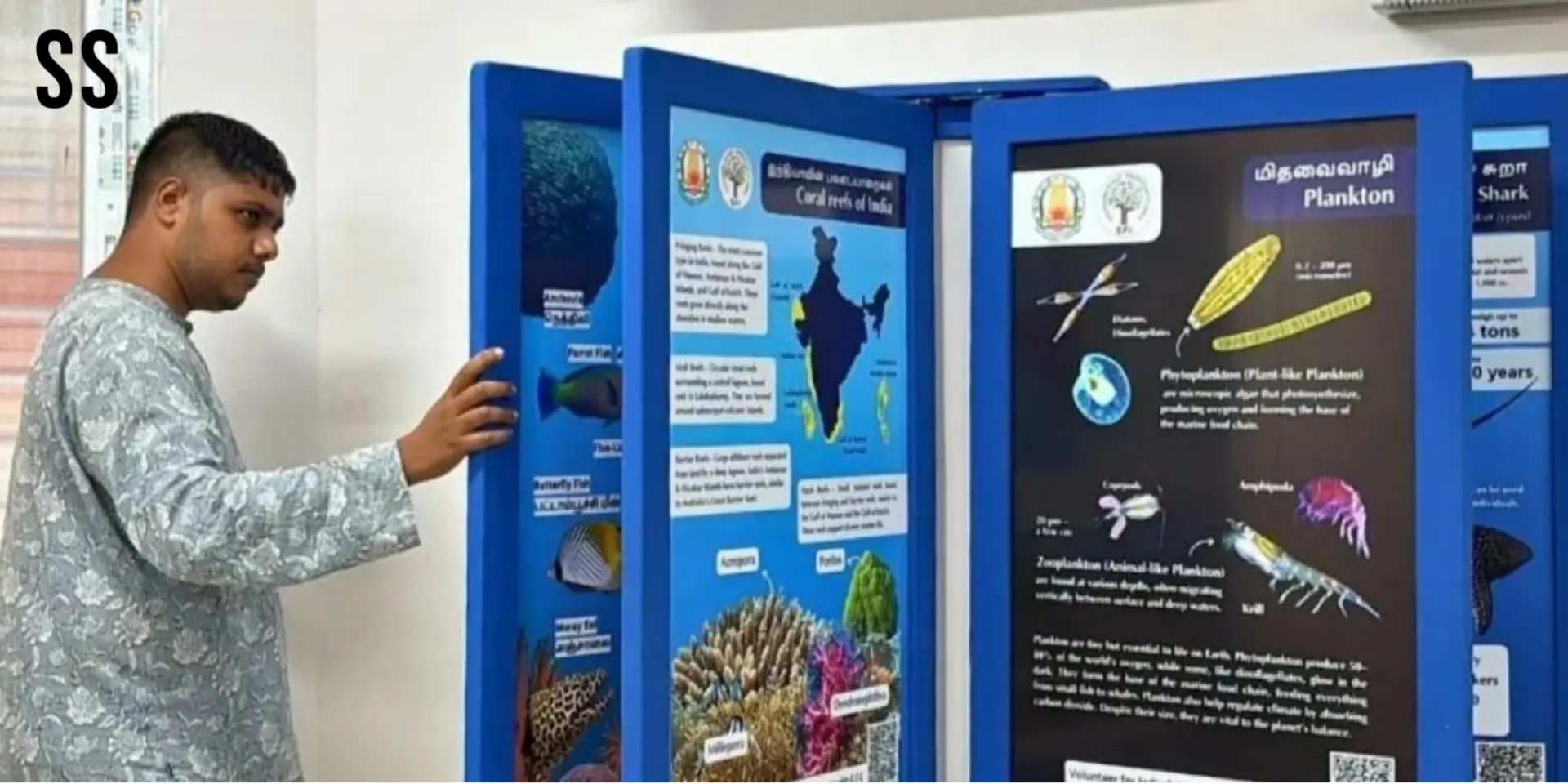
Thanks to EFI, the library isn’t just more visible now but is also vibrant, painted with the colours and rhythms of the ocean. Its walls have come alive with murals of Olive Ridley turtles, ghost crabs, and whale sharks, while interactive exhibits narrate tales of marine biodiversity and conservation.
Walking in, visitors are introduced to marine wildlife, marine habitats, and the threats they are facing.
“We wanted to create a space where the community could engage with the ocean's wonders and challenges,” says Arun Krishnamurthy, Founder EFI. “Ocean Station is our attempt to make marine conservation relatable and actionable. It’s a 10-year mission, with six more Ocean Stations coming up in Besant Nagar, Chennai; Puducherry, Kanyakumari, Visakhapatnam and Mumbai,” he adds.
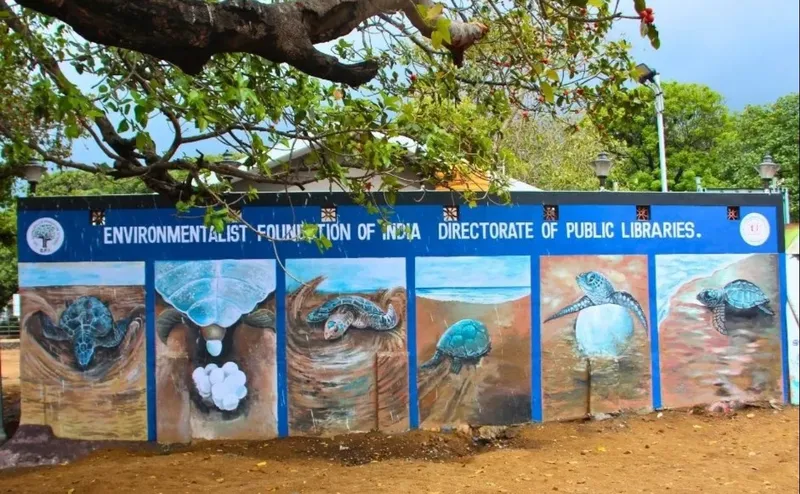
The centre's walls are alive with murals of Olive Ridley turtles, ghost crabs, and whale sharks, and interactive exhibits narrate tales of marine biodiversity and conservation.
The Bay of Bengal, a vital component of India’s maritime heritage, is facing unprecedented challenges. Stretching over 2.6 million square kilometres, it is a vast nursery for marine life. Recent studies highlight its rich biodiversity, from the newly identified Ostreococcus bengalensis phytoplankton species to diverse bivalve populations. However, overfishing, pollution, and climate change remain enduring threats to the ecosystem. Hundreds of sea turtles are found dead along the east coast, becoming victims of accidental trapping and habitat degradation.
In addition to artwork, the Ocean Station will also have a laboratory where students can learn about marine debris and ways to increase biodiversity. Krishnamurthy looks forward to turning it into a platform for community engagement, where workshops, film screenings, and interactive sessions with marine biologists can be regularly organised—to spark a culture of environmental consciousness beyond the classroom. By demystifying marine science and making it accessible, Ocean Station aims to nurture a community that values and protects its coastal resources.
Since 2009, EFI has been conducting large-scale cleanups across 65 kilometers of beaches in Andhra Pradesh, Tamil Nadu, and Maharashtra. “We are now expanding this work to Gujarat, Puducherry, Karnataka, and Kerala,” says Krishnamurthy.
“If people have to care about the ocean, they must first feel connected to it. We don’t want marine conservation to be a disconnected conversation—it should be a community dialogue."
Edited by Swetha Kannan