



Fighting for freedom after 78 years of independent India: 3 stories of survival
As India marks 78 years of independence, three lives show how the promise of freedom still collapses under daily violence, prejudice, and state failure. For them, “independence” rings hollow and is lost in their fight to stay alive.

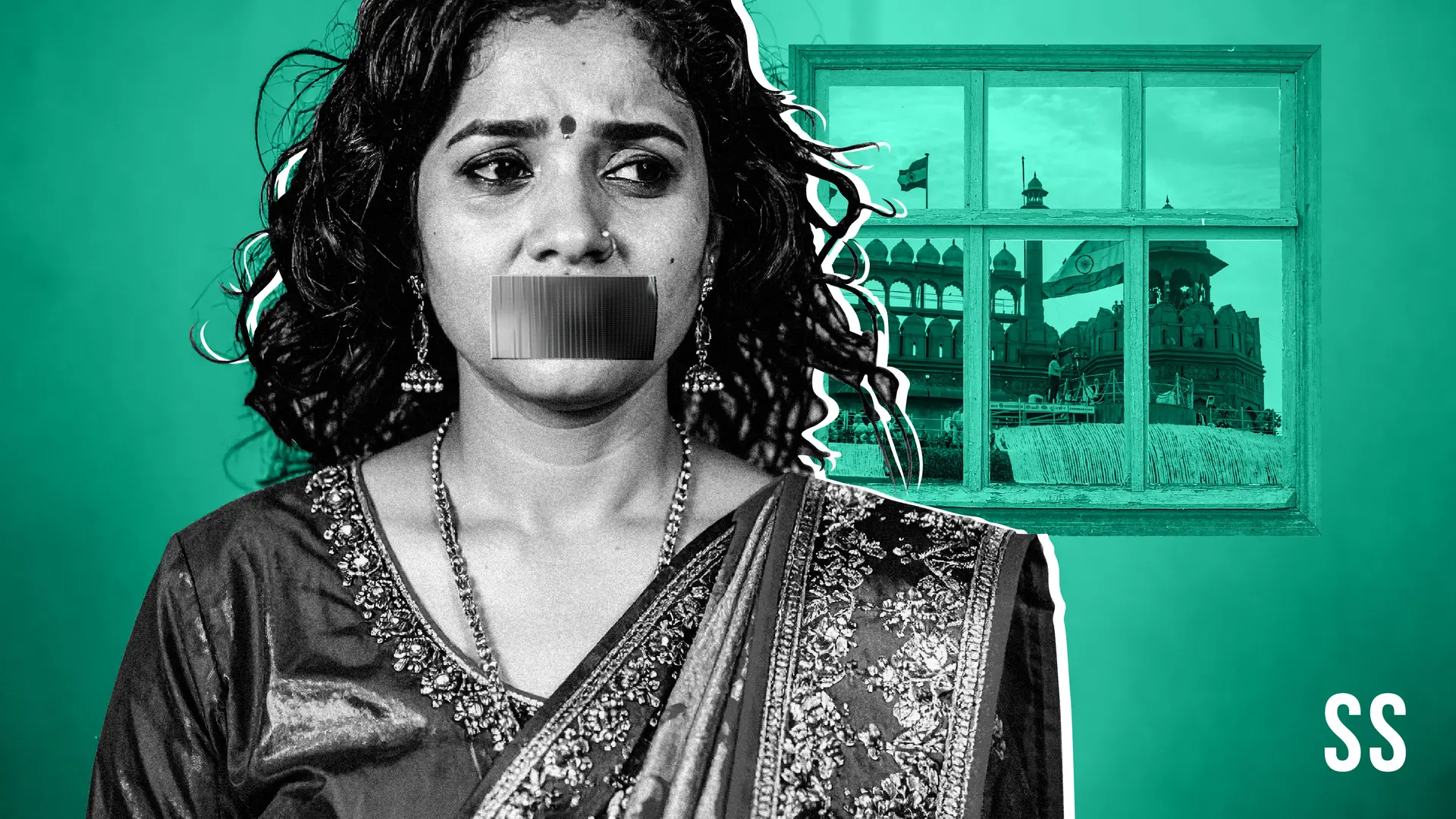

Independence Day is big business: ads, sales, Instagram posts, hashtags. For many, the idea of freedom doesn’t change from day to day, with August 15 being yet another holiday to cash in on the sales. Instead, the promise of freedom that comes with the day rings hollow.
This August 15, we tell stories of survival, justice, and the fight for basic rights, where freedom isn’t just a slogan and independence is hard-fought.
Kalai, domestic violence survivor
Kalai (name changed on request), a resident of Kattukuppam in Chennai, has spent the last three decades of her life as a prisoner in her own body and mind. Words like ‘agency’ or ‘freedom’ hold no meaning for her.
When asked what makes her feel free, she tells SocialStory, “May be the beach....or the temple,” where she prepares and serves food to devotees, and often bargains with the gods for a better life, offering the hair on her head.
Kalai lost all control over her body and mind on the first night of her wedding 25 years ago—a relationship she didn’t consent to, but went along with. Her story is synonymous with that of many women for whom the wedding night marks not the start of a shared life, but the loss of autonomy over their own.
In 2024, the National Commission for Women (NCW) received 25,743 complaints, of which 24% (6,237) pertained to domestic violence.
Like countless women in this situation, Kalai bore children while also undergoing severe physical and emotional violence daily. “He would trash me at night and have sex with me the next day,” says Kalai.
There were times when Kalai stormed out of her house, vowing never to return. But then she thought about her children, and went back.
But Kalai had developed an uncomfortable resilience to the violence much earlier. When she was still in her 20s, her parents offered little to no respite when she sought their help. She was told, “That is your home and family now.”
Eventually, she internalised this message and stopped resisting. The birth of children only enmeshed her further into the web of family ties, celebrating Diwali, Pongal and childbirths with them. “I always showed up with a few bruises here and there,” she says.
Today, Kalai’s silence has taken root in her body. Decades of unspoken pain have manifested as autoimmune disorders, arthritis and hypervigilance, chipping away at her cognition and health.
Yet, despite several attempts by this journalist and an NGO saving women from the violence, Kalai is unwilling to accept an intervention or even counselling. “She carries the message impressed upon her by every foundational relationship she’s ever had in life—from her parents to her husband and in-laws: this is fate—accept it, and live with it,” says her social worker.
Seema Deshpande, the Mumbai president of Bhartiya Stree Shakti (BSS)—an NGO working nationwide to help women facing violence—echoes this reality. “Domestic violence isn’t just about the act of violence. It is a steady, systematic conditioning to make one believe they are not worth taking up space in this world, or that their existence and individuality matter,” says Deshpande.

For every crisis call she receives, Deshpande has just one task for the woman—to collect all her medical reports and keep them safe. “We need it for proof when we take further action,” she says.
She adds that the absence of Protection Officers (POs)—who, as per Section 8 of the Protection of Women from Domestic Violence Act, 2005, must be appointed by state governments—has posed a critical gap. The role of these officers is to assist survivors to file Domestic Incident Reports and submit them to the magistrate; help them access medical aid, shelter, and legal services; ensure court orders are implemented; keep them informed about case progress; maintain updated lists of support services; submit regular reports to the court, and provide free copies of complaints and orders.
“That’s an entire system of redressal that is denied when POs aren’t available, or worse, are not trained to understand and fulfil their duties,” says Deshpande.
She adds that the police are equally under-sensitised and unskilled in handling DV cases. “In a majority of cases, they throw their hands up and say it's ‘domestic matters’. They don’t look at it as a crime to begin with,” says Deshpande.
“Most women call us or go to the police only when the violence becomes unbearable, trusting they will get some protection. But at most, she may be housed at a shelter for 2-3 days before her family is called in and asked to take her back home,” she adds.
With few One Stop Centres and almost defunct redressal mechanisms, freedom here is measured in how quietly a woman can bleed behind closed doors and have just about enough strength to feed the household every single day.
Noorul Amin’s fight for survival
It’s been 72 days since Noorul Amin last heard from his parents, two brothers, and sister-in-law. The last call was brief—they were terrified, stranded somewhere in Myanmar after being dumped on “an island” by fishermen. Since then, nothing. No voices. No messages. Just silence.
The 25-year-old paces the narrow lanes of Delhi’s Vikaspuri, clutching his phone like a lifeline, waiting for it to ring.
In 2007, Amin landed in Delhi as a Rohingya refugee, obtained a UNHCR-issued refugee card, and found sporadic work to feed his family. Survival, however precarious, was possible.
On May 6 this year, everything changed when the Indian authorities allegedly detained 38 Rohingya refugees in Delhi—15 Christians and 23 Muslims, all with UNHCR cards—under the pretext of “biometric verification.” They were reportedly flown to Port Blair (now Sri Vijaya Puram), put on a naval vessel and, by May 8, allegedly cast in the Andaman Sea near Myanmar with only life jackets.
Their fate remains unknown, especially since violence has escalated dramatically in Myanmar.
A UN-backed investigative team reports ongoing systematic torture in Myanmar’s detention centres—documenting electric shocks, strangulation, gang rape, and the burning of sexual body parts, even inflicted on children.
Simultaneously, the UN High Commissioner paints Myanmar’s plight as “a litany of human suffering,” citing over 1,800 civilian deaths in 2024 due to airstrikes and artillery, along with widespread use of beheadings, burnings, human shields, and the displacement of over 3.5 million people.

Every day, Amin ventures into Delhi’s informal labour markets seeking work. Last week, when he declared he was from “Burma”, he was beaten by two men. His inability to walk—due to a physical condition—compounds his insecurity. He cannot provide, yet cannot leave the settlement.
For Priyali Sur, founder of The Azadi Project, Amin’s story mirrors the daily existence of hundreds in Delhi’s Rohingya settlements, where fear is pervasive. Families have been picked up and deported without due process, their meagre possessions confiscated, their years of labour erased overnight. Sur recalls women telling her how the few pieces of jewellery or savings they had managed to hold on to over the years were stripped from them before deportation.
“Everything they’ve worked for—every bit they’ve gathered over years of survival — is taken away in an instant,” she says. “Living in fear, in uncertainty, in a constant state of alertness is not freedom.”
“Article 21 of the Indian Constitution protects the right to life and personal liberty—even for foreigners, even for those without citizenship. But today, that protection has been turned into a joke.”
Kavin Selva Ganesh: A life cut short by caste
On July 27, a young Dalit tech worker, C Kavin Selva Ganesh, was slain with a billhook outside a hospital where his partner works, in Palayamkottai, Tirunelveli. According to reports, the alleged attacker, the girl’s brother, surrendered soon after. Within days, his father—a serving sub-inspector—was also arrested.
Kavin’s family refused to take his body for days, camping outside the mortuary and demanding action against those they say incited the murder. The case has since been handed to the CB-CID. The investigation, officials say, is being run under the SC/ST (Prevention of Atrocities) Act alongside murder charges.
Peer-reviewed work shows caste-based crimes track with entrenched hierarchies: regions with deeper socioeconomic inequality see more atrocities against oppressed castes. Legal scholars also point out how the Atrocities Act — one of the world’s strongest hate-crime laws—still has gaps in implementation, from the FIR stage to conviction. Reports have repeatedly documented this gap, and South Asia Multidisciplinary Academic Journal (SAMAJ) details how prejudice in court remains a structural hurdle.
Recent NCRB submissions to Parliament confirm the scale of crimes against SCs; reportage across South India highlights alarmingly low conviction rates. In May, survivors and families in Madurai demanded a dedicated honour-killing law, arguing that many inter-caste murders slip through when technicalities exclude them from the Atrocities Act.
Harsh Malhotra, chief coordinator of Love Commandos, a voluntary, non-profit providing support and protection to intercaste and interfaith couples facing opposition or harassment, says couples are at times killed years after marriage by dominant caste families.
“One of them was killed 19 years after they got married,” he tells SocialStory. “And in most cases, it’s the neighbours, the community members and caste elders who are the perpetrators, not the parents themselves.”
Through a 24×7 helpline, Love Commandos responds to distress calls, moving couples into secret safe houses where they can stay until it is safe to register their marriage or begin living together openly. The group also offers legal assistance, helping with marriage registration, police protection, and navigating bureaucratic hurdles.
For many, these shelters are the first spaces where couples can be together without fear.
“Freedom is far-fetched; almost absurd to imagine for the people we work with,” says Malhotra. “For them, it’s the basic right to live without someone deciding their adult decisions are a crime. Until hearts change, until the insecurities and hierarchies that feed caste violence are dismantled, we’re only moving people from one hiding place to another. That is not freedom.”
Edited by Kanishk Singh