



Dignity of work: How DBRC and Tetra Pak are empowering Tirupati’s waste pickers
In the temple town of Tirupati, informal waste pickers have long worked in the shadows—excluded from protections, recognition, and dignity. A pioneering partnership is now working to change that reality.


Municipal data shows that the temple town of Tirupati generates more than 200 tonnes of solid waste every day, fuelled by the constant influx of pilgrims and the city’s growing population. Much of this waste is recycled, thanks to the efforts of waste pickers.
However, despite being the backbone of recycling, these workers remain largely invisible and excluded from basic rights. Unlike municipal sanitation workers, who are salaried employees with some legal protections, uniforms, and access to welfare schemes, informal waste pickers remain outside formal recognition.
India has an estimated 1.5–4 million waste pickers, according to the International Labour Organisation and the Global Alliance of Waste Pickers. They lack employment contracts, social security, or health insurance, despite contributing significantly to resource recovery and environmental sustainability. A 2023 study by the All India Kabadi Mazdoor Mahasangh found that nearly 90% of waste pickers lack access to health insurance or social security, while most worked without protective equipment.
The stakes for Tirupati’s waste pickers are high, as large-scale private companies and waste-to-energy plants increasingly monopolise recyclable materials, potentially cutting off these workers from their only livelihood.
Now, a unique partnership between Dalit Bahujan Resource Centre (DBRC), an NGO working with marginalised communities in Andhra Pradesh and Telangana, and multinational food packaging and processing company Tetra Pak, is rewriting the story for waste pickers. Launched earlier this year, their joint initiative is—for the first time in the temple town—formalising the livelihoods of waste pickers by enhancing access to entitlements and integrating them into a formal recycling value chain.
“Our goal is to move waste pickers from mere survival to sustainable livelihoods. That means we are addressing social stigma, ensuring access to welfare, and recognising their contribution to the circular economy,” says Ch. Samuel Anil Kumar, Deputy Director – Programmes at DBRC, in a conversation with SocialStory.
Caste, stigma, and the fight for recognition
Caste plays a defining role in waste-picking, with Dalit and marginalised communities historically carrying the weight of sanitation and waste-related occupations.
Scholars, including Bezwada Wilson of Safai Karmachari Andolan, have long underlined the caste dimension of waste work. Dalit communities remain overrepresented in sanitation and waste collection, which only deepens discrimination. In Andhra Pradesh, this overlap of caste and occupation is continuing to shape how waste pickers are perceived.
“This stigma is such that it doesn’t vanish with income. Waste pickers are still looked down upon because of caste divisions and the nature of their work. So our approach couples livelihood support with social recognition,” Kumar explains. “When we are talking about dignity, it is not just about income. It is about undoing generations of exclusion.”
The DBRC–Tetra Pak project in Tirupati works on three aspects: organising waste pickers into collectives, capacity-building for safer recycling, and linking them with welfare and markets.
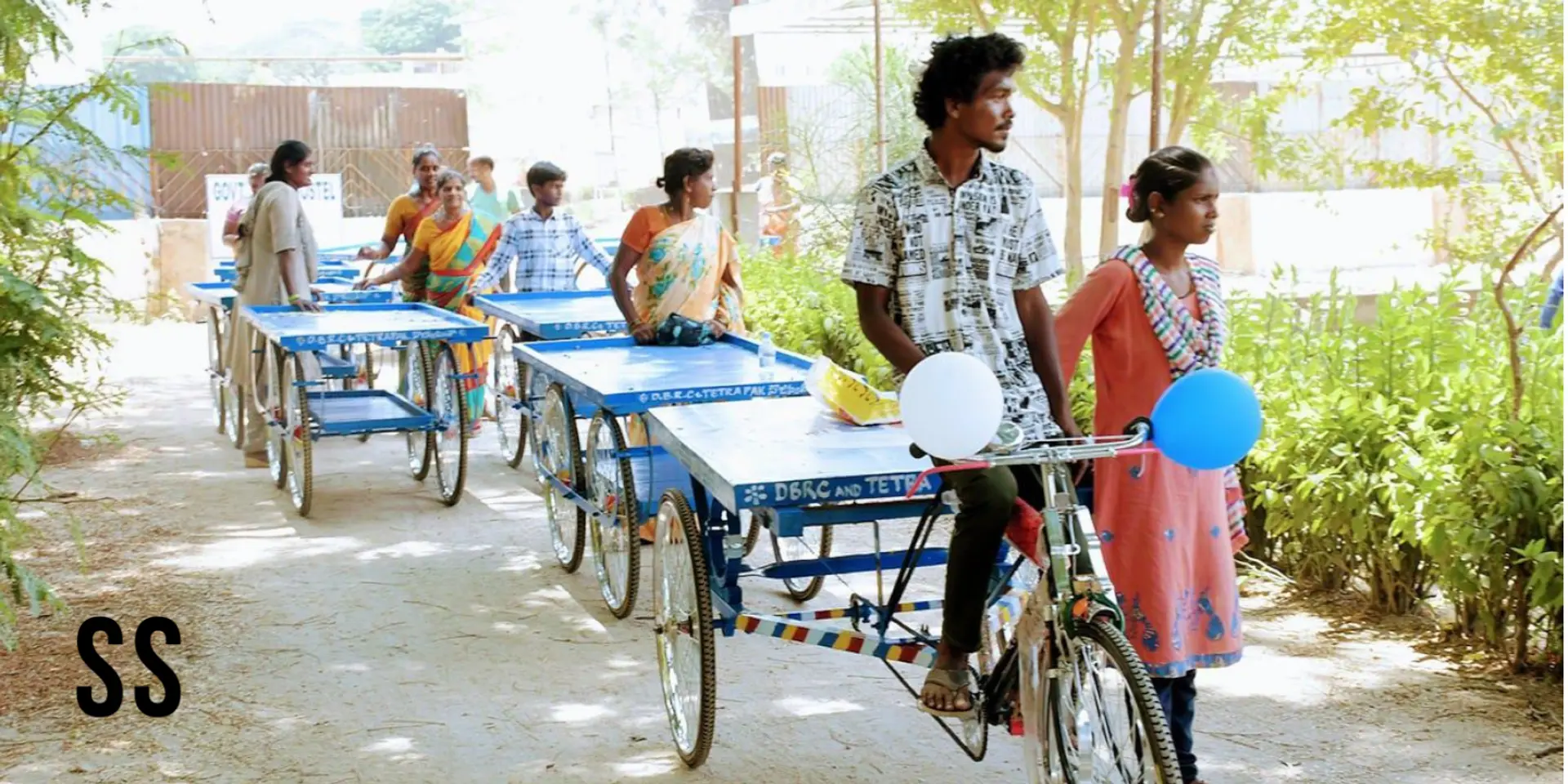
Funded largely through corporate support from Tetra Pak, the initiative provides not only immediate financial relief—such as distributing three-wheeled pushcarts and tricycles to waste pickers—but also pathways for alternative livelihoods. Women in the community, for instance, have been supported to start small fruit and vegetable vending businesses, gaining both income and autonomy.
Beyond distributing equipment, the organisation focuses on training young people in mechanical repairs, plumbing, AC repair, and car washing. “We pay local shop owners to train youth directly—no certificates, no exams,” says Kumar. “The goal is independence without the enmeshment of bureaucracy.”
Removing systemic barriers
The initiative also addresses systemic barriers. DBRC facilitates access to bank accounts, ration cards, health entitlements, and school enrollment for children. Financial and digital literacy programmes teach families how to manage their money, use ATMs, and pay bills, slowly bridging the gap to mainstream systems.
“Education is the way we can change the community,” Kumar emphasises. “We follow children year by year, ensure they are studying well, create aspirations, and motivate them to dream beyond waste picking.”
The programme deliberately nurtures leadership within the community. Waste picker cooperatives, led by workers—many of them women—give members a voice in local governance and decision-making. Visits to other states expand their horizons and challenge deeply ingrained beliefs about what they can achieve.
Gendered realities of waste work
Though men dominate scrap collection yards, women constitute a significant share of waste pickers, particularly in segregating, sorting, and door-to-door collection. Studies show women are subject to double vulnerability: poor pay and exposure to hazardous waste, compounded by gender-based invisibilisation and lack of childcare.
“Women waste pickers are among the most invisible. They handle the dirtiest parts of recycling—sorting and segregating—yet have the least voice in decision-making. We want this project to change this, so we focus on creating women-led groups,” says Kumar.
Gender inclusion is central to DBRC’s model. Women staff lead critical organisational functions, and female teachers and trainers work with children in the field. Initially shy, many women in the communities gain confidence over time, eventually speaking at meetings, advocating for entitlements, and organising programmes themselves.
“In the past two years, four women waste leaders sat on stage and talked about entitlements, cooperatives, and women’s issues,” Kumar recalls. “Respecting them, sitting with them on the ground, acknowledging their dignity—these small gestures make a huge difference.”
Women get direct cash transfers, enabling them to prioritise household needs and educational expenses for children. Workshops and trainings incorporate discussions on gender roles, early marriage, and women’s participation in governance.
The long view
Breaking cycles of marginalisation takes time. Kumar acknowledges that while many adults in the community may never leave waste picking, targeting the next generation is key. By combining education, skill training, leadership, and financial empowerment, the initiative aims to create pathways for young people to enter dignified employment and potentially even entrepreneurship.
“We integrate them into government systems, ensure access to education and entitlements, and build skills so they can chart their own futures,” adds Kumar.
Training sessions include demonstrating safer handling techniques, the use of gloves and protective gear, and knowledge of recyclable streams. More crucially, DBRC is facilitating identity cards and registrations so that workers can access government schemes, pensions, and health insurance.
“Formalisation is not only about wages. It is about inclusion — IDs, health cover, and respect in the community. That is what makes the difference,” Kumar emphasises.
By creating a structured chain of collection and resale, the project is also ensuring that Tetra Pak cartons—usually hard to recycle—are finding their way into authorised facilities. Not only does this reduce landfill pressure, but it also adds value to the waste pickers’ work.
Edited by Kanishk Singh