



Sewing a livelihood: Women in this village in western Rajasthan have become leaders of their households
From stitching fabric to steering finances, women in Chandelao village in Rajasthan are redefining what leadership looks like at home. At Sundar Rang, their craft has become a bridge to dignity, education, and community change.

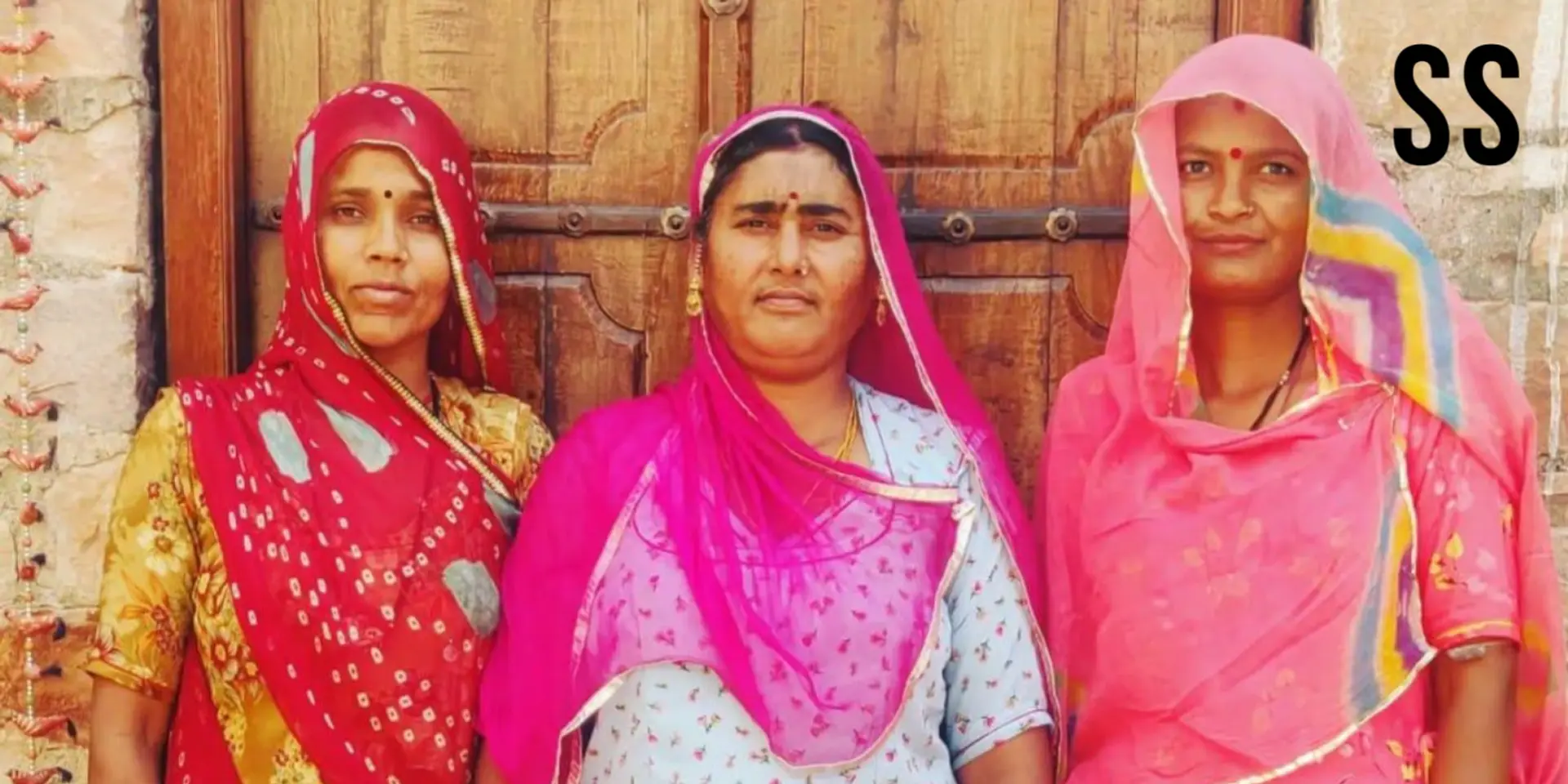

In the village of Chandelao just outside Jodhpur, the hum of sewing machines fills the air every morning. Inside the vibrant courtyard of Sundar Rang—which literally translates to ‘beautiful colours’—a group of women sit cross-legged, stitching block-printed fabrics, and chatting over chai. They’re keeping alive the legacy of craftsmanship that is historic to this village, while running their households independently.
This sense of ownership didn’t always exist here. Sundar Rang, a social enterprise and women’s arts and crafts collective, began in 2007 as a modest craft centre under the larger umbrella of NGO Chandelao Vikas Sansthan, founded by Praduman Singh.
“My father-in-law wanted to do something for his ancestral village,” says Yashodhara Chauhan, Manager at Sundar Rang, and Singh’s daughter-in-law. “He didn’t have the funds for it, but he had the vision—to create employment for local women, while giving them basic education and skill training,” she adds.
The idea was brought to life with the help of Norwegian businesswoman and philanthropist Kristen Andresen and Swedish benefactor Sven Williamson, who became co-founders and lifelong patrons of the initiative.
What started with just five women has now grown into a thriving collective of over 35 artisans—all from the village or its neighbouring hamlets.
Building a holistic village ecosystem
While Sundar Rang is the most visible arm of Chandelao Vikas Sansthan, the NGO has also led several local initiatives—from building household washrooms to running reforestation drives and waste-segregation projects.
In 2023, it planted 500 trees; the following year, with support from Planeterra and other partners, that number grew to 3,000.
Still, it’s Sundar Rang’s craft centre that has turned Chandelao into a small but remarkable example of rural social enterprise. The women here work exclusively with ethically sourced fabrics from Pipar—a nearby village renowned for its dabu block printing—and with upcycled textile waste from Jodhpur’s factories.
“Everything is handmade and nothing is outsourced,” says Chauhan, adding, “The women do the cutting, stitching, and pattern-making—all of it happens right here.”
Each product bears the name of its maker—a small, but radical gesture that gives back ownership to where it belongs. For every piece sold, 60% of the profit goes to the artisan, which is on top of their daily wage.
“This model changed everything,” explains Chauhan. “When we just paid wages, they weren’t as invested. But when they saw their names on the tags and realised their work directly affects their earnings, they took real pride in it.”
Work designed around women’s lives
In Chandelao, as in most of rural India, women’s time is intertwined with domestic duties—milking cows, tending to crops, caring for children and the elderly, among many other tasks.
Sundar Rang found its rhythm by working with, and not against, that reality. The women clock in at 10 am, break for lunch at 1 pm, and finish by 4 pm. “We ensure no one stays late, no matter what the production pressures are. This helps them keep coming back, because it respects their life outside the centre,” says Chauhan.
It’s this flexibility, along with word-of-mouth trust, that has helped the enterprise grow. The women now form a tight community — travelling together on sponsored trips every few years, celebrating each other’s milestones, and teaching the craft to the next generation.
Last year, Sundar Rang launched a formal training centre, hiring a teacher from Jodhpur to instruct women in pattern-making, cutting, and stitching. “We can take ten trainees a year. They train for a year and then join Sundar Rang. We’ve already convinced eight women to start,” says Chauhan.
Besides this, every artisan attends daily English and Maths classes, an investment that’s building skills and increasing confidence among the women, which, Chauhan says, is the real game-changer in a traditionally patriarchal system.
No story captures this transformation better than that of Saroj, one of the earliest recruits, who joined Sundar Rang as a tailor in the late 2000s. Over the years, she grew into the role of supervisor, managing production and handling visiting tourists with professional skills and ease.
Most recently, she cleared her Class 10 board exams, a milestone the entire team celebrated with a party.
“Her story reflects what’s possible when women are given both economic and emotional support,” Chauhan says proudly. Today, Saroj confidently handles card machines, UPIs, and international orders—skills that would seem unimaginable for a rural woman in western Rajasthan only a decade ago.
This financial independence has rewritten family dynamics in Chandelao. Chauhan recalls how, in the early days, it was nearly impossible to convince families to let women step out for work, let alone travel.
“Now, we have women going to Delhi and Hyderabad for exhibitions. Children are taken care of at home by their husbands and in-laws,” says Chauhan.
The change is visible not only in attitudes but in the village skyline. “You can tell which homes have Sundar Rang women; they’ve built new rooms and renovated kitchens, from the livelihood they make,” shares Chauhan.
Women at Sundar Rang earn nearly Rs 150 a day, plus a profit share that takes their monthly income well above the local minimum wage, according to Chauhan. But the impact is best seen in how their children and family view them, how neighbours speak of them, and how self-worth has been stitched into the very fabric of their lives.
Local, honest, and sustainable
Chauhan insists that sustainability isn’t a buzzword but a long-known part of Chandelao. “Villages have always lived sustainably;, it’s the cities that are catching up,” she says.
All materials used at Sundar Rang are organic or upcycled, dyed with vegetable pigments when the weather allows. “Sometimes, if there isn’t enough sunlight, we tell clients their orders will be delayed. Most understand, because they know this is a part of genuine natural craft production, not mass-produced goods.”
Sundar Rang’s work has found loyal collaborators, including Chhatrala Jewels, a long-standing Jodhpur brand, and even a partnership with Norwegian influencer Isabel Rad, whose label has worked on a cross-cultural collection. “They appreciate the fact that nothing is hidden. They can walk in and see every step of production,” says Chauhan.
Of course, there have been hurdles: financial strain in the early years, the challenge of training unskilled workers, and the resistance of social norms. Yet, each obstacle was met with persistence and the support of donors like Kristen, who still visits twice a year.
What stands out most, though, is how joyfully Sundar Rang wears its purpose.
Small is sustainable, says Chauhan. “Empowerment can begin with something as ordinary as a needle and thread.”
Edited by Suman Singh