



How a lake on Chennai’s edge is being restored through science and community
At Nagan Thangal on the outskirts of Chennai, a long-neglected lake is slowly returning to life through a partnership built on hydrology, native ecology and community ownership.

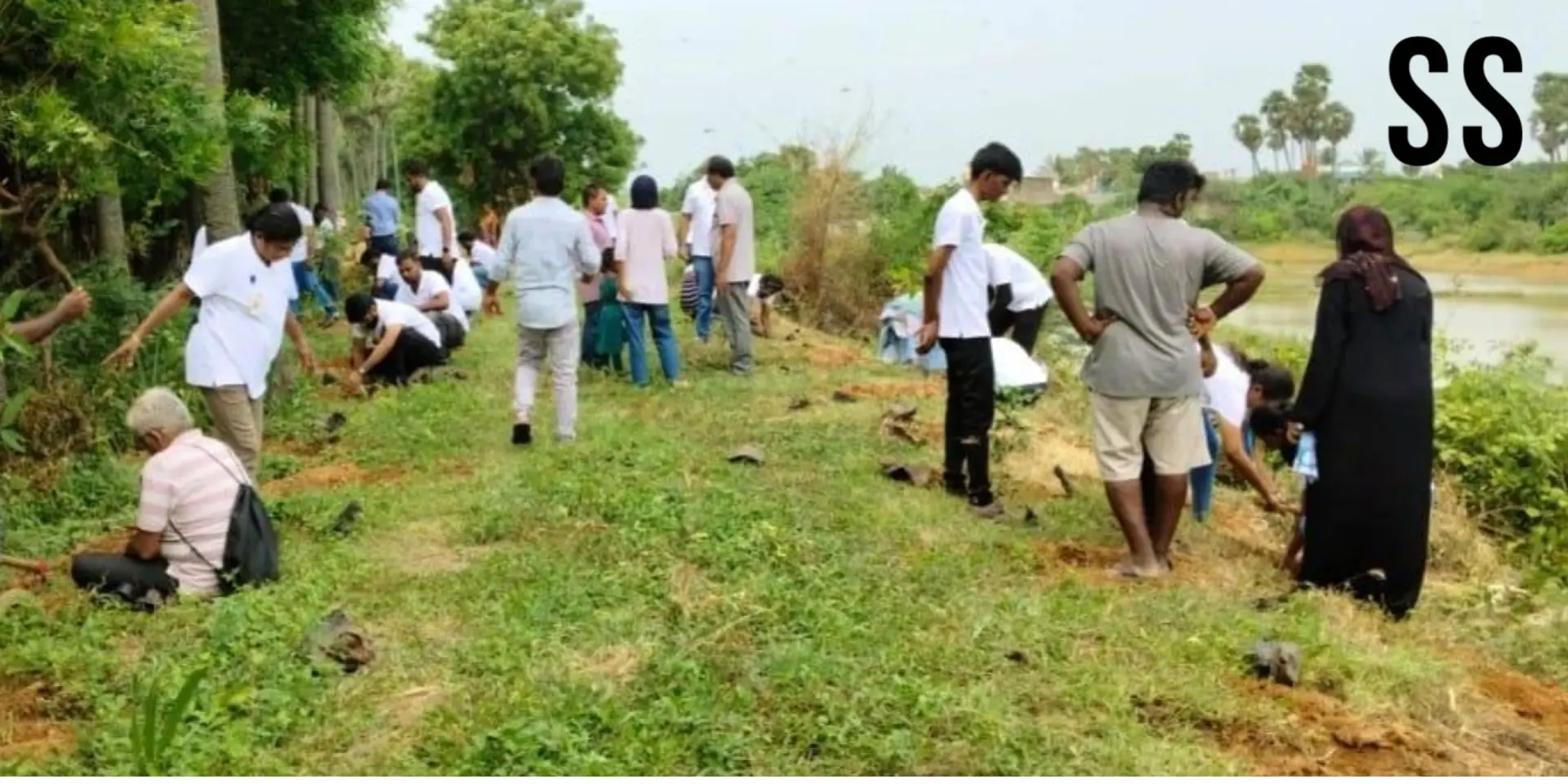

In Upparapalayam, on the outskirts of Chennai, Nagan Thangal Lake sits at the centre of a landscape that has undergone rapid change over the past decade. Once a dependable water source, the lake had become heavily silted, intermittently dry and covered with encroachment and waste. For residents who were dependent on borewells, its decline has meant reduced access to water for agriculture and daily life.
Tamil Nadu’s accelerating water stress has made such stories increasingly common. A 2023 IIT Madras study found that peri-urban Chennai is among the state’s worst-affected zones for groundwater depletion, with small lakes and tanks—once key buffers—losing much of their storage and infiltration capacity.
Against this backdrop, the restoration of Nagan Thangal Lake began in 2022 as a partnership between Pitchandikulam Forest, an Auroville-based ecological restoration collective, and Tata Communications through Project Nanneer, an ecological restoration programme. The organisations worked with the local panchayat to revive the lake using science-based methods. “We recognised early that this would require a solution grounded in the landscape’s hydrology, not surface-level beautification,” Mukul Kumar, Vice President of Sustainability at Tata Communications, tells Social Story.
Pitchandikulam Forest, which has spent decades restoring wetlands and coastal ecosystems in Tamil Nadu, emphasised a community-centred approach from the very beginning. According to their field team, who conducted wetland learning sessions with students from a local school, the lake had to be brought back “as a living system, not just a water container”, with native vegetation, micro-habitats and accessible space for community use. Their field notes describe children identifying wetland plants, observing migratory birds and learning about the role of tanks and lakes in the region’s water cycles. These activities are designed to build long-term care for the site.
Much of the physical work followed recommendations from a geo-hydrological assessment by the Watershed Organisation Trust Centre for Resilience Studies (W-CReS). Around four acres of the lakebed were desilted to a depth of 1.5 metres, increasing capacity and restoring natural gradients. Soil excavated from the bed was reused to create mounds, islands and walking tracks. More than 4,000 native trees and shrubs, including neem, pungam, palmyra and wetland grasses, were planted for their ecological relevance. Pitchandikulam Forest’s team notes that early re-vegetation plays a key role in stabilising bunds, reducing erosion and improving habitat conditions.
For Tata Communications, the focus was on building a community-driven model rather than a one-time intervention. “We wanted to address the root hydrology and work closely with the community so the lake could sustain itself over time,” says Kumar. He adds that collaboration with panchayat leaders, residents and government officials was essential to the project’s implementation.
Post-restoration findings from W-CReS indicate measurable improvements. Water storage capacity has risen from 2.6 million to 8.5 million litres, the infiltration rate at the lakebed has reached 42.1 mm/hr, suggesting stronger groundwater recharge, and the water spread area has expanded, holding water for longer through the year. A biodiversity survey documented 14 fish species, 56 bird species and 33 butterfly species.
Pitchandikulam Forest staff monitoring the site report sightings of Whiskered Terns and Black-crowned Night Herons, which are birds that commonly avoid degraded wetlands. They attribute their return to improved water retention and native planting.
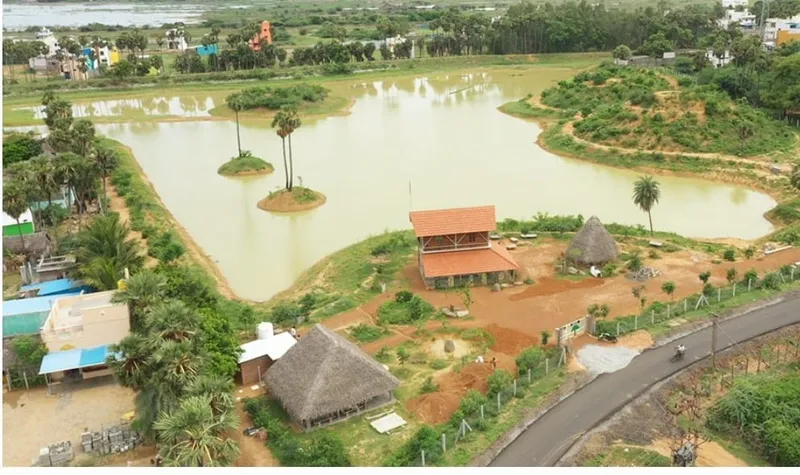
Water storage capacity has risen, the infiltration rate at the lakebed suggests stronger groundwater recharge, and the water spread area has expanded, holding water for longer through the year.
Alongside ecological recovery, solid community infrastructure has been developed around the lake. A multipurpose learning centre built on site, shaped through consultations with residents, now hosts school sessions, SHG meetings, environmental workshops and evening study groups. Residents also use the space for nature walks, rituals and cattle fodder collection. Kumar notes that these co-designed spaces are “critical for embedding collective ownership into the project”.
The restoration has also highlighted ongoing challenges. According to the W-CReS assessment, traces of microbiological contamination remain at low to moderate levels, and the built-up area in the surrounding catchment has increased by around 86%, which can affect runoff patterns and water quality.
Pitchandikulam Forest’s field team has pointed to similar issues in their wetland sessions, emphasising that catchment conditions and upstream pressures continue to influence the long-term health of restored lakes.
Recent studies by ATREE and IIT Madras say that lake restorations succeed only when paired with long-term monitoring, community governance and protection of feeder channels and catchments. Interventions that focus solely on the lakebed tend to offer short-lived results.
Recognising this, the Nagan Thangal project has built a monitoring plan that gradually transitions responsibility to local governance systems. Panchayat officials, community volunteers and school groups are being trained to track water levels, species observations and basic water-quality parameters. During monsoon periods, the Disaster Management Authority collaborates with the panchayat on coordinated flood-response measures at the site.
Revivals like those of Nagan Thangal Lake are not a singular solution to Tamil Nadu’s water crisis, but show the benefits of restoration grounded in hydrology, ecological science and community participation.
As Kumar put it, “Our aim is that communities feel empowered to take care of these ecosystems long after the initial restoration work is complete.”
Edited by Jyoti Narayan