


How two architects rebuilt sanitation and safety in a tribal school
In the forests of Jawadhu Hills, a low-cost, eco-friendly sanitation solution is giving tribal school children safety, dignity and access to uninterrupted education.

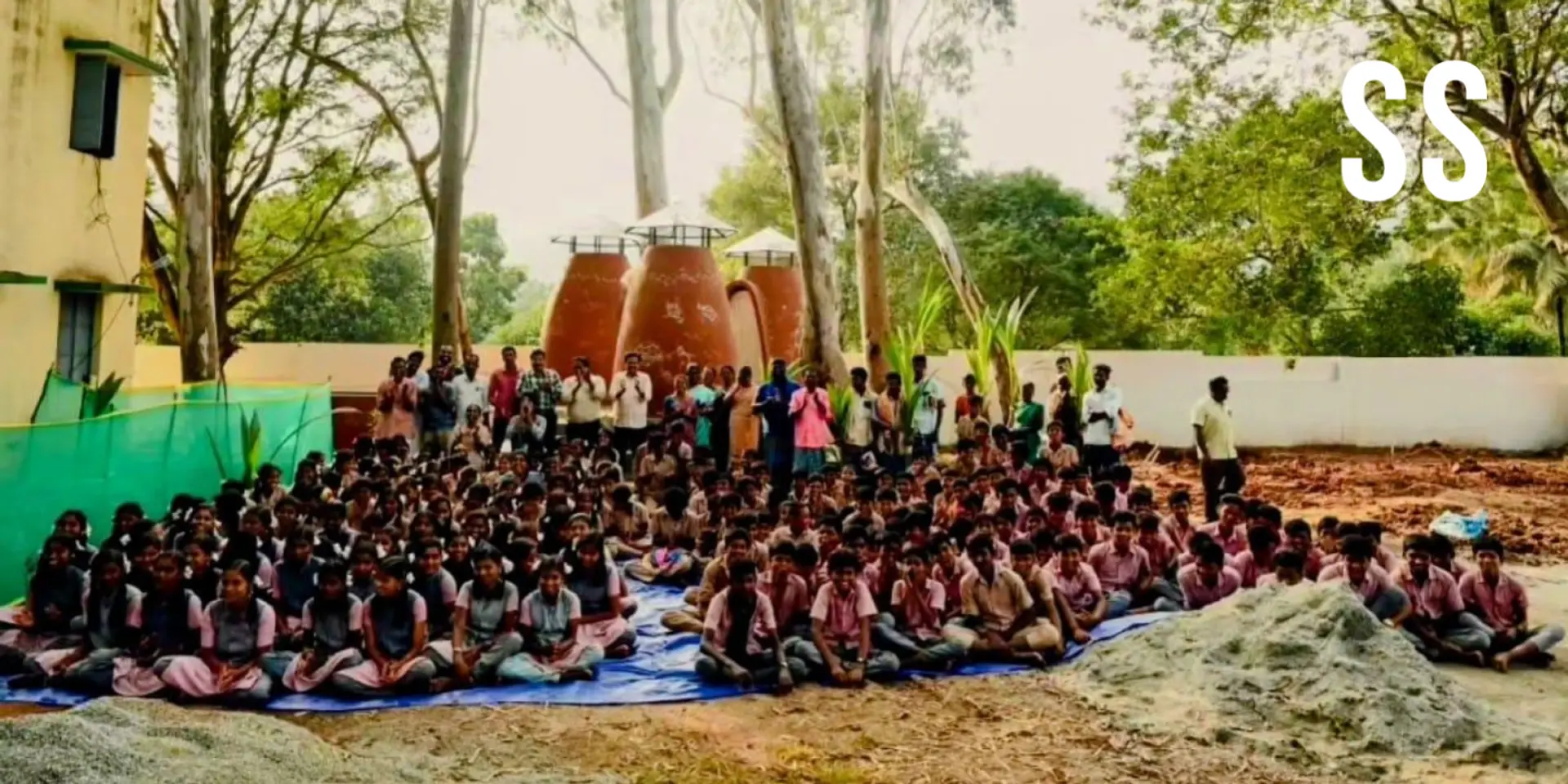

Around 2021, documentary filmmaker Vishnupriya was working on a sanitation project in rural Tamil Nadu when she came across two tribal schools on the forested slopes of the Jawadhu Hills, where children were forced to relieve themselves in the open.
During the monsoon months, with paths rendered unsafe and inaccessible, students would hold in their urine and stool for hours at a time, leading to urinary tract infections, severe constipation, abdominal pain and bloating. In one village, the duo learnt that a child had even lost their life due to serious health complications linked to prolonged toilet deprivation.
This was the reality in Nellivasal village, a tribal settlement in the Tirupathur district, where children grew up without access to toilets. At night, the children hosted at the boarding school hostel would venture out into the darkness to relieve themselves in the bushes, while others resorted to the corners of campus walls, creating a stench that permeated the hostel and dining area.
Vishnupriya then reached out to fellow architect and friend, Barnala Michael from Hosur, and the duo decided to act.
“Open defecation was a crisis that affected safety, health, and the dignity of students who had travelled miles from their villages for education,” says Michael.
While documenting waste management solutions through the work on her film, ‘Meel’, Vishnupriya, along with Michael, began envisioning building low-cost, eco-friendly toilets for the Nellivasal schools. There were close to 80 children from two schools who depended on the hostel. Efforts by the school administration to secure government funding had been unsuccessful.
So, we decided to get the project crowd-funded,” says Michael.
“There were some obvious problems that came with the location. The terrain was part of the Reserve Forest area, and transporting materials and labour was difficult. So, we sought permission from the forest department to build on site and set about designing an approach that was both affordable and sustainable,” he adds.
The team decided that instead of conventional rectangular cubicles, they opted for oval structures that “looked closest” to the kind of environment that the kids were familiar with and grew up in. “Spending time with the community, we knew the children who grew up with no toilets and defecating in the open forests would struggle to suddenly start using a conventional toilet,” says Michael. “So we decided to build toilets that were single structures - like a dome,” he adds.
To keep costs low, the team used ferrocement, a technique that involves applying cement over a mesh of chicken wire, resulting in a durable structure with less labour intensity. Translucent polycarbonate sheets were incorporated into the sunroof to allow soft natural light inside, reducing the sense of confinement for the kids while ensuring privacy.
The toilets were made with two connected pits in which solid waste could dehydrate and decompose gradually while water drained away through porous pit walls.
In all, the team constructed three toilets and an open bathing area at a total cost of Rs 2.5 lakh, which Michael says is at least 30% less than traditional building methods would have required. They also had to complete the project within one month - a period that the forest department had allotted to them. .
The structures were unveiled in November 2023, and the impact was immediate. Hostellers who once feared nighttime trips to the bush could now use safe, clean toilet facilities at any hour. This improved not just health outcomes but also attendance, punctuality, and overall well-being at the school.
The conditions at Nellivasal are not an exception. While government programmes such as Swachh Bharat and Swachh Vidyalaya have significantly expanded toilet coverage in schools over the past decade, official datasets like Unified District Information System for Education primarily track the presence of facilities, not whether they are functional, accessible, or safe to use.
Multiple studies by UNICEF India and education researchers have noted that in remote and forested regions, toilets often remain unusable due to water scarcity, poor maintenance, and lack of funds for upkeep. These breakdowns disproportionately affect residential schools, where children have no alternative sanitation access, showing how poor toilets lead to illness, missed school days, and distress.
For Michael and Vishnupriya, the hope is that this model spreads to other rural schools where sanitation remains a barrier to health and learning. “We hope to inspire architects, engineers, school teachers, and government officials to provide dignity to our students, protect the environment, and embrace sustainability,” says Michael.
Edited by Jyoti Narayan