


Alok Menon on comedy, collapse, and queer survival
In a moment marked by political backlash and collective exhaustion, trans comedian and performer Alok Menon is touring not to offer escape, but to ask harder questions about how we stay alive together.

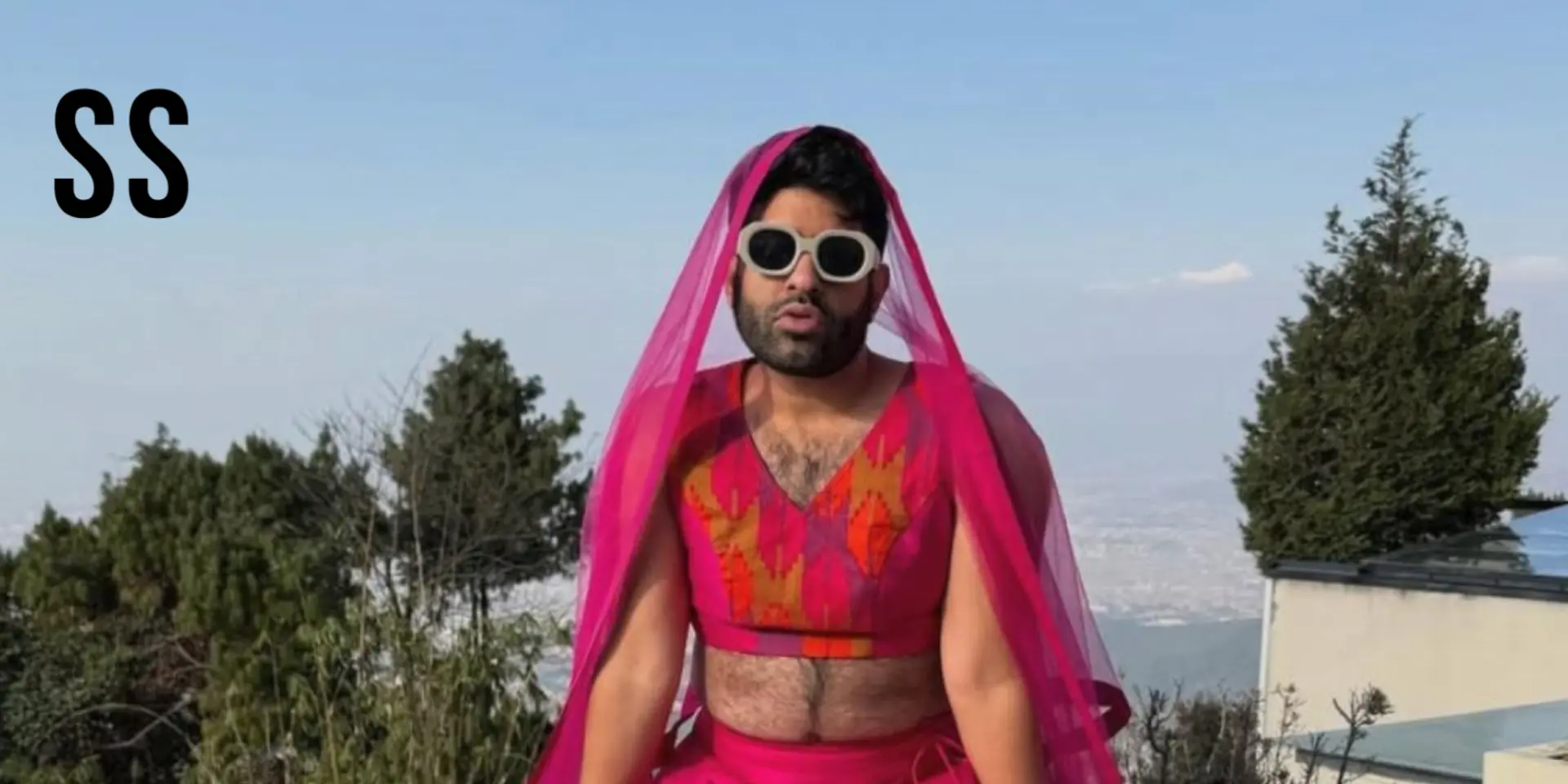

Trans comedian and performer Alok Menon has been moving around a lot lately. Currently in India, and less than a day after landing in Mumbai, we get on FaceTime to talk about collapsing political promises, queer survival, collective grief, and why laughter feels strangely indispensable at the end of the world.
Tired, jet-lagged but undeterred, Menon gets straight to the point of what’s driving them to tour: “Shit has really hit the fan.”
Their fatigue stems less from travel miles and more from the intensifying hostility toward queer and trans lives across the United States and the world. What once felt like a slow, uneven movement toward safety, they say, has now reversed into a free fall, ”a collective PTSD,” where the floor beneath queer communities feels caved in.
Menon’s politics has stood out for its insistence on joy and the use of humour as a disciplined, political practice rather than a coping mechanism. They are clear that joy, in times like these, isn’t something granted by better conditions or kinder governments; “it has to be fought for internally, protected like a diya against collapse.”
“Even now—especially now—I feel galvanised to bring art into rooms across the world, not to deny what’s breaking, but to teach people another way of showing up,” they say.
For these reasons and more, Menon has never considered comedy as just a job; they’ve built a body of work across poetry, performance, and humour that acts as a serious form of cultural intervention.
“Comedy is how I stand up in a world that degrades me,” they say. This awareness comes from years of being targeted, othered, and forced to build resilience outside systems of protection.
Born to Indian parents and raised in Texas, Menon grew up inside the contradictions of the immigrant promise. Sadness had no sanctioned place, because to be unhappy meant to undermine the entire logic of migration—opportunity, success, gratitude. Mental health was imagined as something the family simply did not have, and pain felt like an affront; a burden imposed on others.
“It took me years to learn how to be sad, and longer still to claim sadness as something that could belong to me,” they say.
They trace their own capacity to hold this tension back to being non-binary. Being non-binary dismantled binaries altogether for Menon. “One of the joys of being non-binary is that I inherited a culture that taught me there were only two things—man and woman; us and them—and that those things were opposed. Because when I unlearned that, I began to revisit every single binary we were taught in our culture; not just gender, but joy and sorrow as well.”
“Being non-binary showed me that emotions aren’t separate lanes; they’re baked into each other. Like cocktails. Happiness carries the knowledge of its own finiteness; sadness contains the possibility of release. Comedy—especially dark comedy—becomes the form that allows these contradictions to coexist without denial,” they say.
The prevailing social, economic and political structure today, which rewards emotional distance and efficiency, has begun to betray even those who once believed they could remain numb, asserts Menon. The old bargains—work hard, build a family, stay apolitical, and you will be safe—are no longer delivering security, and the collective search for deeper forms of safety can no longer be outsourced to governments, markets, or algorithms.
For Menon, this is where friendship enters the frame as a radical political force.
They have been outspoken in their pursuit of love and chosen family—especially in South Asian contexts, where the biological family is not only perceived as emotional, economic and social survival, but for many queer and trans people, it is also the first site of harm. Menon remembers being told as a child, “Why do you need friends? You have us.” Friendship was treated as a threat to the family unit.
But their aunt, noted Indian-American LGBT rights activist, lawyer, and writer Urvashi Vaid, who identified as a lesbian, often brought her closest friends—her chosen family—into every family gathering. These friends supported her, helped build her life, and protected her from getting shamed. To Menon, they showed “another way to organise love.
And like her, Menon says, queer communities have learned—through necessity—how to love without qualification. That knowledge, they believe, does not belong only to queer people. “It is something the world urgently needs to learn. Trauma makes people brittle. It turns us antagonistic, armoured, and causes us to replicate harm.”
“Humour, by contrast, loosens that armour,” they say. “On stage, laughter becomes contagious; strangers become a crowd, and the crowd becomes something like a temporary family.”
Menon says many of their most resonant performances have been in places where audiences understood very little English. “What carried us was not words but energy—gesture, timing, eye contact, rhythm. Oh, and also hugs, jokes, dancing!”
This is also why Menon is deeply sceptical of algorithmic healing. Social media mistakes representation for reality and optimisation for growth. “Live art matters because it brings bodies together in real time, asking them to practise being human collectively.”
Menon knows first-hand how many trans people are forced early on to accept that the world may never love them. That confrontation strips away people-pleasing and opens space for self-definition. “Authenticity over safety,” they insist. “It is a brutal choice—and one that becomes survivable only through collective force and community.”
After years of loneliness—of moving through the world without protection, affirmation, or mirrors that reflected them back—visibility and recognition can feel intoxicating. To be seen, finally, to be believed, to have rooms full of people say ‘we know you’, is no small thing. And yet, Menon is acutely aware of how quickly that validation hardens into projection.
They speak openly about therapy and the slow work of learning boundaries—of untangling love from deification, especially in South Asian cultures where worth is often expressed by turning people into symbols or saviours.
“Real love allows for contradiction, ordinariness, rest. Sustainability, not martyrdom, is what makes it possible to keep showing up.”
When Menon returns to India, what moves them the most is not the political despair, but the rooms and the crowds. “The rainbow hair, piercings, tears, laughter, it’s just wonderful!”
In a world coming apart, Menon offers hope not as a demand but as a practice: “learn how to feel, learn how to love, learn how to be friends.
“And please, learn to look up from your phone and into people’s eyes more often. You’ll know then we are more common than we are apart.”
Menon is in India from January 9 to 18, for performances in Mumbai, Hyderabad, Goa, Kochi, Jaipur, Bengaluru, Kolkata and New Delhi.
Edited by Jyoti Narayan