



Where clean energy meets rural livelihoods
Through its Powering Livelihoods programme, Delhi-based think tank CEEW focuses on decentralised renewable solutions that directly support income-generating activities for farmers, women’s collectives, and micro-entrepreneurs.

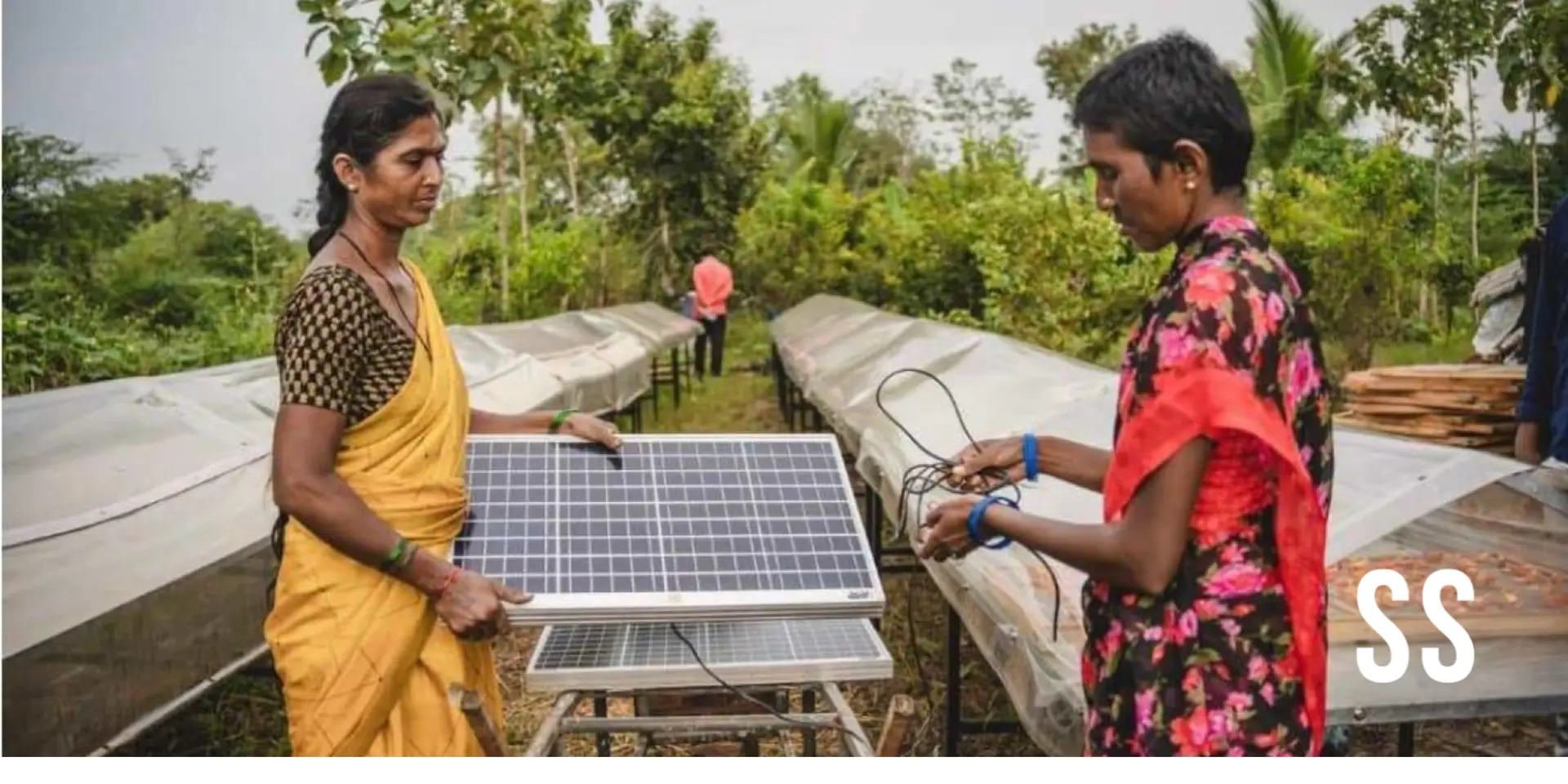

In rural India, where clean energy is frequently discussed in the context of large solar parks and grid-connected renewable infrastructure, the Council on Energy, Environment and Water (CEEW) is charting a different course.
The think tank’s goal is to create decentralised solutions that can power livelihoods and support income-generating activities at the local level.
Titled ‘Powering Livelihoods’, the programme focuses on renewable-powered technologies that directly support income-generating activities for farmers, women’s collectives, and micro-entrepreneurs. Led by CEEW in partnership with social enterprise incubator Villgro, the initiative works to scale decentralised renewable energy (DRE) solutions such as solar cold storages, dryers, hydroponic fodder units, and smart pumps across rural India.
CEEW plays a research, ecosystem-building, and policy-shaping role, while working with grassroots partners to drive on-ground adoption. Through collaborations such as the SURE Sakhi Network, rural women are trained as local promoters and entrepreneurs of clean energy technologies.
Launched in December 2024, the partnership equips ‘Sakhis’ with product knowledge, marketing skills, and lead-generation training to raise awareness, support adoption, and build green enterprises within their communities.
“At its core, we are looking at any kind of renewable energy technology - solar, micro-hydro or small wind, deployed at a small scale,” says Abhishek Jain, Director, Green Economy and Impact Innovations at CEEW. “Typically, these systems are in kilowatts, not megawatts. And when you use these small-scale renewables to power livelihood activities, that becomes a decentralised solution for livelihoods,” he adds.
These technologies range from solar-powered irrigation pumps and rice mills to food processing units, silk reeling machines, solar dryers, refrigeration units, and hydroponic fodder systems. The focus is not just on renewable energy, but also on energy efficiency, says Jain, so that these solutions are economically viable too.
“If the machine is not energy efficient, you end up needing a much larger solar panel and battery system, which makes the cost not as viable,” he explains. “So the more efficient the equipment is, the overall renewable power solution becomes more cost-effective.”
An example to illustrate this is a rice milling machine redesigned to run on a three-horsepower motor instead of a ten-horsepower one. This machine, says Jain, can deliver the same output while requiring far smaller solar infrastructure. The result is lower capital cost, easier adoption, and better affordability for rural users.
Scaling beyond awareness
While the technologies themselves are increasingly robust, scaling them is a challenge because of awareness, financing, and trust.
“One of the biggest challenges with scaling these solutions is awareness among the end customer,” says Jain. “Most of these solutions are developed by small and medium enterprises and startups. They don’t have the capital to do large-scale marketing.”
Outside of government-backed solar pump schemes, many rural users remain unaware that clean energy can run processing machinery, cold storage, or value-addition equipment.
Even where awareness exists, financing remains a major barrier according to Jain. These technologies can cost anywhere between Rs 15,000 and Rs 15 lakh, depending on the application and capacity.
“Even a Rs 15,000 outlay is not something most users would be sitting on,” says Jain.
Beyond money, what matters is also confidence. These are not everyday consumer products. “People want to speak to an existing user. They want to see the technology in action,” he says. “So, in a way, we are selling the concept, yes, but we are also selling confidence.”
CEEW has tried to address this by working on multiple fronts: building awareness among end-users, sensitising financial institutions to assess returns on these technologies, and creating peer-to-peer demonstration models through the Powering Livelihoods programme.
Financing models that work for women
Women make up a significant share of CEEW’s Powering Livelihoods programme. Of the roughly 40,000 users currently engaged with clean energy livelihood technologies, about half of them are women, says Jain. In many cases, these women are not just nominal beneficiaries but the primary users of the technologies - from silk reeling machines to solar dryers - carrying out day-to-day economic activity themselves.
For women, especially those organised into self-help groups (SHGs), collective financing has emerged as one of the most effective pathways to adoption. If women are part of self-help groups, the groups can facilitate loans. “It could be group adoption or individual adoption, and the loans are at very attractive interest rates,” Jain explains.
Powering Livelihoods has also partnered with peer-to-peer lending platforms such as Rang De, where loans can be unlocked “in a matter of hours,” often at interest rates between 4% and 8%, depending on the product and location. At the institutional level, the programme is engaging with the National Bank for Agriculture and Rural Development (NABARD) and regional rural banks to sensitise managers to extend credit for clean energy livelihood technologies.
Group-based lending models, particularly through SHGs and farmer producer organisations, have made financing easier by spreading risk and building collective confidence among borrowers.
For women, the additional income coming from the use of these technologies is often used in education, healthcare, nutrition, household needs, and sometimes reinvestment in businesses.
CEEW does not directly select beneficiaries. Instead, it works with technology manufacturers, financiers, and distribution partners who have on-ground presence. Most of the actual adoption is largely self-driven.
“The intent and the demand have to come from the ground. We don’t push it on anyone,” he adds.
If they face any resistance to adoption of these technologies, they mostly come from practical concerns. “In one case, high humidity led to fungus in a hydroponic unit,” recalls Jain. “If someone sees that, it can create hesitation, even though thousands of units are working fine elsewhere.”
Another big challenge is building long-term service networks in rural regions, where, unlike consumer goods, these livelihood technologies are not used in every household.
“You might have two rice milling machines in a village, not one per household. So it’s not cost-effective for each company to run its own service network,” says Jain.
CEEW advocates for a shared service ecosystem where the same technicians can support equipment from multiple manufacturers. This “platformised” approach makes maintenance viable across scattered deployments.
Standard tech, local settings
While the technologies themselves can remain standardised, their usage must adapt to local contexts. A solar refrigerator, for instance, can serve a kirana store, a dairy outlet, a fishing community, or a vaccine storage unit. “The technology is the same, but the temperature settings, battery size, and backup needs change depending on the application.
Similarly, hydroponic fodder systems work across cattle, buffalo, and horses, but tray requirements vary. Solar dryers can process everything from moringa and rose petals to tomatoes, jasmine, and okra, but drying time differs drastically depending on moisture content.
“That’s where training and capacity building come in,” says Jain. “The products don’t change much. The settings and usage do.”
Sectors seeing strong traction
Some technologies have gained particularly strong ground-level adoption.
Solar silk reeling machines have seen success in eastern and northeastern India, often with support from state governments and tribal development departments. Solar dryers are gaining traction due to India’s high levels of food loss and waste, especially for perishable produce.
Solar-powered pesticide sprayers, animal deterrent systems using programmed LED lights, and hydroponic fodder units are seeing growing demand in regions affected by wildlife conflict and fodder shortages. Solar refrigerators are popular in fishery belts, roadside eateries, and kirana stores.
CEEW places strong emphasis on collecting primary data to assess whether these technologies actually improve livelihoods. They have done two rounds of studies with about 1,500 users. “We look at their income before adoption and then nine to twelve months after.”
Across technologies, CEEW has observed an average income increase of at least 35%. “Many users have moved from sub-Rs1 lakh income brackets into higher tiers.”
The pathways to these higher incomes have been varied. Solar pumps reduce diesel costs and enable additional cropping cycles; solar dryers prevent distress sales and improve bargaining power; refrigeration helps fishers avoid spoilage and eliminate daily ice procurement costs.
Also, not every deployment succeeds. In Bihar, for example, silk reeling machines could not be used during cocoon shortages. CEEW tracks these cases as well to understand contextual risks.
Policy gaps in supporting green livelihoods
While government schemes exist to support rural technology adoption, Jain says that they may not sufficiently prioritise renewable-powered solutions.
“The Agriculture Infrastructure Fund supports post-harvest technologies, but there’s no distinction between solar-run and regular solutions,” he says. The same applies to the Pradhan Mantri Formalisation of Micro Food Processing Enterprises scheme for micro food processors.
CEEW has been advocating for additional incentives such as higher capital subsidies or better interest subvention, specifically for green technologies. However, institutions often work in silos, which can pose challenges.
“The Ministry of New and Renewable Energy is not a livelihood ministry, for instance,” says Jain. “So it becomes hard for them to extend support.” He suggests a convergence between the Ministry of New and Renewable Energy and ministries like Agriculture, Rural Development, and Food Processing to make existing schemes for renewable deployments more powerful.
A decentralised transition
CEEW’s Powering Livelihoods programme is built on ana energy transition that is local, practical, and shaped by everyday realities.
The promise is clear, says Jain,; that decentralised clean energy can raise incomes, reduce vulnerability, and strengthen rural resilience. But the path is not without challenges. Awareness gaps, financing barriers, service infrastructure, policy alignment, and gendered power dynamics continue to shape who benefits, and how.
As Jain puts it, scaling this transition is not just about technology. “You need awareness, you need confidence, and you need financing.”
Edited by Jyoti Narayan