



In Erode’s hills, a solar mill is helping tribal farmers reclaim millet
In hilly regions in Tamil Nadu where electricity is scarce, and millets have long been grown only for survival, a solar-powered mill is reshaping how tribal farmers earn from their crops.

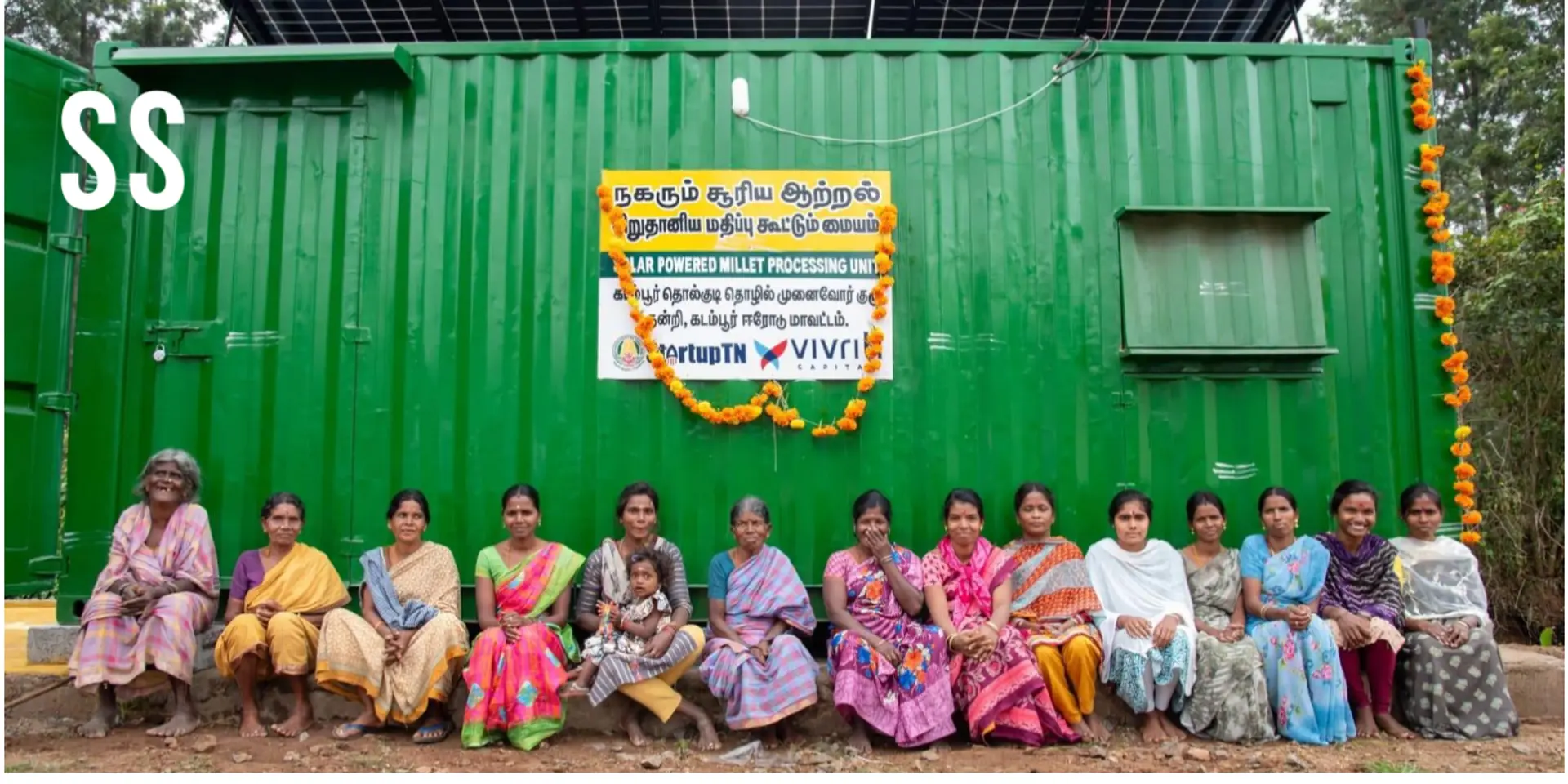

On most days, sunlight is the only reliable power source in Kunri, a small tribal village near Kadambur in Tamil Nadu’s Erode district. In the hilly landscape close to the Sathyamangalam Tiger Reserve, electricity has long been patchy or doesn’t exist at all. For generations, tribal families consumed mostly millets, which grew well on these terrains, but never had a chance to make a livelihood out of these crops.
Today, a solar-powered solution is changing their lives.
A Rs 23.5-lakh solar-powered millet processing centre, launched in December in Kunri, is changing how tribal farmers engage with their harvests. Designed and set up by Oscar Solar Pump, the unit has a metal container fitted with solar panels and machines that clean, destone, dry, and mill ragi and thinai. This has allowed the farmers to process millets locally instead of travelling long distances or selling raw grain at distress prices.
“In these hill regions, millets are not a choice crop; they are the only crop,” says Venugopal, founder of Oscar Solar Pump. “You can’t run diesel engines here easily. There is no consistent electricity. But millets grow well, even in forest and mountain belts.”
Until recently, farmers in and around Kunri had little option but to travel up to 25 kilometres to grind their produce, often spending an entire day and at least Rs 100 on transport alone. Many chose instead to sell unprocessed millets locally for as little as Rs 28–30 per kg, losing out on the value that cleaning, milling, or converting grain into flour could bring.
Processing millets by hand was equally punishing. “If it’s 10 kilos of millets, at least two or three people are needed, and a sack could take days,” says Venugopal.
The new centre compresses that same labour into hours. It houses three solar-powered machines—one for removing dust and debris, another for separating stones and impurities, and a 10 HP milling machine—along with a solar dryer that becomes critical during the monsoon. Together, the unit can process 250–300 kg of millets a day. This kind of work took three to five days of manual effort previously.
What’s important is that the system runs without batteries, relying on direct solar energy. “Batteries increase cost and maintenance. In remote areas, that’s a burden,” Venugopal explains. A small diesel generator is used only as an emergency backup during extended low-sunlight periods.
Besides the Kunri unit, four smaller solar milling machines have also been installed in the nearby villages of Makkampalayam, Kuttaiyur, Andiyur, and Agnipavi—each capable of processing around 50 kg a day. Together, the network now serves more than 1,100 tribal families farming roughly 700–800 acres of millet land.
Venugopal’s aim is not just efficiency, but value retention. “If millets sell raw for Rs 28, cleaned grain can sell for Rs 35–38,” he says. “If it goes to a trader, it can fetch Rs 60 or Rs 65. As flour, it can even reach Rs 100.”
So far, most farmers have used the machines to sell cleaned grain or flour. The next step is value-added production, led largely by women. Training is now underway for making traditional products such as ragi and thinai laddus, sweetened with jaggery, some of which are already being sold locally.
A 14-member local team helps source grain, prepare dough, and manage processing. “Earlier, many women either stayed at home or went into forest labour,” Venugopal says. “Now we are creating a platform where they can work locally, with support.”
Venugopal’s own journey shapes the project. He grew up in Kandikkattu Valasu, studied till Class 10, completed an ITI diploma in electrical work, and spent nearly a decade designing solar devices for farmers. A turning point came when he helped a relative replace an expensive diesel pump with a solar one. “That’s when I saw how much money could be saved and how much stress could be reduced,” he says.
Alongside his company, he also founded Thazhal, a social welfare collective that brings together students, activists, volunteers, and tribal community members to work on local development.
The Kunri centre was supported by StartupTN, Tamil Nadu’s government innovation initiative, and funded through CSR support from Vivriti Capital. Encouraged by early results, Venugopal says the Tamil Nadu Tribal Welfare Department has begun piloting similar models in five districts and 13 locations.
For Venugopal, the larger goal is self-sustenance. He says, “If farmers can process what they grow, eat what they cultivate, and earn a fair price, the community survives. Agriculture has to work locally for local livelihoods, for dignity, and for the future.”
Edited by Jyoti Narayan