



In Chennai’s Buckingham Canal, a floating barrier tests how plastic can be stopped before the sea
A floating trash barrier installed by Kabadiwalla Connect in Chennai’s Buckingham Canal aims to stop plastic waste before it reaches the Bay of Bengal. The pilot links informal waste labour in India with rising demand for recycled plastic in Europe.

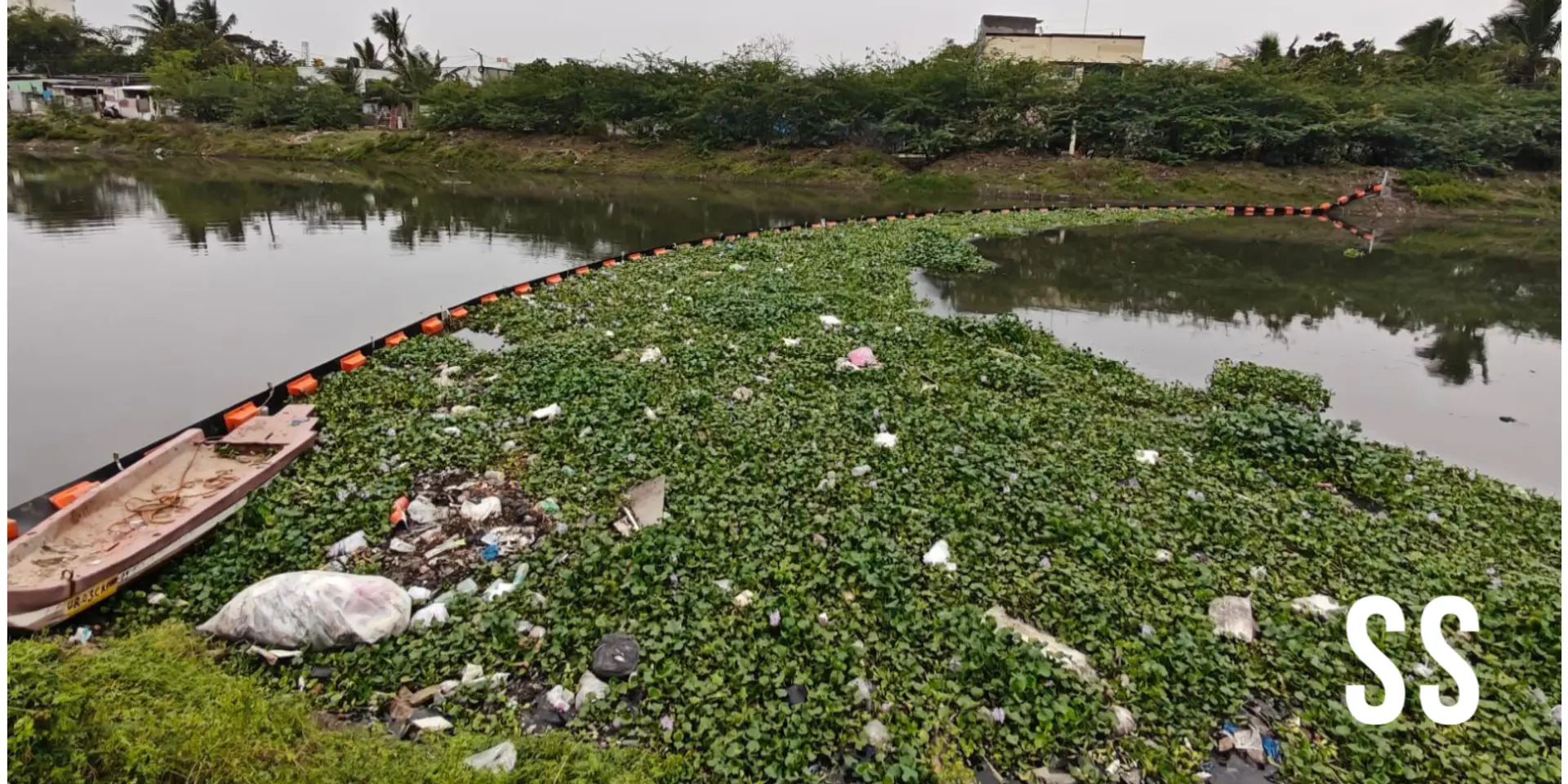

On a stretch of the Buckingham Canal in Vettuvankeni on Chennai’s East Coast Road, a floating line of rubber and plastic now interrupts the daily drift of waste towards the sea. The 60-metre trash barrier, made by Bengaluru-based environmental solutions company Enviro Guard and installed by Chennai-based waste management company, Kabadiwalla Connect earlier this year, is designed to do what seems deceptively simple: stop floating plastic before it reaches the Bay of Bengal.
But behind its seemingly simple infrastructure lies a complex experiment that combines recycled plastics for European markets with the labour of informal waste workers in Chennai.
The barrier is part of ‘From Beach to Bin Bags’, a pilot project under the Danish Green Business Partnerships (DGBP) programme, supported by Danida, Denmark’s development aid agency.
Kabadiwalla Connect, which leads the project, works with informal waste pickers and scrap dealers, along with Ocean Plastic Forum (OPF), a Copenhagen-based non-profit that brings together companies and policymakers to reduce ocean plastic pollution; and GLECO, a European company that makes large industrial bags and is testing whether recycled plastic from India can be used in its products to meet new regulations.
“The barrier is symbolic in some ways,” says Siddharth Hande, Founder of Kabadiwalla Connect. “But the real commercial goal of the project is to test whether we can move 20 tonnes of post-consumer rigid polypropylene from India’s informal sector into a European manufacturing supply chain.”
The European Union’s Packaging and Packaging Waste Regulation (PPWR), which replaces older packaging rules, sets legally binding targets for how much post-consumer recycled plastic must be used in plastic packaging placed on the EU market. Under the PPWR, many types of plastic packaging must contain a minimum percentage of recycled content, around 30%, by 2030.
The regulation entered into force in early 2025, and most of its requirements, including recycled content targets, will begin applying in the lead-up to 2030.
The new rules require some plastic products to be made using at least 30% recycled material. These rules have increased the demand for recycled plastics that can be properly tracked and verified. Under this pilot, plastic collected from the barrier and from waste pickers and scrap shops will be processed in India and then used by GLECO to make industrial bags.
The barrier, installed at a cost of Rs 8-10 lakh, works by catching waste that floats on the surface of the water. It does not clean the water, treat sewage, or collect plastic that is submerged below the surface. “It’s essentially a trash boom,” says Hande. “It captures floating particulate waste; whatever comes on the surface.”
Within the first week of operation, the barrier trapped an estimated five to six tonnes of material, most of it water hyacinth, an invasive species fuelled by sewage and nutrient-rich flows. While the hyacinth shows the canal’s broader ecological distress, it also highlights the limits of interception-based solutions.
“Sewage is not being collected in any meaningful way through this barrier. This doesn’t solve upstream dumping or discharge. It only deals with what’s floating,” says Hande.
Ganga Sridhar, a member of the Mandaveli Raja Street Residents’ Welfare Association and co-founder of Eco Connectors Trust, says the barrier addresses the problem only after plastic has already entered the waterbody. “We are working at the source level—trying to stop plastic itself from entering water bodies,” she says. “This barrier is what happens after everything has already landed there.”
Sridhar, who lives about 10 km away from Vettuvankeni in another south Chennai neighbourhood of Mandaveli, has worked closely with Kabadiwalla Connect on waste segregation and plastic collection initiatives for nearly a decade, traces the crisis back to Chennai’s flooding history.
“One of the main reasons Chennai flooded in 2015 was plastic,” she says. “When stormwater drains were opened, they were clogged with plastic packets. Every time it rained, drains got blocked because waste from nearby bins flowed straight into them.”
She says that while the city has made progress—particularly among middle- and upper-middle-class neighbourhoods—segregation and awareness remain weak in communities living along the Buckingham Canal.
“We’ve evolved to a point where people talk about segregated, door-to-door collection. But the residents who live right next to the canal often don’t have that awareness. There are slums on one side and waste mountains on both sides of the canal.”
She acknowledges the value of the intervention, particularly in preventing plastic from breaking down into microplastics and entering the marine food chain. “All of this plastic eventually becomes microplastic. It comes back to us—through fish, through water, through the environment.”
Sridhar also highlights how the barrier project involves local waste pickers, scrap dealers, and even fisherfolk. “When I visited, I saw local fishermen and waste pickers collecting plastic from the barrier, wearing proper safety gear. A local recycler was sorting polypropylene and sending it for recycling. That’s how employment is generated locally, and that’s how people begin to take ownership.”
She believes that such involvement can itself become a form of awareness. “When people see how much plastic is being pulled out every day, they start asking: why should this even be entering the canal? That’s when the conversation shifts back to stopping it at source.”
The barrier is not permanent infrastructure. It is instead anchored using simple rods. It rises and falls with water levels and can be removed or redeployed if needed, including during extreme weather events. The team had to obtain permissions from the Water Resources Department, which vetted specifications and materials as part of the approval process.
Rather than relying on municipal contractors or large waste management firms, Kabadiwalla Connect has built a decentralised collection model anchored in the informal sector. “Collection is the part that usually fails with barriers,” Hande says. “You’ll see installations abandoned because no one is responsible for clearing them.”
Under this pilot, Kabadiwalla Connect manages waste removal from the barrier, working closely with a nearby scrap shop and waste pickers from its existing network. Two waste pickers are currently employed on monthly salaries to service the barrier, with plans to scale up to four or five as the project progresses. Across the wider supply chain, around 50 waste pickers are involved, along with five scrap shops being upgraded to meet compliance and safety protocols.
Workers receive health and safety gear and are enrolled under the Chief Minister’s Comprehensive Health Insurance Scheme. The project also involves training, formalised data collection, and integration with an informal material recovery facility capable of sorting and baling rigid polypropylene.
This decentralised approach, says Hande, is both cheaper and more scalable in Indian cities. “Instead of working with large formal contractors—which is expensive and slow—we’re showing that you can work with a local scrap shop and waste pickers close to the barrier location.”
The project’s focus on clear responsibility for waste collection has attracted interest from government officials in Chennai, especially since earlier barrier projects failed due to poor maintenance. Hande says there are plans to replicate this model in other parts of the country once they find the right partners.
For now, the barrier in the Buckingham Canal acts as both a tool to stop floating waste and a test case. It shows that low-cost infrastructure, combined with informal labour and demand from international markets, can slow plastic pollution, at least in the short term, while deeper problems in the canal persist.
Edited by Megha Reddy