



From street schools to roadside libraries, five initiatives making literacy accessible in India
On International Literacy Day, we bring to you five stories that show how literacy can extend far beyond textbooks.

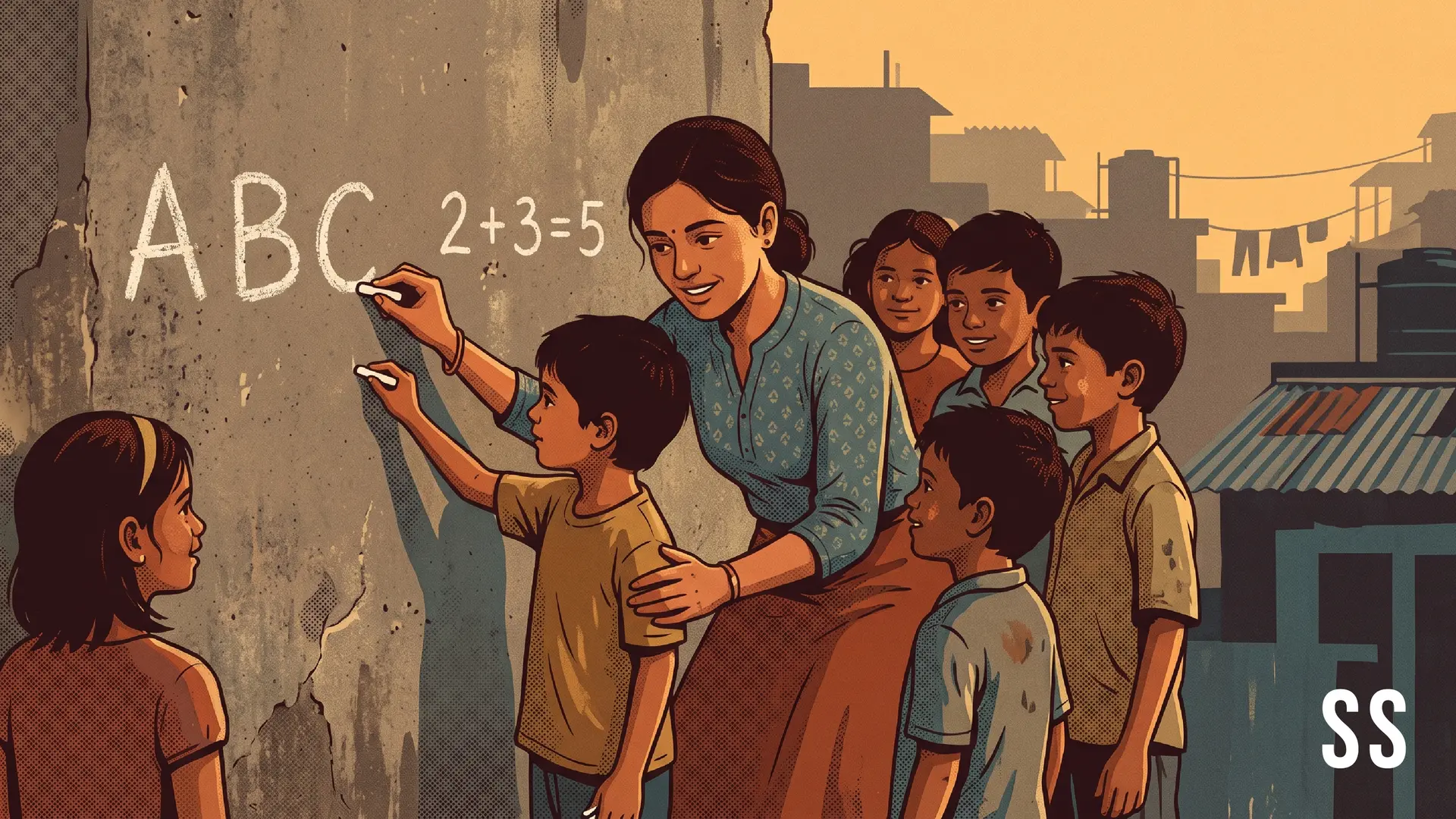

Literacy is often understood as the ability to read and write. But for millions of children across India, access to a classroom, a teacher, a book, and the opportunity to learn remains out of reach.
A number of individuals and organisations are working on the ground to bring education to underserved communities and find ways to introduce foundational skills to those often left out of the system.
From street schools in Delhi’s slums to street libraries in Arunachal Pradesh, these initiatives are rethinking how and where learning can happen.
On International Literacy Day, here are five stories that show how literacy can extend far beyond textbooks.
Pehchaan The Street School brings education to Delhi's slums
In Anna Nagar, a slum cluster in Central Delhi, a small temple turns into a classroom every weekend. Children sit on the floor with volunteer teachers and learn different subjects. They then attend sessions on psychology and emotional well-being. This is Pehchaan The Street School, a volunteer-led initiative that works with children from marginalised communities.
Started in 2015 by Akash Tandon and his friends, Pehchaan began with five children in Anna Nagar. Within a month, 35 children had joined, and by the end of the first year, 100 were attending classes. Pehchaan has now grown to 10 centres across Delhi and has more than 800 volunteers, including students from IITs and IIMs and working professionals.
The initiative uses a topic-based curriculum, repeating concepts until children master them. Along with academics, Pehchaan organises health camps, psychology sessions, and vocational training.
Arunachal's street libraries are putting books within reach
For sisters Ngurang Meena and Reena, the importance of literacy began at home—their mother had never attended school. In 2014, they registered the Ngurang Learning Institute (NLI) to impart education and life skills for women and children. NLI has since helped more than 1,000 people learn to read and write.
The Street Library Initiative emerged during the pandemic after NLI's library closed. Inspired by a street library in Mizoram, Meena set up Arunachal Pradesh’s first roadside library in Nirjuli in 2020, using a makeshift shelf and books worth around Rs 10,000. When the sisters realised access alone wasn’t enough, they used activities and promotions to encourage children to read.
With government support, the initiative expanded to 26 free-standing libraries across three districts. NLI now wants to take libraries to border areas and schools with limited facilities, while developing learning that encourages critical thinking and helps children navigate misinformation.
Food4Thought is taking books to the remote corners of India
When Madhavi Sharma saw a girl in a remote government school reading Cinderella, the child began crying because she had never imagined that a dress like the one in the story could exist. Madhavi realised how access to books can expand a child’s understanding of the world.
In 2015, Madhavi, her brother K Srinivas Rao, and his wife, Shefali Rao, started the Hyderabad-based Food4Thought Foundation to bridge the gap between unused books and readers. It establishes libraries in schools and communities, matching books with children’s reading abilities, from picture books to novels. It also sources vernacular books through the National Book Trust.
Food4Thought has established 622 libraries—557 school and 65 community libraries—and has reached 70,500 readers, with books received from around 425 donors. Its Reading Olympiad and Reading Decathlon encourage reading, while its Save Endangered Stories project has recorded 501 stories in eight languages.
This Delhi constable started a school to keep children away from labour and crime
When Delhi Police constable Than Singh was posted near the Red Fort, he noticed children of labourers spending their days on the streets, doing odd jobs or loitering around.
Many could not afford formal schooling. Singh realised older children struggled to enrol in a school because they lacked basic literacy skills. To address this, he started Than Singh Ki Pathshala in 2015 with four children.
Singh’s own childhood was marked by different struggles. He grew up in financial hardship, helping his father, an ironsmith, and later selling corn to support his education before joining the Delhi Police. At the Pathshala, he teaches basic subjects and works with parents to convince them of the value of education.
By 2023, 80 children attended his classes and 75 had entered formal education. With support from the Delhi police, nearly 70 children enrolled in government schools the previous year. They continued returning to the Pathshala for help with their studies, and Singh said 10 students had topped their classes.
One of those children was Sakshi, a girl from Madhya Pradesh whose family had migrated to Delhi for work. After her education stopped at Class 7, she joined Than Singh’s Pathshala and continued learning there. In April this year, she cleared her Class 10 examination.
CSF is taking literacy beyond reading and writing
In a government primary school in Dugdha village, Madhya Pradesh, students learn mathematics through songs and activities. This approach is inspired by Mission Ankur, a foundational learning programme launched by the Madhya Pradesh government in 2022 with support from Central Square Foundation, which works with governments across 11 states.
CSF supports teacher training, learning materials, assessments, and technology-enabled interventions. Mission Ankur has helped roll out foundational learning programmes across around 80,000 schools in Madhya Pradesh. In Uttar Pradesh, CSF has supported more than 1.12 lakh schools and trained nearly 1.93 lakh primary teachers. In Bihar, it helped launch Mission Daksh, supporting around 30 lakh children in Classes 3 to 8.
In 2024, CSF launched AI Samarth with Google.org, which focuses on understanding AI’s possibilities and limitations, evaluating information and considering its ethical implications. It aims to reach more than 5 million students, teachers and parents.
Edited by Swetha Kannan